Key Takeaways
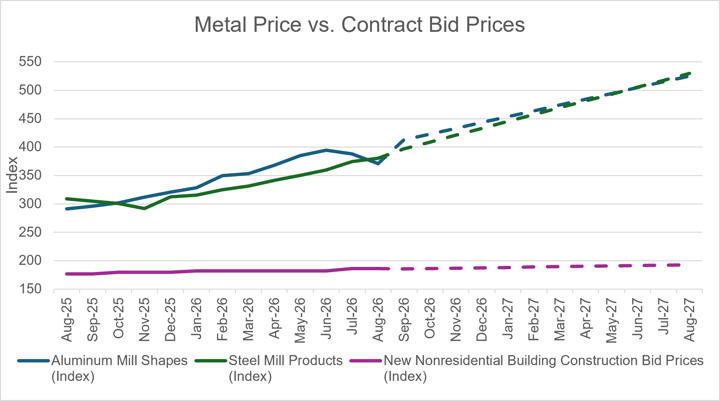
- Metal prices are outrunning contract prices. Over the past year, prices for aluminum and steel mill products have climbed far faster than contractors’ bid prices, squeezing profit on projects priced before the run-up.
- Section 232 tariffs on steel and aluminum have changed repeatedly since early 2025, so the tariff assumption built into a supplier quote can be outdated before a contract is awarded.
- Contractors and owners who pair disciplined quote tracking and supplier validation with early buys, defined material allowances and index-based escalation clauses will be able to share metals risk openly rather than bury it in contingencies or fight over it in claims.
A fixed-price bid is only as firm as the numbers underneath it. For commercial work, the steel and aluminum lines in that bid rest on supplier and fabricator quotes that are held for days or a few weeks. Awards, notices to proceed, shop drawings and the actual mill order can follow months later. Whatever moves in that window, whether mill prices, tariffs, freight or fabricator backlog, lands on whoever signed the lump sum.
The gap between quotes and final sums is not new
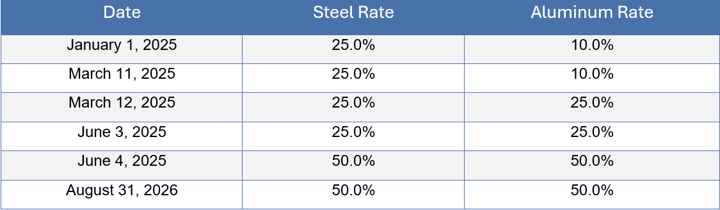
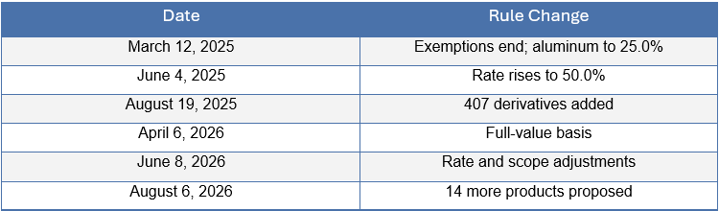
Contractors who experienced the 2018 tariffs and the 2021 to 2022 supply shock know it well. What has changed is the speed. The original 2018 Section 232 duties were 25.0% on steel and 10.0% on aluminum. Country exemptions ended in March 2025, and the rate rose to 50.0% on June 4, 2025. In August 2025, 407 more product categories were added as derivatives. Then, an April 2026 proclamation applied duties to the full customs value of covered goods rather than only their metal content, with derivatives at 25.0%. Further adjustments were made in June and July 2026, and in August 2026, regulators proposed adding 14 additional derivative products, including certain cranes, electric conductor cables and heat exchanger parts (Sandler, Travis & Rosenberg, 2026).
Source: ProcurementIQ
The price data shows the result. According to the Associated General Contractors of America (AGC), input prices for new nonresidential construction rose 8.9% from August 2025 to August 2026. Aluminum mill shapes rose 27.3%, steel mill products 23.4% and diesel fuel 77.8%. Earlier in the year, the swings were sharper: aluminum mill shapes were up 52.4% year over year in June (AGC). Over the same twelve months to June, contractors' bid prices for new nonresidential buildings rose just 3.5%, a sign that firms are absorbing much of the increase.
The pressure is reaching project pipelines. In an AGC and National Center for Construction Education and Research survey conducted in July and August 2026, 55.0% of respondents said projects had been canceled, postponed or scaled back in the prior six months. One-third blamed rising costs, and 13.0% cited lengthening or uncertain completion times. Freight and logistics add another layer: DPR Construction's supply chain leader told Construction Dive that disruptions in the Middle East were stretching delivery timelines and raising freight costs. He also noted that the construction industry's reliance on distributors and bundled materials makes tariff-reducing tools such as the First Sale Rule hard to use.
Exposure has been building since early 2025 and remains in effect in late 2026, with Section 232 rates holding at 50.0% for articles made wholly or mostly of steel or aluminum. This is a national issue because tariffs and price indices are national in scope. The sharpest exposure sits on imported and derivative products, aluminum-intensive envelope systems and markets where data center and industrial work compete for the same fabrication shops.
Source: ProcurementIQ & FederalRegister.gov
Note: The chart shows only the Section 232 headline tariff rate. It does not reflect changes in which products were covered (such as the derivative additions in August 2025 and June 2026) or in how duties were calculated (such as the full-value basis adopted in April 2026), which raised costs on many products while the rate remained at 50.0%.
General contractors, construction managers, structural steel, miscellaneous metals, metal deck, cold-formed framing, curtain wall, storefront, metal panel and MEP subcontractors; and the owners, developers and public agencies who write the contracts and ultimately pay for risk carry the lump sum and guaranteed maximum price risk.
What does this mean for contractors and owners?
On a typical job, the metals gap rarely sinks a project, but it reliably erodes profit. Zekelman Industries' CEO estimates that the steel frame accounts for roughly 8.0% to 9.0% of the cost of a typical commercial building. On a contractor's thin margin, though, a 20.0% move in that line can erase the profit for a whole job. Owners should care just as much. When the risk is unmanaged, bidders either pad their numbers with blind contingency, which owners pay for whether prices rise or not, or they bid tight and look for relief later through change orders, claims or a stalled schedule.
Source: ProcurementIQ
Quote tracking and supplier validation turn vague exposure into a dated, itemized list. That lets an estimator decide which numbers to defend and which to protect contractually. Early buys convert future price risk into a known cost of carrying material. Allowances and escalation clauses do the most important work: they replace hidden contingency with transparent, auditable terms. Owners get tighter, more comparable bids. Contractors avoid betting the margin on trade policy. Both sides avoid the dispute that follows when a quote assumes one tariff rate and the invoice reflects another. Standard forms help here as well. The ConsensusDocs family, for example, includes a price-impacted materials amendment that can serve as a starting point.
The firms that come through this cycle in good shape will be the ones that treat metals pricing as a managed risk rather than an estimating line. They will win the work they bid at margins they can keep, and owners who share the risk fairly will attract more and better bidders.
Final Word
Before the next bid goes out, buyers must establish a quote log for every steel and aluminum line and require suppliers to state validity dates, origin and tariff assumptions in writing. Buyers should also identify long-lead metal packages in which an early release would pay for itself. Owners should decide, before bid documents are issued, which metal risks they will carry through allowances or escalation clauses, and write those terms plainly. Counsel would need to review any escalation or change-in-law language before it is used, since enforceability varies by state and contract form.