

Key Takeaways
- A major court ruling in early 2026 struck down a significant category of tariffs, meaningfully lowering the overall effective tariff rate compared to pre-ruling levels — though other tariff programs remain in force. The government has since introduced replacement measures that have kept duty burdens elevated in different forms.
- Businesses that paid the invalidated tariffs are now eligible for substantial refunds, with a new government processing system working through a large backlog of claims. Tens of billions of dollars have been returned so far, out of a total expected to exceed $100.0 billion.
- For buyers, the net effect is a reshuffling of where and how tariff costs land, creating ongoing uncertainty around pricing and sourcing. Companies should continuously reassess their exposure, revisit contracts and supplier decisions made under prior assumptions and seek guidance on recovering past overpayments.
Note: This article was last updated on August 10, 2026. The regulatory environment surrounding tariffs remains highly volatile due to ongoing litigation and upcoming court decisions. ProcurementIQ will continue to monitor trade policy developments and publish updates as tariff guidance shifts and subsequent legal rulings clarify next steps.
On February 20, 2026, the United States Supreme Court invalidated tariffs imposed under the International Emergency Economic Powers Act (IEEPA), declaring that the IEEPA does not authorize the president to impose tariffs. IEEPA-based tariffs imposed under the Trump administration include the wide-ranging global reciprocal tariffs, fentanyl tariffs, free-speech tariffs on Brazilian-origin goods and the secondary tariffs on Indian-origin goods. This ruling also affects trade deals with foreign countries under the IEEPA, creating uncertainty about whether those agreements will remain in place or be renegotiated, as most were structured around IEEPA rates. The Trump administration has since imposed Section 301 forced-labor tariffs on imports from 60 trading partners, effective July 23, 2026, with many countries receiving the lowest 10.0% tariff rate under those agreements.
The Supreme Court did not issue a decision on whether previously collected tariffs must be repaid, prompting the United States Court of International Trade (CIT) to issue an order on March 4, 2026. This order requires United States Customs and Border Protection (CBP) to issue refunds, plus interest, to all affected importers, including those who have not filed lawsuits. On April 20, 2026, CBP started accepting applications for tariff refunds through a new system called the Consolidated Administration and Processing of Entries (CAPE). The refund process is being rolled out in phases, with the first covering 63.0% of the $166.0 billion in IEEPA tariffs collected. Phase 2, rolled out on June 29, 2026, expands the refund process to cover an estimated $28.7 billion in claims for tariff entries flagged for reconciliation. CBP estimates that refunds will be issued within 60 to 90 days after an importer’s application has been accepted. The Cato Institute estimates that interest payments on the $166.0 billion owed could reach $22.0 million per day. As of August 4, 2026, the Trump administration has refunded an estimated $100.0 billion of tariff revenue, with an additional $29.0 billion in refund requests accepted and ready for processing.
Importantly, other tariff regimes remain in effect. Specifically, tariffs imposed under Section 201 and Section 301 of the Trade Act of 1974 and tariffs imposed under Section 232 of the Trade Expansion Act of 1962 are still valid, as well as any general, countervailing (CVD) and anti-dumping (AD) duties.
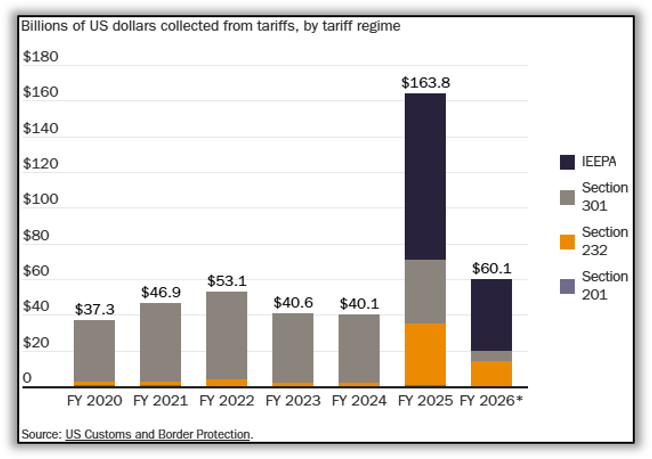
Most-favored nation (MFN) duties also still apply, and Section 122 removes MFN caps, increasing tariff exposure for certain products that had preferential treatment under the IEEPA tariff regime. Section 301 tariffs are currently levied on almost all imported goods. The Supreme Court decision did not directly address the suspension of the de minimis exemption for duties on imports under $800.00 on IEEPA grounds, and the Trump administration announced that this exemption would remain suspended. For buyers, this means overall duty burdens remain elevated, and the specific rates and products affected have shifted, changing landing costs and sourcing economics.
These changes have created practical challenges for procurement leaders, as the tariffs that shaped sourcing decisions in 2025 are being reshuffled, refunds remain uncertain and new policies (and potential future tariffs) are coming into effect. This article outlines the administration’s response to the ruling, the refund process, the impact of new tariff policies and the overall effect on procurement.
The administration’s response
The Trump administration responded to the recent Supreme Court ruling by imposing tariffs using Section 122 of the Trade Act of 1974, which authorizes the president to address balance-of-payments deficits through global tariffs of up to 15.0% for 150 days (effective February 24, 2026, and expired on July 24, 2026). Section 122 tariff rates remained at a flat 10.0% on all countries and products, with exemptions for certain critical minerals, energy and energy products, certain agricultural goods, pharmaceutical products and ingredients, certain electronics, certain aerospace products, goods already subjected to Section 232 tariffs and goods covered by the United States-Mexico-Canada Agreement (USMCA).
The administration also announced trade investigations under Section 301 of the Trade Act of 1974, and on July 24, 2026, the Trump administration broadly imposed Section 301 forced-labor tariffs on 60 trading partners, which covers 99.4% of all US imports. The new tariffs start at 10.0% or 12.5%, with five trading partners capped at MFN rates. On July 22, 2026, the administration imposed a 25.0% Section 301 tariff on a wide range of imports from Brazil, including sugar, steel, machinery and more. The administration has pursued tariffs under Section 232 of the Trade Expansion Act of 1962 and may pursue tariffs under Section 201 of the Trade Act of 1974. These face procedural hurdles, such as investigations, public hearings and public comment. The administration has invoked 50.0% tariffs using Section 338 of the Tariff Act of 1930 on Canadian dairy, alcohol and motor vehicle imports and may further utilize it to authorize tariffs of up to 50.0% if countries are discriminating against US products and favoring goods of foreign competitors. There is also a slew of non-tariff measures and barriers the president could employ to block trade, such as economic sanctions, military measures, embargoes or restrictions on export licenses.
On April 2, 2026, in the first move to expand tariffs since the February Supreme Court decision invalidating tariffs issued under the IEEPA, the Trump administration announced a duty rate of up to 100.0% ad valorem on imports of certain patented pharmaceuticals and associated pharmaceutical ingredients under Section 232. The duties took effect on July 31, 2026, for certain large companies and September 29, 2026, for others; however, the order provides a wide range of exemptions, including major companies that have negotiated private deals with the administration, companies that have committed to domestic manufacturing within the next few years, generic drug manufacturers, countries that have struck trade agreements with the United States and more. On the same day, the administration also announced a change to how tariffs are assessed on steel, copper and aluminum, now basing them on the full value of imported metal products, rather than the lower production costs in foreign countries. The order also clarified how Section 232 tariffs on metals should be applied, lowering rates to 25.0% on derivative articles made substantially of steel, aluminum or copper, 10.0% for imported products made of American steel, aluminum and copper, and removing tariffs for products made of less than 15.0% steel, aluminum or copper.
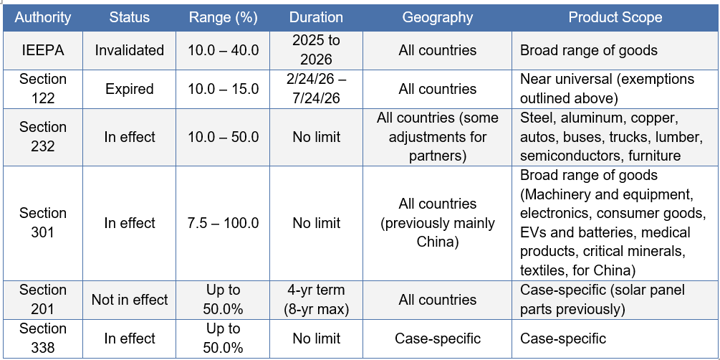
The Trump administration has repeatedly indicated its intention to unilaterally use tariffs as a tool to achieve its economic policy goals, and the aftermath of the ruling does not signal a shift away from them. Section 122 tariffs were used as a temporary placeholder before other trade actions, such as the broad-ranging Section 301 forced-labor tariffs and new Section 232 tariffs on pharmaceuticals, were implemented. The table below outlines different tariff authorities, their status, rate range, duration and geographic and product scope.
Below is a breakdown of key IEEPA tariffs revoked and major Section 232 and 301 tariffs still in place.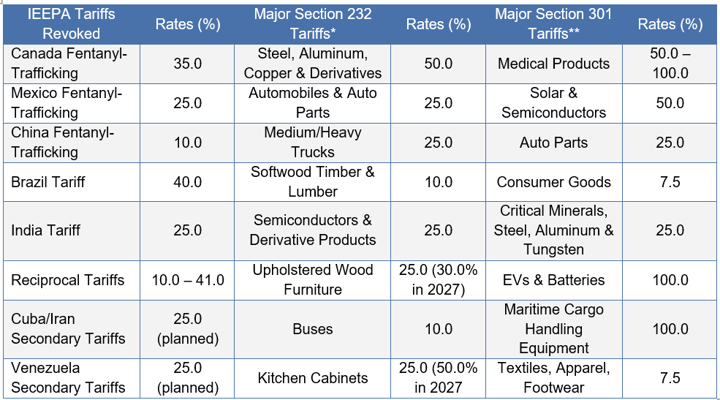 *The Trump administration is currently considering Section 232 tariffs on the following: commercial aircraft and jet engines, processed critical minerals, drones, polysilicon, wind turbines, medical equipment, and robots, and industrial machinery.
**Section 301 tariffs, as opposed to Section 232 national security tariffs, can “stack” on top of the Section 122 tariffs. The Section 301 tariff rates in this table apply to Chinese imports.
***Section 201 tariffs on solar panels recently expired. These tariffs are limited to four years and can be extended to eight.
The refund process
Following the United States CIT decision on March 4, 2026, requiring CBP to issue refunds for IEEPA-based tariffs, CBP began accepting refund applications on April 20, 2026. Importers of record (IORs) and licensed customs brokers can file for refunds through CBP’s new CAPE system, which is an automated refund tool. IORs or licensed customs brokers will only need to file CAPE Declarations within the Automated Commercial Environment (ACE) in CSV format. According to the CBP, “The CAPE Declaration consists of the list of entries for which refunds of IEEPA duties are being requested.” The refund process is being deployed in phases, with phase 1 released on April 20, 2026, covering certain unliquidated entries and entries within 80 days of liquidation, estimated to cover 63.0% of IEEPA-affected tariffs. Phase 2 started on June 29, 2026, and opened the claims process to tariff entries flagged for reconciliation, covering an estimated $28.7 billion in claims, or about 17.0% of IEEPA-affected tariffs. Following the July 17, 2026, CIT order, Phase 3 was initially planned to start at the end of July 2026 for finally liquidated entries. However, it has since faced delays due to ongoing legal disputes and appeals regarding whether the CPB has the authority to issue refunds for finally liquidated entries without court litigation. Refunds are issued electronically, only to US bank accounts, within 60 to 90 days after review and acceptance. However, there are limitations with the CAPE system, including the system not processing entries that are under protest filing, refunds only being able to be sent to a US bank, and the inability to argue or adjust classification or value issues.
The government has resisted and attempted to limit refunds, and the administration has suggested that the refund issues could be tied up in litigation for years. Hiring legal counsel is also an effective way to navigate the varying authorities and complex processes. The refund process will generate implications for tax treatment, accounting recognition, contractual disputes and valuations, creating significant complications and paperwork for businesses. Given the uncertainty surrounding appeals, litigation and shifting comments from the Trump administration regarding certain refunds, importers may consider moving expeditiously to preserve their potential refund rights. Importers should seek expert guidance on requesting refunds through the new CAPE system. Finally, protest filings must be filed within 180 days after liquidation.
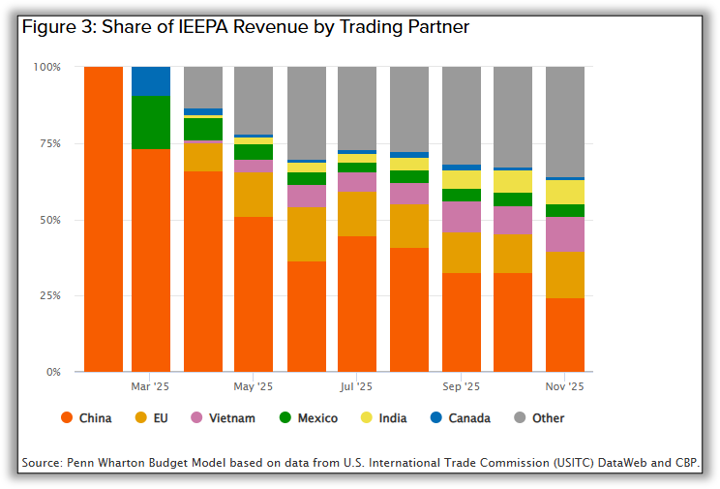
The chart below shows the monthly share of IEEPA revenue by trading partner, with China accounting for the largest share for most of 2025. As such, buyers who have been importing from China may be best positioned to benefit from refunds. Large importers should dedicate internal resources, legal budget or lobbying resources to securing refunds. Procurement departments should coordinate with finance teams and customs brokers to ensure operational readiness for refund processing. This includes confirming that payment mechanisms are in place with CBP.
While importers themselves will seek refunds, commercial customers who bore higher prices due to pass-through may also seek recoupment. Non-importing companies will not have avenues to pursue direct tariff refunds, but they should contact importers of record to ensure that protests have already been filed and that any refunds obtained by the importer are passed down. Generally, the safest way for downstream buyers to recover funds is through contractual reimbursement or assignment, the latter meaning that the importer of record assigns part of the refund claim to the downstream buyer. Legal action would be another path against the importer of record, but this would be a lengthier, more complicated process. In cases involving buyers and shippers, buyers without a clear pass-through clause may be able to sue shippers for unjust enrichment because they have already paid the full tariff cost to the shipper. By allowing the IOR, which is the shipper, to keep the tariff refund, they would receive a windfall. Given the level of uncertainty, companies should still consider all available avenues for recoupment.
The impact of new tariffs
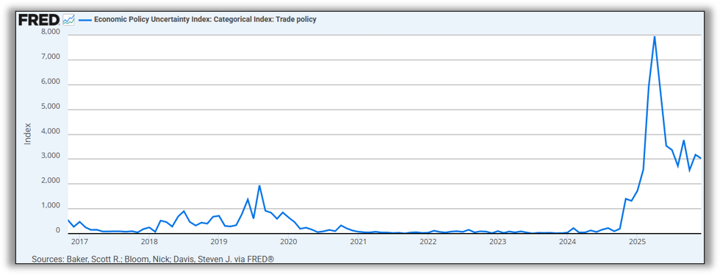
The second Trump administration has created considerable uncertainty regarding trade policy. The chart below shows the trend in trade-related uncertainty, calculated from the frequency of economic policy terms across major newspapers. The effective tariff rate on imports of foreign goods has sharply risen and fallen in the last year. As of July 2026, the Budget Lab at Yale estimates that effective tariff rates will range from 9.0% to 10.9% by the end of the year under current law, which includes several scheduled tariff increases. Under current tariff laws, the government is expected to raise an estimated $1.9 trillion in the next decade. Moreover, additional tariffs related to unfair trading practices and national security threats are likely based on announcements by trade officials.
The new trade environment has challenged businesses, especially in procurement. The Budget Lab at Yale has estimated that the impact of all tariffs implemented through the end of 2026, including Section 301 forced labor tariffs, will be a 0.79% increase in consumer prices before consumers start switching to cheaper alternatives. So, for a company with an annual procurement spend of $100.0 million, a 0.79% increase in the overall price level due to tariffs translates into roughly $790,000 in additional annual costs. Tariffs tend to result in higher prices since they accelerate the costs of importing products from foreign countries, and these costs are typically passed on to consumers. A February 2026 study by the Federal Reserve Bank of New York found that there was substantial pass-through to US import prices (86.0%) from 2025 tariffs, meaning foreign exporters lowered their prices enough to absorb only about 14.0% of the tariff burden, while the remaining 86.0% showed up as higher landed costs for US consumers and businesses bore the burden of tariffs. This implies that a 10.0% base tariff would raise the cost of an imported product or input by about 8.0% to 9.0% before downstream markups, indicating these temporary measures could have a significant impact on contract prices. Tariffs also affect prices indirectly, as reduced foreign competition incentivizes domestic producers to raise prices. Other macroeconomic effects of tariffs include higher unemployment; the Budget Lab estimates that tariffs will increase unemployment by between 0.12% and 0.16% by the end of 2026. They also estimate that real GDP will remain 0.1% lower than it would be without the tariffs in the long run.
The new tariff environment will have a larger impact on specific sectors of the economy. While US manufacturing output will expand due to tariffs that incentivize more domestic purchasing, construction, mining and agricultural output will contract, highlighting the trade-offs of these policies. Despite changes in how tariffs are applied to metal products, buyers of motor vehicles and machinery will still be heavily impacted due to their high metal content and the many product-specific tariffs that affect metals. According to the Budget Lab, consumers will see a 3.87% increase in clothing and footwear prices before they switch to cheaper alternatives.
Computers and electronics will be another commodity group hit hard by the current tariff regime. This is partly due to the heavy impact of Section 301 tariffs on Chinese-origin computers and electronics (e.g., semiconductors), which typically face a 25.0% tariff. Tariff stacking can have a particularly significant effect on goods subject to high Section 301 tariffs. For example, the total duty for a Chinese-origin computer would be the MFN duty of approximately 3.3%, plus a 25.0% Section 301 tariff and a 10.0% Section 122 tariff, yielding an effective tariff burden of between 35.0% to 40.0%.
The continued suspension of the de minimis exemption will have a large impact on imports. After the exemption in 2025, postal traffic into the United States dropped 80.0%, as reported by the Universal Postal Union. The elimination of de minimis has increased the cost and complexity of importing products under $800.00, especially for companies with cross-border operations, due to the exposure to duties, additional compliance requirements and the number of customs handling procedures. Congress already permanently repealed de minimis treatment, effective July 1, 2027, so firms can likely treat it as permanent.
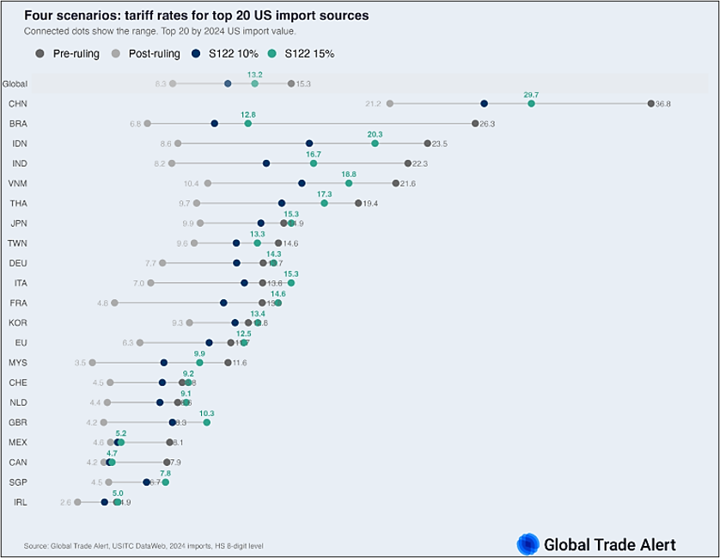
Brazil, China and India will significantly benefit from the new tariff environment. Without high IEEPA-based tariffs impacting these countries, the relative tariff advantage of countries like Mexico, Canada and the European Union (including Great Britain) with prior trade deals or less burdensome IEEPA tariffs will shrink. The European Union and Great Britain will see the smallest decrease in the effective tariff rate. The chart below shows how tariff rates will change under different scenarios. While China still bears the highest relative tariff burden after accounting for the various Section 301 tariffs, buyers of Chinese-origin goods would see one of the largest drops in tariff rates, with similar declines visible for Brazil and India. Other countries whose relative trade advantage will improve include Vietnam and Thailand, both of which were endangered by the Trump administration’s tariffs under IEEPA due to comparatively high reciprocal tariff rates. While countries like Mexico and Canada saw their relative tariff advantage margins compress, they remain relatively attractive sourcing locations due to their proximity to the United States, inclusion in the USMCA and relatively stable tariff rates.
Procurement teams should not expect quick price drops, as supply chains have already experienced significant cost shifts for many months before the ruling. Policy changes, including the Section 301 forced-labor tariffs, and general uncertainty will keep prices elevated. The Harvard Business School Pricing Lab, which has been tracking the short-run impact of 2025 US tariffs, reports that the cumulative effect of the tariffs has been a 0.8% increase in all items in the Consumer Price Index (CPI) as of February 2026.
Procurement takeaways
- Sourcing & Pricing: Reassess sourcing strategies and tariff exposure now, renegotiate contracts to reflect lower effective rates and consider short-term shipment front-loading to capture near-term relief.
- IEEPA Reset: Revisit any previous changes made to address IEEPA-based tariffs, particularly relating to any destination shifts or pricing model adjustments made in response to these now-revoked tariffs.
- What to Watch: Monitor and plan for further expected developments relating to Section 232 and Section 301 tariffs, existing country-specific trade deals and any exemption changes.
- Refund Readiness: Seek expert advice before submitting IEEPA-duty refunds through CBP’s CAPE system and coordinate with finance and customs partners to ensure proper submission.
- Strategy Discipline: Express caution about committing to major reshoring or other capital investments based on temporary tariff changes, instead prioritizing scenario planning and increasing supply chain flexibility.
Procurement departments will want to reassess their sourcing strategies and tariff exposure and, if possible, seek to renegotiate contracts based on lower effective tariff rates. Key products or supply chains may be better or worse off under the new tariff regime. Section 301 forced-labor tariffs and scheduled tariff increases (e.g., tariffs on Canadian goods and pharmaceuticals) are keeping effective rates near historical highs. Buyers should adjust long-term procurement strategies, including potentially front-loading shipments as needed to mitigate the higher costs associated with future tariff increases.
Buyers will want to reassess any changes they made regarding IEEPA-based tariffs, especially sourcing destinations modified to mitigate exposure to countries affected by reciprocal tariffs, as well as any pricing models that were changed. While trade policy uncertainty makes it challenging, it is necessary to continue monitoring US policy developments to stay abreast of likely changes, lawsuits and legislation. For large changes or capital investments, such as factory reshoring, it may not be worthwhile to change plans or sourcing strategies because these decisions are more costly to unwind and are not outweighed by temporary reversals in tariff policy. Following the introduction of the broad-based Section 301 forced labor tariffs, buyers should continue monitoring future adjustments related to Section 232 and Section 301 tariffs, including the newly announced Section 232 tariffs on certain pharmaceuticals and changes to how tariffs are determined for steel, aluminum and copper, which are longer-term tariff measures impacting procurement. Buyers will also want to watch for clarity or guidance on the outcome of country-specific trade deals already in place. The standing of these deals would have a significant impact on sourcing destinations, as the relative attractiveness of some countries could increase or decrease. Buyers should seek to enhance overall trade compliance to quickly handle new filing requirements, adapt to changing requirements and mitigate risks or avoid bottlenecks.
Businesses should treat 2026 as a transition in United States tariff laws, moving from emergency authority orders to the use of statute-specific trade tools, court decisions and potentially stronger congressional action. Conducting scenario planning to better account for volatility, rather than solely relying on tariff relief, is a better strategy. Procurement teams should use available tariff rates for budgeting and scenario planning. Increasing flexibility in supply chains and logistics strategies will be necessary to strengthen resilience and reduce exposure to tariffs. Buyers should still be scenario planning for supply‑chain disruptions, because future tariff changes are likely and could trigger retaliation, new exemptions or sudden policy adjustments that alter where goods are sourced, how they move across borders and the reliability and cost of logistics for companies. Practical steps include qualifying alternative suppliers in lower-tariff areas, mapping critical components with high tariff exposure and evaluating additional logistics costs under scenarios where countries become more expensive to import from.
Close coordination with stakeholders and alignment among procurement, legal and finance teams will also be necessary when making strategic decisions on capital investment, inventory and tariff-mitigation strategies. Many firms may need to formalize the roles of legal and policy monitoring and procurement strategy to best adjust to tariffs. This cross-functional alignment helps ensure that pricing, sourcing and risk assumptions are consistent across departments. Companies should also consider other mitigation tools, such as duty drawbacks or refunds for imported goods or products that are later exported. Foreign-trade zones (FTZs) can also help avoid or reduce tariffs on imported goods.
The geopolitical implications of tariffs will require firms to build internal capabilities to address these issues, specifically in customs, policy monitoring and logistics. ProcurementIQ’s ad-hoc custom research reports can help in this ever-changing environment. One recent ProcurementIQ research report conducted a manufacturing sourcing analysis (detailing current sourcing locations and overall tariff exposure) and outlined best practices for adapting to tariffs and shifting supply chains. Common strategies to build longer-term cost resilience in this environment include diversifying suppliers, negotiating contract adjustments and considering nearshoring or reshoring manufacturing operations or sourcing to better reduce exposure to tariffs. Multi-source resistance is crucial for critical materials and components. The recent ProcurementIQ report noted that companies cite tariffs more than four times as often as a justification for shifting their supply chains. Utilizing technologies such as artificial intelligence for scenario planning can also be helpful in addressing supply chain issues.
Final Word
ProcurementIQ can support procurement teams with category‑specific tariff exposure analysis, supplier risk assessments and custom best practices tailored to your business. Our extensive catalog of over 900 category reports includes market-specific recent developments highlighting the impact of tariffs, as well as analyses of products such as steel, aluminum and copper for affected markets.