


Key Takeaways
- Energy-driven inflation hasn’t spread to the broader economy. The Iran conflict has lifted headline inflation, but core prices remain stable, allowing the Bank of Canada to hold rates. A prolonged conflict could change that.
- Government support is propping up growth. Tax rebates, incentives and public spending have sustained consumer spending and construction, while private employers and homebuilders remain cautious.
- US trade uncertainty is the key risk. Tariffs and annual USMCA reviews are delaying business investment, though Canada’s push to diversify trade offers some flexibility.
Inflation has risen in 2026, as energy shocks tied to the Iran conflict kept gasoline and oil prices elevated, driving significant increases in headline inflation. However, these costs have been slow to pass through to non-energy items, limiting broader price gains. With core inflation holding at target, the Bank of Canada has kept rates unchanged. Consumer spending held up well across both quarters, as tax rebates and credits provided households with essential funds, even as consumers stuck to their budgets and cut back on discretionary categories. The labour market had a muted first half with little to no job growth, but unemployment did not rise either, as low population growth and consistent employment kept conditions stable. Construction had a solid quarter despite rising costs, led by projects already underway. GDP growth was soft in the first quarter at an annualized rate of 0.3%, but it accelerated sharply in the second quarter to nearly 3.3%, driven by rising exports and household, government and business spending.
Labour Market:
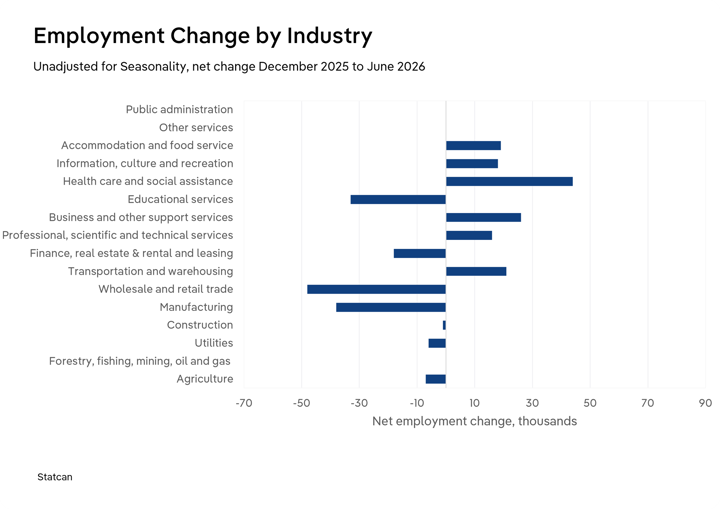
- The labour market has been uneven, growing just 0.1% from the second half of last year to the first half of this year. Growth was concentrated in essential fields like health care and social assistance, which consistently need workers as an aging population expands. Protected government spending has also supported hiring for roles such as nursing aides and mental health specialists, helping these employers regularly find workers.
- However, the national unemployment rate has stayed above 6.0%. In a cautious business environment, employers have largely retained their skilled, tenured staff but have not added to them; low turnover has further limited openings, putting pressure on younger job seekers. Slower population growth from lower immigration has kept the unemployment rate from climbing further. Still, those already in the country have faced a tougher job search, raising youth unemployment over the year.
- Job losses were concentrated in trade-exposed sectors such as wholesale trade and manufacturing, where tariffs led businesses to hold back on hiring, weighing on overall employment growth. Businesses' adoption of automation has also reduced labour demand in select industries.
- Wages have continued to grow, supported by minimum wage increases that took effect in April. Fields like finance and real estate have also raised pay to attract skilled workers who are harder to find through entry-level pathways.
Consumer Spending:
- Despite persistent inflation, consumer spending has continued to grow, with real household final consumption expenditure up 2.1% year-over-year. This means spending held up even after adjusting for inflation, though growth slowed to a moderate pace from Q1 to Q2, showing signs of strain as the first half of the year came to a close.
- Spending on big-ticket durable goods led quarterly growth, as consumers made purchases that they had previously delayed, releasing pent-up demand for costly items. Government incentives also played a role, as EV credits that reduce the price of Canadian-made fully electric and hybrid vehicles narrowed the cost gap and encouraged hesitant buyers, driving a year-over-year surge in EV spending.
- While durable goods spending grew in Q2 2026, non-durable goods spending was flat. Government assistance, such as tax benefits, helped households maintain spending on core essentials like food and energy, but rising prices also pushed them toward cheaper alternatives, thereby moderating overall spending in the category.
Inflation:
- Headline inflation, which includes food and energy, reached 2.8% year-over-year in June 2026, above the Bank of Canada's 2.0% target. Excluding those items, however, inflation fell below the target, indicating that rising input costs have not yet spilled over into the broader basket of goods and services. Slack in the economy, with businesses operating below their ideal capacity in terms of labour and operations, has tempered the price increases that would typically accompany these conditions in a hotter economy. The lag before energy shocks reach core items has also kept them from feeding into core prices sooner, limiting the increases reported so far in the first half of 2026.
- The Iran conflict, which began in early 2026, has kept energy costs elevated, with gasoline prices up 14.5% year over year in June 2026. A temporary US-brokered ceasefire failed to reverse the steep price increases that had built up since the spring, when attacks escalated. The closure of the Strait of Hormuz and strikes on critical energy infrastructure in the region drove up global benchmark prices, raising costs for Canadian consumers.
- Shelter costs grew year-over-year in the first half of the year, but they’re showing signs of moderation. In January, shelter inflation fell below 2.0% for the first time in nearly five years, and it eased further to 1.5% by the end of June. Slow population growth and softer demand in some metro areas have eased rental conditions. Traditionally expensive markets like Toronto and Vancouver have seen housing supply outpace buyer demand, leading to notable price declines for homebuyers.
Residential construction:
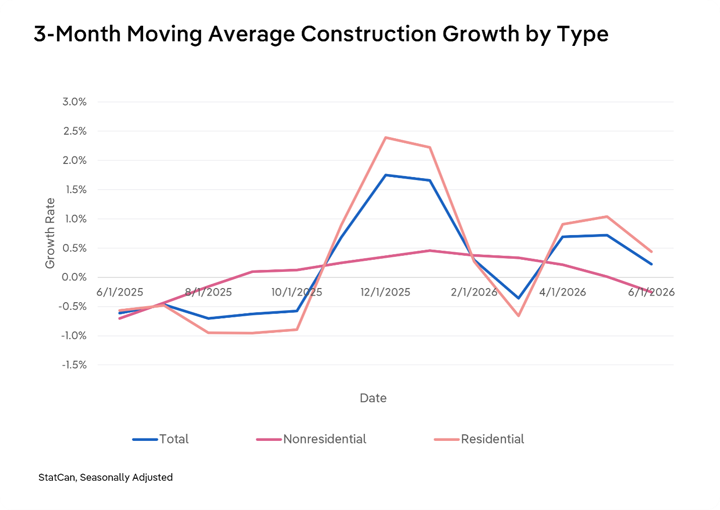
- Residential construction investment grew 4.1% in the first half of the year compared with the second half of 2025, spanning both multi-family and single-family homes. Growth was driven by housing projects already in the pipeline, as well as rising renovation activity on single-detached homes.
- However, housing starts dropped sharply, falling more than 10.0% year-over-year in Q2 2026. Construction of condos and ownership homes declined as builders shifted toward purpose-built rental apartments, which were supported by government incentives such as low-interest loans and Ottawa's removal of the GST on these projects. Meanwhile, home construction for ownership collapsed, as high costs made homes unaffordable for buyers.
- Mortgage rates move with interest rate decisions and bond yields. With the Bank of Canada holding its policy rate steady in the first half of the year, variable mortgage rates were unchanged. Fixed mortgage rates, however, rose as inflation rose, pushing bond yields higher.
Nonresidential construction:
- Nonresidential construction investment had another strong half-year period, rising 1.5% from the second half of last year. Provinces expanded their capital commitments, directing targeted investment toward categories critical to their economic development. Growth was also supported by industries facing rising demand for new builds as their operating needs evolved.
- The transportation and utilities subsegment of the industrial category was a notable standout, leading growth in the first half of the year despite weaker investment in factories. Major projects supported this performance, including LNG pipeline and infrastructure developments in British Columbia. Large transit projects added to activity as well, including long-running builds like the Ontario Line and newly started projects like the Oakville GO station.
- Government spending has also extended to hospitals, driving sharp growth in this category and lifting the institutional segment. Dedicated funding to support provincial health care systems has led to new and expanded medical facilities, raising spending in provinces such as Quebec and Nova Scotia.
Financial Markets:
- The Bank of Canada held off on rate changes in the first half of the year despite rising headline inflation. Excluding the effects of the energy shock, core inflation remained at target, which weakened the case for a hasty move. With energy costs have yet to filter through to broader prices, the bank kept rates unchanged while leaving the door open to adjustments depending on how the conflict ultimately affects inflation data.
- The Canadian dollar weakened against the US dollar in the first half of the year as the spread between US Treasury and Government of Canada bond yields widened amid rising expectations of US rate increases. Higher returns on US Treasuries drew capital away from the loonie. At the same time, investors also turned to the US dollar as a safe haven during the energy shock, adding further downward pressure on the Canadian dollar.
- The TSX performed strongly in the first half of the year. First-quarter gains were more modest at 3.9%, led by energy and utilities, as the energy shock from the conflict drew investors toward defensive, dividend-paying stocks. In the second quarter, returns surged to 32.9%, led by financials and industrials, as investors refocused on fundamentals, supported by capital growth and an improved outlook absent in the previous quarter.
Macro Outlook:
- Canada's macroeconomic outlook has become increasingly uncertain due to ever-evolving global events. The conflict in Iran has driven up gasoline and oil prices, raising costs for consumers this year. So far, the impact on core inflation has been limited, which weakens the case for rate increases for now. However, the longer the conflict continues, the more businesses will be forced to pass higher energy costs on to customers, raising the risk that inflation spreads more broadly.
- The economy is also contending with US tariffs on Canadian goods, which the US imposed over alleged trade violations. The US announced a 50.0% tariff on select Canadian imports starting in August 2026, prompting Canada to retaliate with countermeasures on select US goods to limit the damage while inflicting modest costs on the US. If these measures stay in place for an extended period, they will raise domestic inflation risks and cost trade-heavy businesses exports and jobs, adding further strain on the Canadian economy.
- The USMCA, signed in 2020 between Canada, the US and Mexico to ease trade access through lower duties, poses additional risk. Rather than agreeing to an automatic extension that would have kept the deal in place into the 2030s, the US opted to subject the agreement to annual reviews. As a result, the US or another partner could exit the deal at any time, exposing goods to duties and tariffs that do not currently apply. This uncertainty has already led businesses to postpone capital commitments in Canada until negotiations with the US over the deal's future are resolved, holding back investment and threatening to keep economic growth muted.
- In response, Canada has pursued trade diversification away from the US, negotiating economic agreements with partners such as Europe and ASEAN. Canada has since become an associate member of the EU and has explored deeper economic integration with the bloc. These efforts give the outlook some flexibility, as Canada works both with and beyond the US on key economic matters, and could ease risks if the deals move forward.
Risk Ratings:
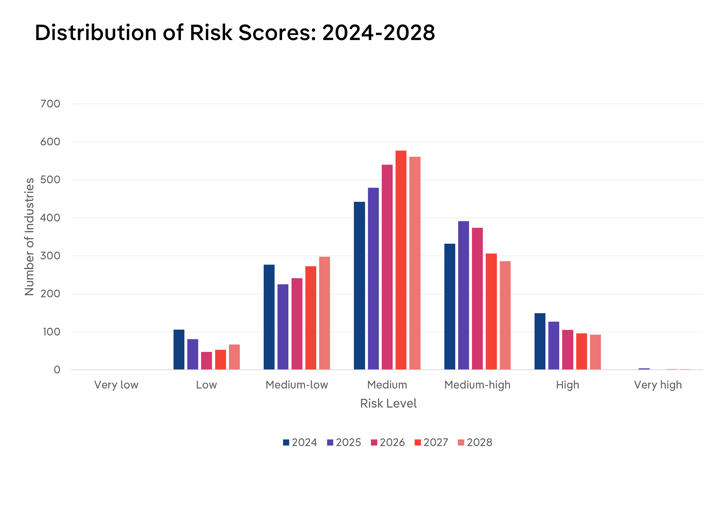
- By the end of 2024, inflation had returned to the Bank of Canada's target range. However, unemployment had risen and housing costs remained high, keeping housing the largest expense for most consumers and dampening overall spending. Businesses also continued to struggle to fill skilled positions, leading to persistent labour shortages. As a result, the share of industries rated medium-high risk or greater rose to 36.9%.
- In 2025, that share climbed to 39.9%, as tariff risks defined the year. The US imposed duties on non-USMCA-compliant goods that had previously entered duty-free, curbing exports to the US, reducing trade and pushing GDP below expectations.
- Inflation risks have risen this year, as energy shocks from the Iran conflict threaten to push consumers and businesses to absorb higher costs. However, the decision to hold rates steady and a weaker dollar are set to support exports. At the same time, energy commodity exporters stand to benefit from rising energy prices through stronger trade demand and investment interest. As a result, 36.6% of industries will be rated medium-high risk or greater in 2026.
- A stable outlook will depend on geopolitical developments, including the Iran conflict, US trade disputes and the future of the USMCA. Still, conditions are expected to ease further in 2027, supported by sustained government spending on defense and critical projects, along with business investments spurred by government incentives aimed at accelerating investment that is critical to economic development. However, the risk of rising interest rates and the lingering effects of US tariffs on Canadian goods in 2026 will put jobs at risk if the government fails to mitigate these risks. Since these pressures will not affect all industries equally, about 30.9% of industries will be rated medium-high risk or higher in 2027.
- Inflationary pressures are expected to ease in 2028, as war-related disruptions fully fade and economic slack is absorbed, creating a more balanced price environment for consumers and businesses, provided no new disruptions emerge. As a result, 29.2% of industries will be rated medium-high risk or greater in 2028.
Sector Rankings
Agriculture, Forestry, Fishing and Hunting
Farmers' performance varied by crop type, but many were positioned to do well after China agreed to resume select Canadian imports at lower duties and tariffs. Exports to China began rising in 2026 as the country increased purchases of Canadian canola and beef, improving farm economics for producers selling into that market. Domestically, the cattle herd is expanding as favourable weather and rising meat prices encourage ranchers to retain heifers, positioning them to capitalize on strong international meat demand this year and next. Poultry farmers have also benefited, as the rising cost of red meat pushed more Canadian households toward chicken and turkey, lifting demand for their products. These conditions are set to support Chicken & Turkey Meat Production and Beef Cattle Ranching & Farming.
Educational Services
Since 2024, the federal cap on international students, introduced to curb immigration, has reduced the number of students admitted to postsecondary institutions. As a result, colleges in provinces like British Columbia have cut staff and programs this year, with many operating at a deficit. Ontario's announced funding to support its institutions during this period of financial strain will ease part of the burden. Still, rising costs will require further government funding in future years, adding operational complexity for these institutions. These pressures will raise financial risks for the Colleges & Universities sector.
Construction
The construction outlook is uneven. Residential and nonresidential spending is rising for now, supported by large projects that have been announced and housing developments already underway, which give both segments a steady near-term pipeline. However, expectations that conditions will improve are low, as fewer housing starts are expected to break ground. Slow population growth and weak housing demand, driven by limited income growth, will add further pressure. Nonresidential construction, by contrast, has a pipeline of large projects set to ramp up later in the outlook. In Alberta, Bell's AI Fabric data center is expected to begin construction soon, and Meta has signaled its interest in building a data center in the province. Announced government funding for medical centres and energy projects adds to this pipeline. Together, these conditions will constrain Home Builders while supporting Commercial Building Construction over the outlook period.