


Key Takeaways
- Casual-dining chains have been closing locations for more than a decade, as the barbell effect pushes diners toward either low-cost fast food or premium dining experiences.
- The mid-tier chains that kept growing did so by borrowing from one end of the barbell, either offering a steakhouse experience for less or competing on value with fast food.
- Traditional department stores have faced a similar decline, while off-price retailers, warehouse clubs and premium department stores have continued to grow.
A loaded barbell carries its weight at both ends, with the middle serving as the small support piece. The "barbell effect" borrows that image to describe a market where consumer spending piles up at the low- and premium-ends while demand for mid-priced options thins out. Businesses at either end can win on price or on experience, but those that fail to carve out their niche are left competing for a shrinking pool of customers.
Casual dining has become one of the clearest examples of this phenomenon at work. In October 2026, True Food Kitchen filed for Chapter 11 bankruptcy after closing 12 of its 46 locations. According to Nation's Restaurant News, the chain's systemwide sales fell 0.7% to $312 million in 2025, marking its first annual decline. On the Border, which was sold to Pappas Restaurants in 2025 due to bankruptcy, filed for Chapter 7 liquidation in June 2026 after closing its remaining company-owned locations.
These closures represent a broader shift in consumer spending. As household budgets have tightened and diverged, consumers have increasingly gravitated toward either low-cost options or premium experiences.
Casual dining has been shrinking for a decade
Casual dining, which includes sit-down chains such as Applebee's, Chili's and Olive Garden, occupies the space between fast food and fine dining, yet the segment has consistently lost ground. According to IBISWorld analysis of company filings, franchise disclosures, bankruptcy records and press reports, the 18 casual-dining chains with public unit data that operated at least 100 US locations in 2015 ran 18.4% fewer restaurants by 2025. Six of those chains lost more than half of their locations, while only five expanded.
The chains that endure the most shrinkage frequently shared the same weaknesses. TGI Fridays, Ruby Tuesday, Romano's Macaroni Grill and similar chains were once fixtures of suburban shopping centers. Still, they offered overly broad menus at middle-of-the-road prices without a clear reason to choose them over a cheaper fast-casual meal or a more special night out. As traffic slowed, aging restaurants and frequent discounting made it harder to win customers back. Some chains also carried heavy debt or rent obligations, leaving little room to reinvest. Romano's, which operated 158 restaurants at the end of 2014, has fewer than 20 as of 2026.
Even the chains that have demonstrated resilience are struggling to keep pace with rising costs. Menu prices have climbed sharply over the past decade, rising by nearly 50.0% according to BLS data. While surviving chains have grown their sales in dollar terms, much of that growth reflects higher prices per order, rather than a growing customer base. After accounting for menu-price inflation, full-service restaurant sales grew only about 5.0% from 2015 to 2025, according to Census data. This indicates that rising meal costs, rather than an increase in customers, drove much of the segment's growth.
What's behind the decline?
For the restaurant industry, two forces are working against the middle at once. The first is demand. Casual-dining chains were built to serve middle-income families seeking an affordable sit-down meal, but this income group has been shrinking for decades. Many households have moved up the income ladder while others have slipped down, with those left in the middle tightening their budgets. That leaves mid-market chains competing for a smaller pool of customers who have fewer reasons to choose them.
The second force is cost. Sit-down restaurants require large dining rooms and staff to serve each table, with many of these costs staying the same whether the dining room is full or half empty. Value-focused establishments offset these costs by drawing high customer traffic in with low prices or rotating specialty deals. Meanwhile, premium restaurants charge enough per guest to make each table profitable. Mid-market chains often have neither advantage, so they absorb the costs of a full-service restaurant without the patron volume or per-order profit to offset their significant fixed expenses.
Together, these two forces have pushed the restaurant industry into a classic barbell. Higher-income consumers have had more room to spend on premium dining experiences, while budget-conscious diners have shifted to fast food or home-cooked meals.
The move toward cheaper, faster options is evident in federal data. According to the US Census Bureau, sales at limited-service restaurants, which include fast-food and fast-casual chains, rose 80.8% from 2015 to 2025, compared with 56.4% for full-service restaurants. Limited-service restaurants, which trailed their full-service counterparts a decade ago, now capture most restaurant spending. The premium end has proven less consistent, with traffic at Darden's fine-dining segment falling 5.2% in fiscal 2025 as even higher-income diners became more selective.
Fine-dining establishments have responded by reaching down toward the middle. Many premium restaurants now offer bar menus, lunch service and prix-fixe meals that give diners a taste of the premium experience at a lower price. This puts them in direct competition with casual-dining chains for occasions like date nights and celebrations, which mid-priced meals also compete for. Casual-dining chains are now squeezed from both sides, losing price-conscious diners to fast food and experience-seekers to premium restaurants.
Winners and losers in the middle
Not every mid-range dining chain has struggled. Texas Roadhouse has added more than 200 US restaurants since 2015 and nearly doubled its average sales per restaurant. LongHorn Steakhouse has also consistently added new locations, while Chili's has staged a sharp turnaround in recent years after struggling until 2022. Together with Olive Garden, these chains represent the middle winners. Rather than disappearing, the middle is consolidating around a handful of strong brands.
What separated these chains was a clear position at one end of the barbell. Texas Roadhouse and LongHorn offer a steakhouse dinner for a fraction of what diners would pay at a fine-dining steakhouse. A meal at LongHorn costs about a quarter of the average check at The Capital Grille or Ruth's Chris, which parent company Darden also owns. Chili's and Olive Garden took the opposite approach and competed on value. Chili's openly compared its $10.99 "3 for Me" meal to fast food, while Olive Garden built its appeal around generous portions at a low price. In each case, the winners gave diners a clear reason to choose them, while the chains left in between continued to close.
Department stores face a similar squeeze
The pressures facing the restaurant industry are not isolated. Traditional department stores, which have historically served middle-income shoppers, have faced a similar squeeze. According to the US Census Bureau, sales at department stores, excluding discount department stores, fell by nearly half from 2015 to 2024, while sales at warehouse clubs and supercenters rose by a similar percentage. Shoppers did not stop buying clothing and home goods; instead, they moved to stores that offered either lower prices or a more premium experience.
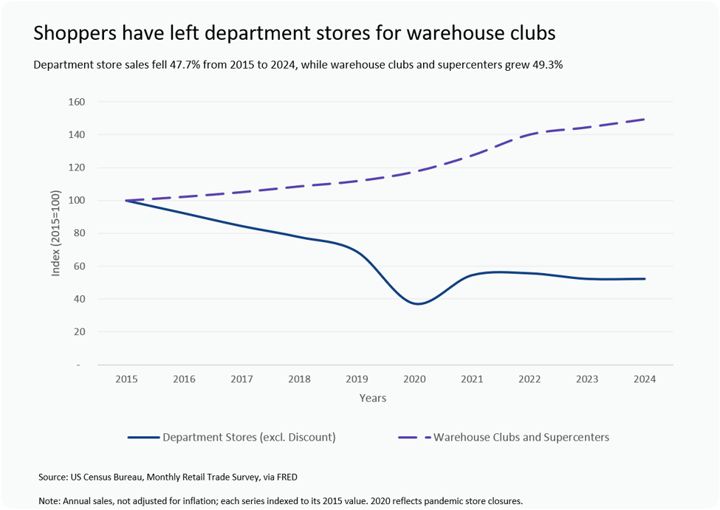
Rather than trying to survive in the middle of the barbell, Macy's has been moving toward both ends at once. At the top, the retailer is closing about 150 underperforming Macy's stores while opening new Bloomingdale's and Bluemercury locations that offer a wider selection of high-end and luxury goods. At the bottom, it has spent a decade building Macy's Backstage, an off-price shop designed to compete with budget retail options like T.J. Maxx and Marshalls. Backstage now operates inside nearly 300 Macy's stores and the company has said these locations outperform its full-line stores and draw shoppers who buy elsewhere in the building. With the shift in strategy, Macy's is trying to give the same shopper a reason to visit, whether they are hunting for a bargain or splurging on a special item.
The same shift is reshaping the grocery store industry's landscape. In 2024, discount grocer Aldi acquired Southeastern Grocers, the parent company of the Winn-Dixie and Harveys supermarket chains and has been converting those stores to its own low-cost format, with nearly 80 conversions planned for 2026 and more than 200 by the end of 2027. This trend demonstrates the shift away from the traditionally strong middle-tier segment, but in the opposite direction from Macy's.
Landlords and workers pay the price
As mid-market chains close, both landlords and workers have also struggled in tandem. According to Restaurant Business, Red Lobster listed about 228 leases for rejection during its bankruptcy, leaving property owners to find new tenants for these large, specialized buildings. Re-leasing often requires costly conversions for fast-casual, drive-thru, or non-restaurant tenants, particularly when economic conditions worsen and interest rates rise. For landlords and lenders, the mid-market restaurant is no longer the safe, long-term tenant it was twenty years ago.
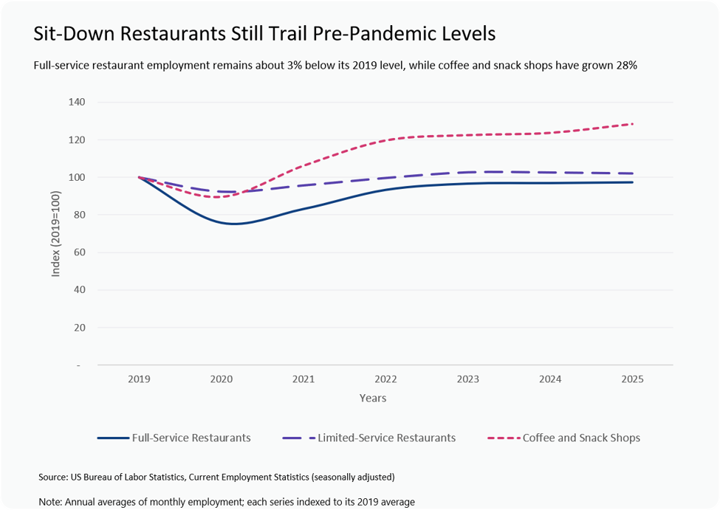
The shift is also changing the nature of restaurant work. According to the Bureau of Labor Statistics, full-service restaurants employed about 212,000 fewer workers in 2025 than before the pandemic, while quick-stop establishments, such as coffee shops, added about 184,000 workers, even as automated kiosks and robotic order-takers grew in popularity. For workers, this means fewer higher-paying table roles, where tips can lead to far higher wages than fast food establishments.
Upstream ingredients and equipment suppliers face a similar adjustment. As casual dining consolidates, food distributors and equipment vendors are selling to fewer, larger customers. This leads to the leaders in the middle, like Texas Roadhouse and Chili's, gaining more leverage in the mid-level restaurant category while diminishing their suppliers' pricing power. These suppliers will also need to monitor customer concentration more closely, since a single bankruptcy, such as Red Lobster's, can erase a major account and lead to financial instability.
Final Word
The barbell effect does not mean the middle of the US consumer market is disappearing, but it is becoming smaller and considerably more competitive, as value-conscious diners trade down, visit less often or shift their spending toward options that promise convenience and value. More casual-dining chains are likely to close locations over the next few years, while recent winners like Olive Garden and Texas Roadhouse will expand to fill the gaps. Without unique offerings or strong brand loyalty, mid-market restaurants and retailers will continue to lose ground to competitors at both ends of the barbell.