

Key Takeaways
- Uncertainty and potential disruptions can cascade into higher freight rates, elevated insurance premiums and longer lead times that push costs up even for buyers with no direct exposure to the chokepoint.
- Risks now reach well beyond Hormuz and Suez as tensions over Taiwan threaten annual trade through the Taiwan Strait, drought is limiting Panama Canal crossings and the Russia-Ukraine conflict is slowing Black Sea grain, fertilizer and oil exports.
- Because most critical supply chain risks originate with Tier 2 through Tier 4 suppliers, procurement teams need to map exposure upstream, build rerouting and insurance costs into contracts and diversify supplier geography.
The impacts of trade tensions, military conflicts and broader geopolitical tensions on procurement have been on full display in the past few years. Countries have been leveraging control of natural resources, geographic features and financial power over various chokepoints to narrow the flow of trade through a specific node. In a volatile world, with ever-increasing complexity, economic fragmentation and conflict, navigating the age of chokepoints is critical to maintaining operational continuity and efficiency as traditional procurement risks are reshaped.
Trade depends on far more than ports, ships and warehouses. Beyond the geographic infrastructure chokepoints, such as canals and straits, which have been widely covered, financial payment systems, regulatory frameworks and logistics networks can all influence procurement and create significant operational risks or add to complexity in the event of disruptions. Even without direct exposure, organizations can face cascading effects that require procurement teams to look beyond supplier risk and understand how goods move through upstream networks.
Chokepoints and their broader impacts
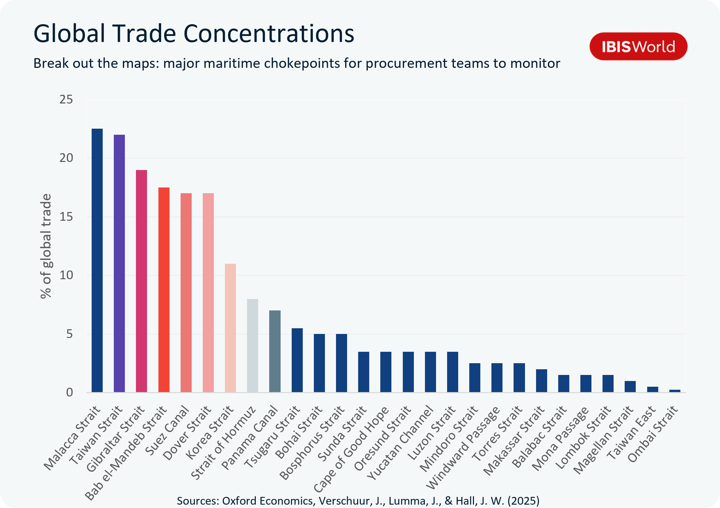
Over half of global trade is transported by sea, and around 27 major maritime chokepoints account for most of this trade. As a result, maritime chokepoints should be a procurement priority. The Strait of Malacca and the Taiwan Strait together account for around 42.0% of global trade traffic, posing dilemmas for organizations in the event of trade disruptions. China's continued threats of an invasion of Taiwan threaten the $2.4 trillion in annual trade that transits the Strait, particularly the supply of semiconductors. There could also be a Malacca dilemma, in which a blockade of the Strait could adversely affect upstream Chinese suppliers, or US buyers, since 14.0% of Chinese exports transit it. According to Sphera, 85.0% of critical supply chain risks derive from events impacting Tier 2, Tier 3 and Tier 4 suppliers. Organizations will want to prioritize suppliers with high contractual compliance and ensure that contracts account for volatility by requiring upstream suppliers to report incidents and maintain business continuity plans, with clearly defined force majeure and termination clauses.
Volatile weather events can also impact chokepoints. Drought conditions in the Panama Canal can limit daily crossings, and water shortages restrict passage. As a result of draft restrictions in these narrow nodes, buyers face upward pressure on fees, extended lead times, and disrupted schedule reliability. In addition, the canal is another arena for US-China competition, with the United States looking to curb Chinese influence in the region. China’s COSCO Shipping suspended operations at Balboa Port after a Panamanian court ruling, so that companies relying on major Chinese shipping lines encountered sudden route changes and delays. This highlights heightened chokepoint risk and long-term instability around the canal. Procurement leaders should develop methods to account for forecast volatility, given the risks posed by transit constraints and weather disruptions. Successful leaders will invest in cross-border bonded facilities, integrate canal transit wait times or draft notices into procurement systems.
The Black Sea region is another global chokepoint that has been squeezed by the Russia-Ukraine conflict. Russia has been striking Ukrainian ports and Ukraine has been attacking Russian ships, slowing oil, fertilizer and grain exports and threatening Caspian Pipeline infrastructure, which carries around 2.0% of the world’s oil. Buyers exposed to agricultural commodities, fertilizers or other Black Sea-linked inputs should evaluate the impact of route disruptions and develop contingency plans.
The Strait of Hormuz, the Bab el-Mandeb Strait and the Suez Canal have been widely covered. The impact of double-chokepoint crises in the region and broader threats from groups like the Houthis will continue to pose risks to supply chains exposed to the Middle East. Damage to energy infrastructure, such as refineries or export facilities, can disrupt suppliers for years. There are also emerging Arctic chokepoint risks. China’s Arctic Express uses the Northern Sea Route, but companies that use the route risk violating secondary sanctions due to how it is managed. These trends highlight the importance of considering friendshoring or nearshoring to help mitigate vulnerability to transoceanic chokepoints. Regional sourcing can limit exposure to supply chain disruptions and reduce fuel consumption during periods of elevated fuel costs.
The unseen layer of chokepoints
Recent years have seen a rise in protectionism, economic sanctions and broader trade policy uncertainty, contributing to a volatile environment for procurement teams to navigate. Nations are increasingly using economic warfare tools unilaterally to gain control over certain chokepoints, whether technological, logistical or financial. Sudden tariff, subsidy or regulatory changes can disrupt suppliers and require sourcing changes. Furthermore, sanctions on the Society for Worldwide Interbank Financial Telecommunication (SWIFT) can disrupt cross-border payments to upstream suppliers operating in or with sanctioned countries, and the broader weaponization of this chokepoint could spur the development of alternative payment networks, ultimately increasing complexity and compliance risks.
Logistics chokepoints can inhibit operations by raising maritime insurance premiums or disrupting shipping services. With ships targeted in the Middle East and insurance coverage repriced or restricted in dangerous areas, collapsing insurance markets can disrupt logistics networks and increase financial risk for companies reliant on global shipping. War risk insurance can itself become a chokepoint: higher premiums and surcharges, restrictive insurance coverage terms and financing requirements can make commercial transit prohibitively costly and trigger expensive rerouting. Additionally, oil and LNG tanker capacity constraints can lead to higher inventory buffers, port delays and higher logistics costs overall. Procurement teams should pre-negotiate contingency clauses and maintain alternative logistics arrangements.
Digital communication infrastructure, such as undersea cables, is increasingly at risk due to recent physical sabotage and attacks. These cables support areas such as customs documentation, financial transactions, cloud systems and port operations. As a result, damage can lead to partial system availability, rerouting traffic or increasing latency. With this new threat, buyers will have to identify which digital services are critical and how to ensure their own continuity when these systems degrade and become narrow chokepoints. Managing exposure to these will require broader integration with compliance, operations, finance, IT and legal specialists.
What procurement teams can do
Chokepoint risk exposure needs to be mapped and monitored continuously. With this new form of risk, end-to-end modeling of exposure through Tier 2 and Tier 3 suppliers is important since issues in hyper-critical nodes well upstream in supply chains can produce cascading effects. This may require organizations to expand their investments in supply chain and inventory visibility, as teams will want to plan for scenarios and prioritize products with high lead-time sensitivity and limited substitution.
Teams need to begin building routing contingencies into contracts and adding buffer stock for critical components tied to high-risk chokepoints. Building prescribed actions and establishing decision rights and action owners is necessary for making rational decisions during a crisis. Rehearsing organizational responses to scenarios can help reduce reaction times and the need for emergency actions, the latter of which tend to be more costly.
For companies facing commodity risk at major chokepoints, conducting risk analysis and developing hedging strategies can help reduce their exposure to price risk. Dual sourcing for key commodities is also common. Other companies facing indirect exposure should monitor early-warning indicators, including canal and strait restrictions, growth in carrier blank sailings, port attacks, changes in sanctions and cable incidents.
In addition, organizations should not only incorporate indexation to mitigate inflation but also account for higher insurance premiums and rerouting costs in the total cost of ownership models. Teams must account for volatility, implementing contractual clauses that allow for frequent renegotiation or dynamic adjustment. Organizations should review contracts, particularly force majeure and hardship clauses, and take early measures to mitigate potential losses to the counterparty. Lastly, diversifying supplier geography is crucial to avoid narrowing chokepoints in specific regions.
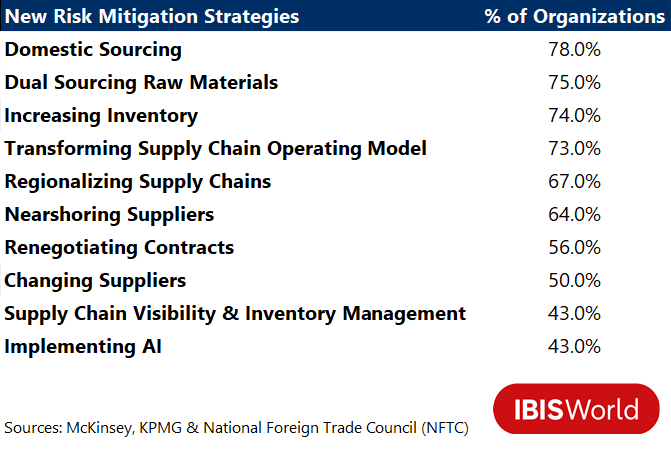
According to KPMG, managing and mitigating geopolitical risks and uncertainties is the top near-term objective driving supply chain transformation. ProcurementIQ can help develop or benchmark industry best practices, map supply chain exposure, or outline key contract clauses or service level agreements to mitigate risk in this new area of chokepoints.
Final Word
The new era of geopolitical risk requires a broader understanding of procurement operations. Developments over the past five years point to this environment becoming a long-term feature to manage, rather than an isolated event. Teams should be advised to have playbooks or alternative options on the shelf to implement before disruptions occur. Resilience is essential for procurement, so ensuring operational continuity during disruptions is critical.
Organizations will need to improve cross-functional integration across logistics, finance and legal disciplines to enable more real-time decision-making. In times of crisis, the ability to switch to alternative suppliers, shift transportation methods or adjust contracts will help mitigate negative shocks to the supply chain.