Key Takeaways
- Buy Now, Pay Later (BNPL) is scaling fast. Loan originations and consumer adoption have grown sharply in recent years, making BNPL a significant payment option for a growing share of US households, though it remains small next to credit cards.
- Consumers increasingly use BNPL for groceries, rent and other necessities, often because it's the only way they can afford them, signaling a shift from payment preference to cash-flow management.
- Providers are moving beyond retail, and risks are building. New entrants now finance household bills and medical care, even as missed payments rise and most BNPL debt remains invisible to credit bureaus.
As household budgets continue to be squeezed by rising costs, consumers are increasingly seeking ways to stretch a dollar. Credit card debt in the US rose $21.0 billion in the second quarter of 2026 to hit $1.26 trillion, a near record high, according to the Federal Reserve Bank of New York.
Buy Now, Pay Later (BNPL) has emerged as a fast-growing alternative to traditional revolving credit. These loans allow shoppers to pay for purchases in small installments over time, often without interest. What started as a pandemic-era tool for online retail splurges has quickly spread across almost every industry, allowing consumers to use loans to finance everything from basic household needs to large discretionary purchases. The Fed estimates that BNPL providers originated nearly $160.0 billion in consumer credit products in 2025, nearly twice the amount consumers spent on BNPL loans in 2023. Traditional pay-in-four loans represented about half of total issuance, with other short- and longer-term installment products accounting for the rest. But what happens when the consumer can’t pay later?
What exactly is Buy Now, Pay Later?
BNPL plans split the total cost of a purchase into smaller amounts repaid over time. The most common BNPL plan is a short-term, interest-free loan that is divided into four equal payments. Under this “pay-in-four” plan, the consumer makes an initial down payment and pays the remaining three payments to the provider at two-week intervals. However, BNPL has become a broader category than pay-in-four. Some providers now offer monthly installment loans that extend over several months and may charge interest, while others offer plans for bills, health care or larger-ticket purchases.
In a BNPL transaction, the provider pays the merchant at the time of purchase and collects repayments from the consumer over time. The provider earns much of its revenue through fees paid by merchants, which the Federal Reserve estimates generally range from 5.0% to 8.0% of the transaction value. That is above the roughly 2.0% to 3.0% that merchants typically pay to process credit card transactions.
Many consumers are enticed by BNPL because it can be obtained almost immediately: they simply download an app, connect it to their bank account and start spending. Unlike credit cards, it allows buyers to avoid building a revolving line of credit and often offers easier lending terms with little to no credit checks. However, this can become a slippery slope. A 2026 survey by LendingTree reported that one in four BNPL users had three or more active loans at the same time. And because pay-later loans often pull payments directly from customers’ bank accounts or debit cards, one missed payment can trigger additional fees or overdrafts.
A concentrated market is expanding into new niches
The US BNPL market is dominated by a small group of financial technology companies. According to the Federal Reserve, Afterpay (owned by Block Inc.), Affirm, Klarna and PayPal accounted for around 87.0% of total pay-in-four loans and 92.0% of total credit issuance in 2025, with Afterpay leading the pack.
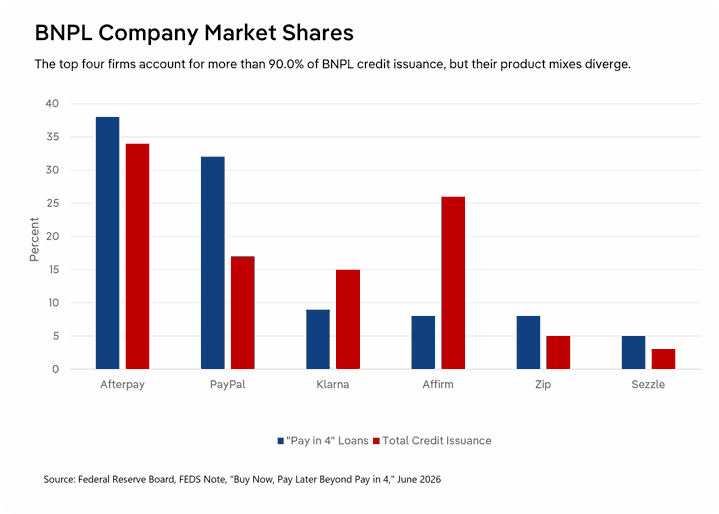
Though the market is highly concentrated among these top players, smaller firms are rapidly entering to fill different niches. Other lending apps like Flex and Zip allow customers to take out loans to split essential household bills, such as internet and phone bills, car payments, rent and mortgages, into smaller installments. Cherry, based in San Francisco, focuses on medical, dental and related services, in which consumers may face high out-of-pocket costs. These offerings demonstrate how BNPL is moving into categories that are less discretionary and more closely tied to routine household finances.
BNPL firms generally rely on a mix of partner-bank relationships and capital-markets funding. Banks may originate loans or supply lending capital, while the BNPL provider manages the customer experience, merchant relationships and digital platform. Most of these companies derive their revenue primarily from merchant fees, especially from no-interest pay-in-four plans. Others generate revenue through interest from longer-term installment loans, interchange revenue from branded cards or advertising and service-fee income through their consumer apps.
Consumers are using BNPL to manage spending
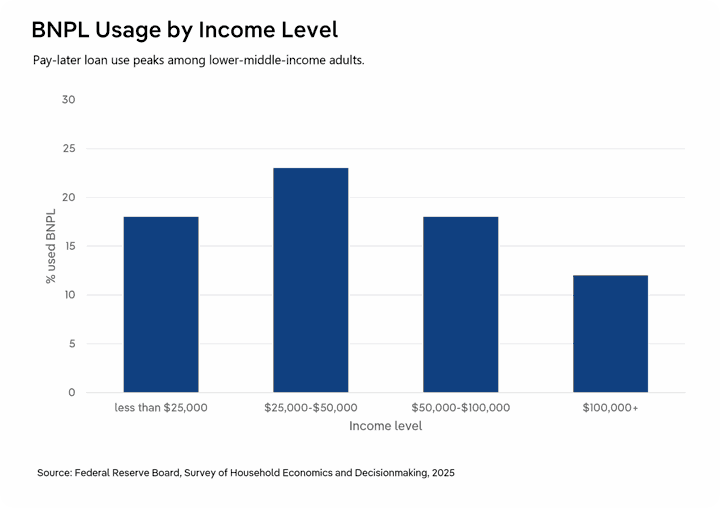
BNPL remains modest compared with credit cards, but adoption has risen quickly. The Federal Reserve Bank of Richmond estimates that the value of pay-in-four transactions reached about $70.0 billion in 2025, equal to roughly 1.1% of total US credit card spending. BNPL has not displaced credit cards as the dominant form of consumer payment, but it has become a significant payment option for a growing share of households. BNPL usage in the US rose from roughly 10.0% to 16.0% of US consumers between 2021 and 2025 (Fed SHED).
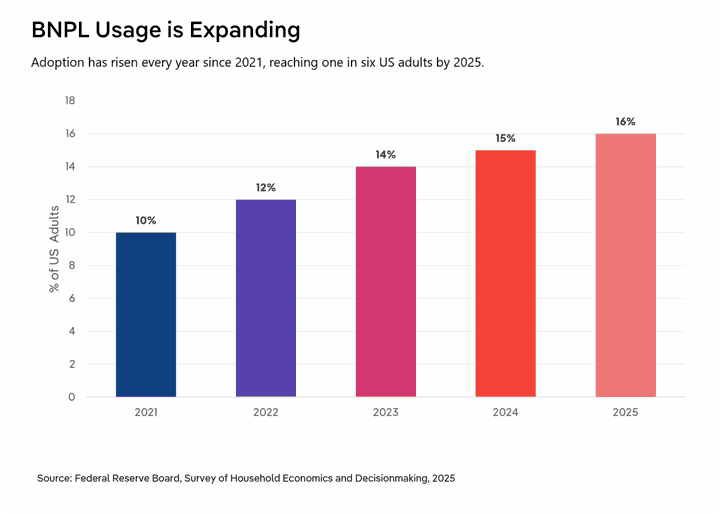
Among users, BNPL was more common for consumers making less than $100,000 a year. Differences by race and ethnicity were large, with Black and Hispanic adults being more than twice as likely to use BNPL as White or Asian adults.
Using BNPL for essentials is on the rise
BNPL loans have expanded to virtually every industry. Clothing and accessories remain the most common purchase, cited by 49.0% of users, ahead of electronics at 32.0% and furniture or appliances at 26.0%. But one in five users now use it to pay for groceries or food delivery, according to the Federal Reserve, and 13.0% use it for rent. A 2026 LendingTree survey suggests the shift is recent: the share of users buying groceries with BNPL more than doubled between its 2024 and 2026 surveys.
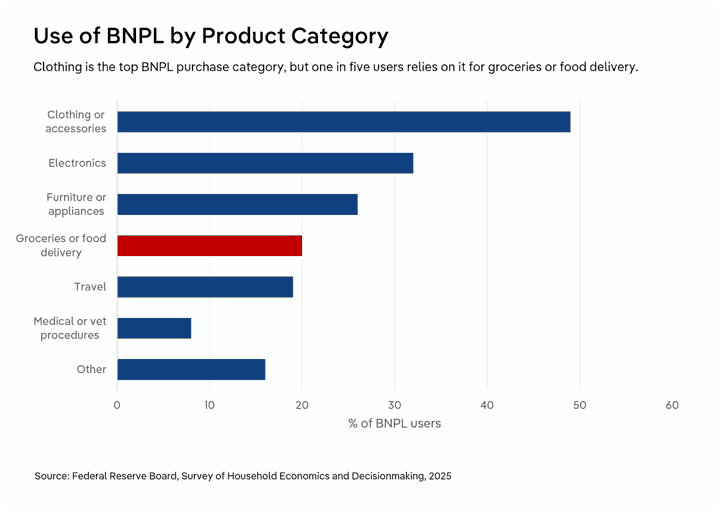
The expansion into necessary goods changes the implications of BNPL. Splitting the cost of a new phone or vacation can be a matter of payment preference. Using installment lending for groceries, rent, utilities or medical bills may instead reflect a shortfall between income and the cost of living. According to the Federal Reserve's 2025 Report on the Economic Well-Being of US Households, 45.0% of those who used BNPL for grocery or food delivery purchases said the main reason for using BNPL was that it was the only way they could afford the purchase.
Providers are adapting to this growing demand across industries. Affirm has started providing some tenants with loans to extend their monthly rent payment for a few weeks. Many dentists, veterinarians and medical clinics now often offer instant pay-later financing options, allowing patients to spread out their medical expenses. Some financial services are also developing BNPL options in-house, such as Intuit rolling out its version of “File Now, Pay Later” loans to TurboTax users who owe money on their tax return.
Even major consumer brands are contributing to the trend. Apple recently revealed a partnership with Klarna, allowing customers to lease iPhones starting at $17.99 per month for 12 or 24 months, then buy, return or upgrade the device at the end of the term (Forbes). This comes as Apple continues to raise prices on tech products, highlighting how BNPL-style financing has moved beyond discretionary retail purchases and into the sales strategies of major consumer brands. Companies can maintain a higher price point while reducing the immediate payment required of customers. For consumers, however, the result is another payment obligation to weigh against existing bills.
BNPL’s growing trade-offs
Pay-later loans can provide useful short-term flexibility when consumers understand the terms and can comfortably meet the repayment schedule. However, risks increase when borrowers take out loans from multiple providers, use BNPL lending for recurring needs or lack sufficient funds when automatic payments are withdrawn. About a quarter of BNPL users missed at least one payment in the past year, according to the Federal Reserve's Survey of Household Economics and Decisionmaking.
Pay-later loans also have been largely invisible to traditional credit reporting, allowing consumers to accumulate multiple loans from different providers without any single lender seeing their full borrowing picture; a phenomenon researchers describe as “phantom debt.” FICO, a credit score giant, announced in mid-2025 that it would soon launch two new credit scores incorporating pay-later loan data, though the company has yet to disclose a release date.
For retailers, BNPL presents a direct trade-off. The product can make purchases feel more affordable at checkout, expanding the pool of potential buyers and helping merchants increase conversion rates. This is particularly valuable for larger-ticket products, such as furniture, electronics, travel and elective health services, where an upfront price can deter a purchase.
However, merchant fees reduce the effective value of each sale. If BNPL primarily shifts existing customers away from lower-cost payment methods rather than generating new sales, the retailer may incur higher payment costs without a comparable increase in revenue. The outcome depends on a merchant’s average transaction size, customer base and the extent to which BNPL creates truly incremental demand (WashU).
Final Word
BNPL provides consumers with another way to manage the timing of purchases while offering merchants a tool to reduce price friction and support sales. The market is still small compared with credit cards and as of early 2026, the Federal Reserve of Richmond found no clear evidence that pay-later was contributing to broader financial stress at its current scale.
Yet the next phase of BNPL growth may be more consequential than its early retail-focused model. As installment financing expands into groceries, medical care, rent-related payments and recurring bills, it becomes less a convenience for discretionary purchases and more a household cash-flow tool. For consumers, providers and retailers alike, the central challenge will be ensuring that payment flexibility does not become an accumulating and difficult-to-track source of debt.