


Key Takeaways
- The price of new passenger vehicles has been steadily rising for consumers as factors like tariffs and advancing vehicle technology have made production more expensive for manufacturers.
- Other costs associated with owning and operating a car have also grown. Insurance premiums have reached record highs, driven by rising maintenance and repair costs and a greater risk of crashes causing total vehicle losses.
- To manage monthly expenses, consumers have been taking on longer car loan terms, which can help keep monthly payments in check, but raises the effective cost of their cars.
- Rising manufacturing costs and tightening consumer budgets have put pressure on dealerships to keep price increases low. Meanwhile, delinquency rates have grown as drivers struggle to make their monthly payments.
Unless you live in one of the few cities with a robust public transportation system, odds are you use a car on a daily basis. According to the US Department of Transportation’s National Household Travel Survey, in 2022 (latest available data), 87.9% of adults in the US used a personal car, truck or van to commute to work. However, despite being a necessity for millions of people, personal vehicles are becoming increasingly expensive. This goes beyond the sticker price of the car; from insurance and maintenance to parking and tolls, nearly every cost associated with vehicle ownership has been on the rise over the past decade.
The hidden and not-so-hidden costs
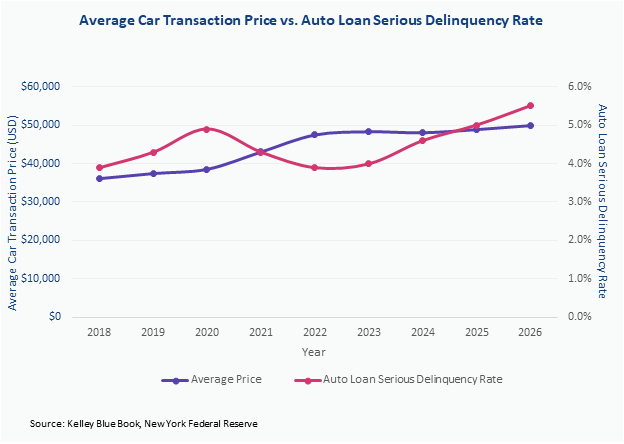
When the 2026 model year began rolling out in September 2025, the average price of a new vehicle surpassed $50,000 for the first time, according to Kelley Blue Book. Since then, the average price has fluctuated between $49,000 and $51,000. This marks a significant increase from 10 years prior, when the average transaction price was $33,549. As dealerships prepare for 2027 models, consumers can expect further price increases.
Prices have gone up and household budgets have become constrained, making financing increasingly important. In 2026, 83.3% of new vehicles were purchased using auto loans, up from 79.5% in 2023, according to Experian. Auto loans make it easier to purchase new vehicles, but they also increase the overall cost for consumers through interest payments. Increasing loan amounts and high interest rates have led to skyrocketing monthly payments. According to Experian data, the average monthly car loan payment is $770 in 2026, up from $557 in 2019, representing a 38.2% increase over the past 7 years.
Meanwhile, rising monthly payments are pushing drivers to take on extended terms to keep their monthly expenses in check. In 2026, the percentage of new car loans with terms longer than 7 years is 35.6%, up from 27.9% in 2024. This has brought the average car loan term to 69.5 months, as more buyers have chosen 6, 7 and even 8-year loans. For the average buyer, the lifetime repayment amount increases by about $1,500 for each additional year of the loan period. As average loan terms have grown, so has the effective price of cars.
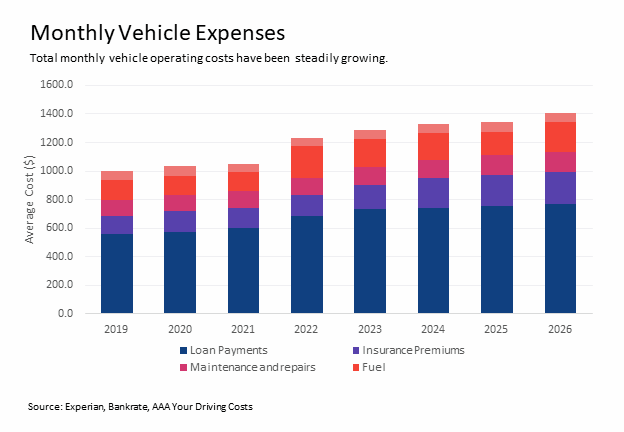
In addition to vehicle prices, the costs of owning a vehicle have also grown over the past decade. While insurance prices can vary significantly between states and levels of coverage, on the whole, premiums have been rising in-line with new vehicle prices. Since 2019, BankRate estimates that the average premium for full coverage auto insurance has increased from $1,502 per year to $2,697 in 2026. For the average driver, this translates to an extra $100 a month.
Vehicle maintenance has grown as an expense largely in line with new vehicle prices. Increases in maintenance have been driven by rising wages for mechanics and higher costs of auto parts and materials. Meanwhile, inflation and rising road maintenance costs have led to regular and typically annual increases in tolls and parking costs.
Ironically, while gas prices are typically at the center of discussions about driver expenditures, improvements in fuel efficiency have made the average fuel costs of driving a mile fairly cyclical over the past 20 years. Data from the Environmental Protection Agency shows that average fuel efficiency has grown from 19.9 miles per gallon in 2005 to 27.2 miles per gallon in 2025. During this period, fuel efficiency gains have mostly offset increases in gas prices and, at times, allowed for decreases in average fuel costs.
Recent spikes in gasoline prices, driven by the US conflict in Iran and the closure of the Strait of Hormuz, have put additional financial strain on drivers already dealing with inflated vehicle costs. However, the volatile nature of the crude oil supply chain and steadily rising fuel efficiency present one area where drivers may get some relief when the Strait reopens.
What’s driving the increase?
While this price growth has been driven by several factors, one of the most significant is technological advances in consumer vehicles. Features like electronic control systems, touchscreen consoles and collision detection sensors have become standard for nearly all new vehicles sold in the US. Semiconductor supply chains have been unstable for automakers since the pandemic. In the early 2020s, most automakers had limited production capacity as supply chain bottlenecks made it difficult and expensive to acquire the necessary chips.
As supply chains have recovered from the pandemic, automakers face a new challenge: AI data centers. The AI boom has created a surge in demand for DRAM chips, which cars use to power onboard computers and infotainment systems. Meanwhile, foundries have been shifting capacity away from less profitable foundational chips toward more advanced AI chips; however, most automakers rely on foundational chips for brakes, airbags, power windows and other essential systems.
As foundry capacity shifts, automakers will need to either pay a premium for these legacy chips or transition their systems to more advanced chips. In either case, production costs will rise, likely leading to growth in vehicle prices.
Chip shortages and advancing vehicle technology have also led to rising insurance and maintenance costs. While rising vehicle prices alone would already lead to higher insurance premiums, the cost and fragility of onboard computer systems have made repairs more expensive. A minor collision that may have caused only aesthetic damage to an older car could easily damage the collision sensors and cameras in a newer model. According to the CCC Crash Course 2026 report, 23.1% of all car insurance claims in 2025 involved a total vehicle loss, a record high for the car insurance industry. With crashes more likely to lead to expensive repairs, insurance companies have been steadily raising premiums.
However, this may be a cost that drivers are willing to pay, as vehicle safety has been improving steadily, with the number of collisions resulting in fatalities declining in recent years, according to the National Highway Traffic Safety Administration. In 2025, there were 36,640 motor vehicle fatalities in the US, marking a significant decline from 42,939 in 2021. While the number of crashes has been growing since the pandemic, reaching 6.2 million in 2024, the falling fatality rate shows that vehicles are getting safer.
In addition to the electronic components used in car production, tariffs on cars and car materials like steel and aluminum have threatened to further raise vehicle prices. The Trump Administration’s tariffs on passenger vehicles, including a 25% tariff on Canada and Mexico and a 27.5% Most-Favored-Nation tariff, have raised operating costs for automakers. Additionally, tariffs on steel and aluminum have raised material costs for domestic automakers. Manufacturers largely swallowed these costs in 2025, with the industry operating at a loss. However, as tariffs have persisted into 2026, companies have begun passing tariff costs on to dealers.
Dealers and drivers pay the price
As car prices and loan terms continue to grow, new car dealerships are feeling the pressure. While vehicle costs rise, steady inflation has made consumers less able to afford high car payments. This forces dealerships to keep prices as low as they can while still turning a profit. For the past five years, profit has stayed at or below 3.0% for new car dealers. Meanwhile, longer loan terms have led drivers to keep their vehicles longer. Dealerships have historically relied on repeat customers, but with 7-year loans, customers will have longer to wait before they can get a profitable trade-in value.
For consumers, these trends have had harsh effects. With the exception of major cities with robust public transportation systems, most of the US is designed around personal vehicle ownership, so with costs rising, most people don’t have the option to simply not have a car. While used cars are a possible alternative, used car prices have also grown, with the average price of a used car reaching $27,028 in 2026, up from $19,900 in 2019 before the onset of the pandemic.
This means that drivers will need to either hold on to their vehicles longer or tighten their budgets elsewhere to make their car payments. However, that may be more easily said than done. According to the New York Fed’s Household Debt and Credit Report, in 2026, 5.5% of auto debt was more than 90 days delinquent, the highest this rate has been since the 90s.
Final Word
While vehicle costs have slowed slightly in 2026, tariff pressure and supply chain disruptions threaten to further inflate prices over the next few years. If prices continue to increase, so will insurance premiums, maintenance costs and other vehicle-related expenses. This growth is indicative of a broader trend in the US, with consumers facing higher, more burdensome cost-of-living increases, which will further tighten household budgets. Without relief, vehicle ownership will become increasingly challenging for many consumers.