
Key Takeaways
- Since 2021, recent grads have experienced higher unemployment than the overall US workforce, marking a sharp reversal of a decades-long trend as the competitive edge of a college education fades.
- The impact of AI on new grads isn’t uniform across the economy. Early-career roles built around repeatable digital tasks are thinning out, even as opportunities tied to in-person care and real-world problem-solving stay more resilient.
- Some economists argue that remote work is a bigger drag on entry-level pipelines by raising the perceived cost of training and oversight, nudging employers toward mid-career professionals who can operate more independently.
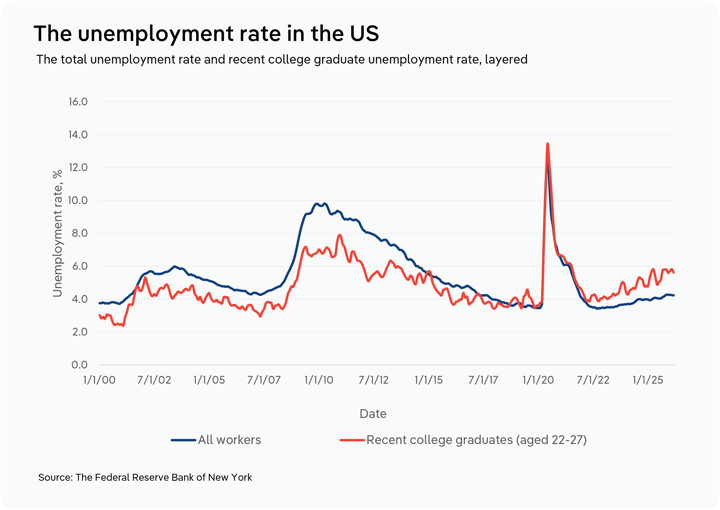
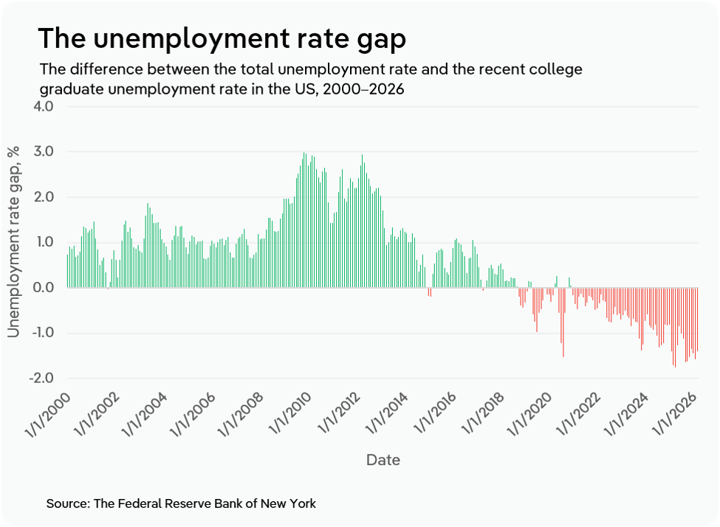
Since 1990, the unemployment rate for new grads (defined as college graduates aged 22 to 27) has been lower than the US unemployment rate with the exception of a few rare dips, according to data from the Federal Reserve Bank of New York. However, this trend began to falter in 2018, and by 2021 it had reversed entirely. Since then, new grads have experienced a higher unemployment rate than that of the overall workforce.
Degrees used to reliably improve students’ employment chances
The option to earn a college degree as a pathway to greater success in the US was popularized during World War II with the passage of the 1944 GI Bill, and was reinforced with the National Defense Education Act in 1958 and the Higher Education Act of 1965. These acts made college more accessible and affordable for a larger share of Americans seeking higher education to advance their skills, which led to a 380.0% climb in college enrollment between 1940 and 1990, based on historical data from the National Center for Education Statistics.
Eager to capture this growing pool of educated talent, employers built structured pipelines (i.e. campus job fairs, rotational programs and internships) to recruit new college graduates into entry-level roles. As these pipelines expanded, a college degree became a competitive advantage and the increasingly educated workforce gained stronger starting wages.
From a flicker in 2018 to a full reversal in 2021
In the spring of 2018, the unemployment rate for new graduates and the overall US unemployment rate began to move more closely together, practically erasing the historical gap. This instability carried into 2020, when the COVID-19 pandemic sparked job losses on a scale not seen since the Great Depression, according to the US Bureau of Labor Statistics. Even as overall unemployment began to normalize in 2022, the old positioning of the two rates had broken down.
New graduate unemployment has remained above the overall US rate since early 2021. Unlike in previous disruptions, it hasn’t reverted to the historical norm. As a result, since just before the pandemic began, new college graduates have been entering a labor market in which their diplomas no longer clearly lead to the job opportunities they once did.
The eroding of the college edge
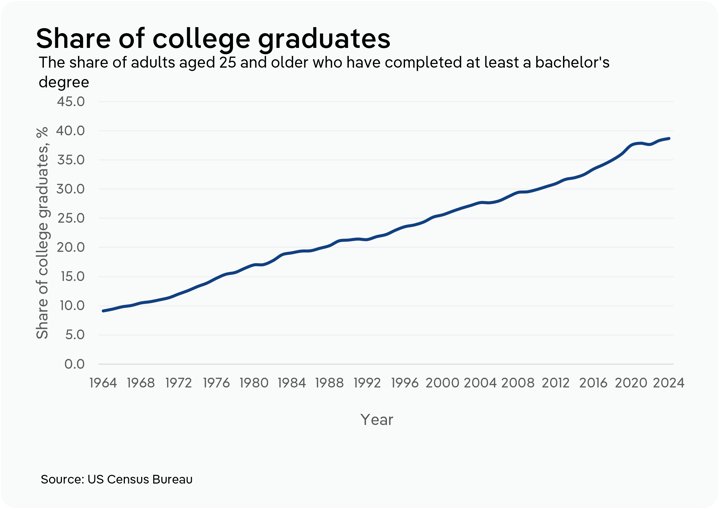
A degree from a postsecondary institution indicates one’s learned skills and discipline of study. When a smaller share of Americans attended college in the 1990s and early 2000s, a degree carried greater weight, enabling graduates to stand out as employers screened for capable staff. This helped keep the new graduate unemployment rate lower than that of the overall population.
However, the composition of the US workforce has changed radically. Based on US Census Bureau data, as of 2024, 38.7% of adults aged 25 and older have completed at least a bachelor's degree. That is up from 25.6% in 2000, representing a gain of more than 50.0%. As degree attainment has steadily risen, the job market has become more crowded with credentialed workers, contributing to the decline in the value of a degree.
In this environment, new grads are not only competing with each other but also with mid-career professionals who hold the same credentials in addition to years of experience. While this pressure is strongest in generalist majors like humanities and business, it extends across most fields. A college degree still carries value, but its role in separating new grads from the rest of the labor market is far more limited.
The labor market isn’t letting people in
Higher new graduate unemployment also stems from how employers pursue their labor strategies. Since 2022, total unemployment levels have largely remained historically low, but this surface-level figure masks a deeper change in hiring that disproportionately affects new graduates: employers are retaining their existing employees while adding fewer new people.
The “low-firing, low-hiring environment,” as highlighted by former Federal Reserve Chair Jerome Powell, is forcing a growing number of new grads to compete for a seemingly flat pool of entry-level openings. This situation was partly triggered by the end of the postpandemic hiring boom and compounded by high inflation rates, elevated interest rates and persistent geopolitical uncertainty. These forces have led employers – particularly in white‑collar, degree‑intensive industries – to stretch their existing staff and delay filling more junior roles, pushing recent grad unemployment rates upward.
The finance sector, which is highly dependent on current macroeconomic conditions, offers a clear example. Commercial banks and consulting firms often recruit nearly a year ahead of graduation through college internships and fixed analyst cohorts. However, since the postpandemic hiring surge cooled, many firms have trimmed new class sizes and postponed start dates, adding further pressure to new graduate unemployment.
Remote and hybrid work appear to have reinforced these decisions. A May 2026 study from the London School of Economics found that remote work is a “better predictor” than AI of the decline in entry-level hiring, noting that it tends to raise the cost of supervision and limit on-the-job learning. As a result, employers’ incentives to invest in early-career workers are reduced, and companies are increasingly favoring mid-career candidates with prior experience. In fact, a December 2024 survey by Intelligent found that one in eight hiring managers planned to avoid hiring recent college graduates in 2025.
AI and the hollowing out of junior-level work
In addition to these headwinds, AI has injected further turbulence into the labor market for recent college graduates. While AI isn’t the sole driver of the reversal of new graduate unemployment relative to the overall US unemployment rate, it’s likely amplifying it, because AI enables companies to boost productivity without increasing headcount. Routine tasks that once formed the backbone of entry-level roles are increasingly being handled by smaller teams using automation and AI tools, leading companies to delay or shrink hiring for junior roles – or skip it altogether.
Notably, AI’s effects are unevenly distributed across sectors and types of work. In industries that are heavily reliant on digital tasks, companies are reducing the number of entry-level roles through a mix of layoffs, attrition and fewer new openings. In contrast, job growth is occurring in human-centric fields (e.g. healthcare) and in roles tied to developing AI algorithms and platforms (e.g. software publishers). However, these positions tend to be higher up the career ladder, making it harder for new graduates to access those opportunities.
For example, in the tech sector, employment in computer systems design and related services has slipped from recent highs even as overall US employment has continued to climb. At the 2026 Fortune Workplace Innovation Summit, Indeed’s chief economist noted that more tech employers are moving away from hiring entry-level candidates, with a growing share of job postings asking for three to five years of experience. These trends suggest that even as AI-related work expands, new graduates encounter fewer true entry-level roles and steeper experience requirements. Entry-level jobs are where new graduates learn how to apply their skills in real workplaces. They provide a structured way to build experience, judgment and professional networks that support longer-term career progression. If AI continues to chip away at the availability of these roles, more of that learning is likely to happen through short-term contracts, side gigs and informal work that doesn’t always translate into stable, upward growth paths.
AI-related layoffs at companies like Meta and Amazon make the disruption seem sudden and alarming, but those headlines don’t capture how most firms are actually adopting these tools. AI is often introduced gradually, in specific functions or teams, rather than through a single sweeping replacement of workers.
Research by the Federal Reserve Bank of New York underscores this picture of a subtler, cumulative shockwave. Alongside other economists, it attributes most of the gain in recent graduate unemployment to the spread of remote and hybrid work and regards generative AI as a smaller, layered influence. AI is less a sudden break and more an added pressure on the ladder for young workers that was already starting to buckle.
Final Word
The fading advantage of a college degree, a cautious hiring environment and the rise of AI have put new graduates in a tight spot. For the first time since the Fed began tracking this data, recent graduate unemployment rates have been consistently higher than the overall rate for an extended period, and the gap is widening rather than snapping back as it had in the past. No one can say with certainty whether this reversal is now the “new normal” or whether a different mix of growth and hiring practices will eventually narrow the gap again. What seems clear, however, is that a simple return to the older pattern – in which having a bachelor’s degree reliably insulated new college graduates from labor market swings – is unlikely.
Instead, improvement in new graduate employment will be sector-specific. Outcomes will depend on where early‑career pipelines still exist, how much routine work has been absorbed by AI and which employers prioritize hiring and training new graduates. Despite rising “anti-AI” sentiment and the public rejection of commencement speakers who praised AI, the underlying incentives for businesses to adopt AI systems remain strong, potentially limiting a return to the norm for entry-level work. In this unfamiliar landscape, the transition from school to work is no longer a single, predictable pathway but a more fragmented and uncertain process that is still evolving as economic conditions and technology continue to transform.