


Key Takeaways
- Growth is slowing while inflation accelerates. Real GDP rose just an annualized 1.5% in Q2 2026, and inflation climbed to 3.8% year over year—the strongest reading since Q3 2023—driven largely by energy costs tied to the Iran conflict.
- Real spending grew only 2.3%, with households dipping into savings and shifting toward essentials like gasoline and food as discretionary spending cools.
- Construction is diverging sharply by segment. Residential and manufacturing facility investment both declined amid labor shortages, regulatory barriers, and sunsetting government funding, while data center construction surged 13.0% on AI-driven demand.
Consumer spending grew despite rising inflation, meaning households largely kept pace with higher costs even as many dipped into savings, adding strain on budgets. Signs of relief came from steady employment gains and healthy returns in capital markets. Uneven construction investment and the Federal Open Market Committee (FOMC)'s decision to hold rates in the face of rising inflation tied to the Iran conflict pointed to friction elsewhere in the economy. Real GDP grew at a 1.5% annualized rate in the second quarter of 2026, slower than the previous quarter as rising imports and reduced government investment subtracted from growth.
Labor Market:
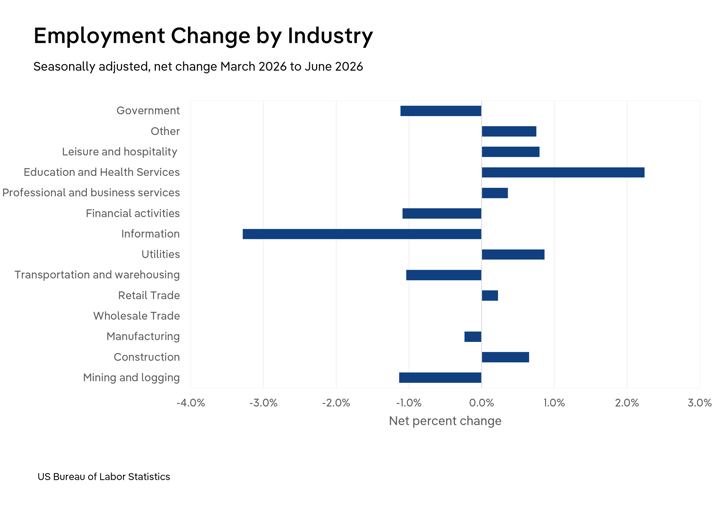
- The labor market had a steady second quarter, with private employment rising 0.2%, a gain of 231,000 jobs. The economy is still finding a need for workers, but the meager growth rate signals an environment that isn't producing large gains either. Employers are keeping both firings and hirings low to hold headcounts stable, taking a cautious stance on labor costs.
- Healthcare and professional and business services led employment growth through the quarter. Healthcare demand is steady as an aging population drives the need for outpatient clinics and home health services. Employers have also turned to employment services like temp agencies to supplement staffing, which lifted hiring at those agencies as well.
- Unemployment remained above 4.0% throughout the quarter, reaching 4.2% by June 2026, a slight decrease from March but not enough to meaningfully affect the figure. The decline stems partly from a shrinking labor force participation rate, reflecting a smaller immigrant workforce and an aging population, alongside job gains in select industries and a low volume of layoffs. Employers increasingly cite AI as the reason for layoffs.
- Wages grew 3.5% year over year in June 2026, supported by minimum wage increases and by labor supply shortages that pushed employers to raise pay. Wage growth hasn't outpaced inflation, though, which shows how contained these increases have been.
Consumer Spending:
- Inflationary pressure is building, and that's producing moderate spending conditions across the country. Nominal spending grew at a 6.2% annualized average in the second quarter of 2026. Still, real spending rose just 2.3% once inflation is factored out, barely moving from the previous quarter and decelerating from the second quarter of 2025. Cracks are emerging as consumers dip into savings and shift spending toward essentials and away from discretionary purchases, holding growth rates muted.
- Durable goods spending rose 5.5% annualized, led by recreational goods and vehicles and by motor vehicles and parts. Wealthier consumers are sustaining purchases of pricier items, lifting categories like wearables. Buyers seeking fuel efficiency have increasingly turned to hybrids, which offer a middle ground between EVs and internal combustion vehicles without a significant trade-off on either side.
- Nondurables rose 7.3% year over year in the second quarter, double the first-quarter rate and the fastest growth of any spending category, even though its share of household budgets changed minimally. Rising energy costs explain much of the increase, since gasoline is a nondurable good and households have little room to cut back on it.
- Services grew 6.0% year over year in the quarter. Housing and utilities held spending steady despite rising costs, as consumers remained locked into these essentials, while insurance costs rose year over year, leading the category. Financial services also grew year over year in the second quarter.
Inflation:
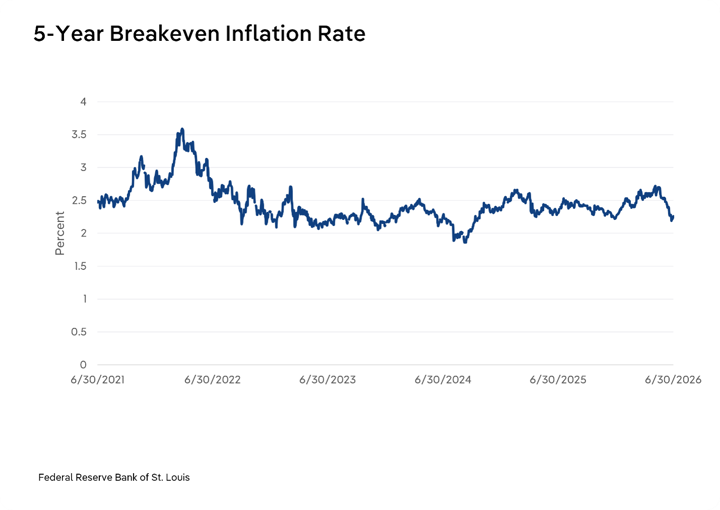
- Inflation climbed through the second quarter to 3.8% year over year, a 0.7% climb from the first quarter. That makes the second quarter of 2026 the strongest quarterly reading since the third quarter of 2023 and leaves inflation well above the FOMC's 2.0% target.
- Energy drove the acceleration, as it did in the previous quarter. Gasoline prices rose 26.7% year over year, and fuel oil climbed 42.9%, largely because of the Iran conflict. A temporary ceasefire eased monthly costs in June 2026. Still, energy prices remain above year-earlier levels, and the effects will be long-lasting as the Strait of Hormuz remains exposed to the conflict and energy infrastructure remains damaged.
- Food costs have risen as well, up 3.0% year over year in June, with red meat climbing more than 10.0%. A chronically low national cattle herd is compounding these costs for consumers. Food away from home rose 3.4% year over year in June, outpacing the overall food index, as restaurants pass higher operating costs on to diners.
Residential Construction:
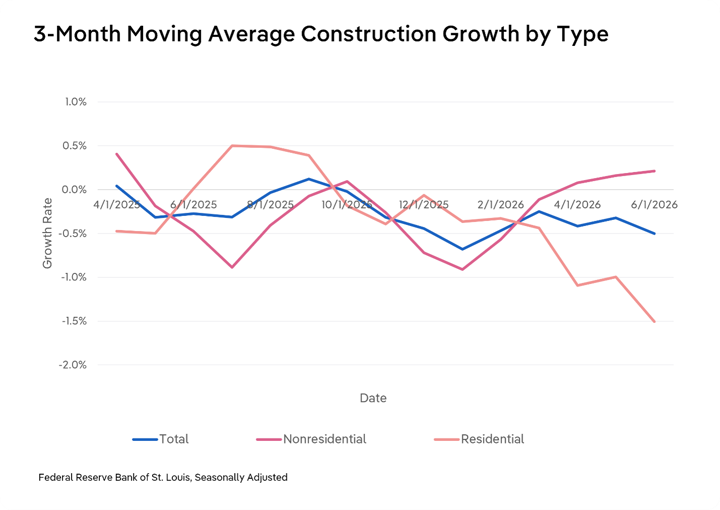
- Residential construction investment fell 3.5% in the second quarter from the first, with declines across single-family and multifamily homes. Developer strain has been pronounced as builders contend with labor shortages, zoning and regulatory barriers and rising construction costs. Those pressures widen the supply gap, since buyers who want new homes can't afford what's on offer, and that mismatch discourages builders from breaking ground despite underlying demand.
- Home prices have been falling even as broader inflation persists. The median sales price of new homes sold in the US reached $410,700 in the second quarter of 2026, down 1.3% from a year earlier, with existing home prices declining annually as well. Sellers and developers have cut prices and discounted listings to incentivize sales in a costly environment, though housing growth has stayed sluggish.
- Sales of both new and existing homes grew from the first quarter to the second, but sales of new homes fell year over year in June 2026. Lower prices aren't translating into sales because buyers remain constrained by costs. Younger adults, in particular, face affordability barriers that keep quarterly figures at meager levels.
Nonresidential Construction:
- Nonresidential construction spending grew 0.4% in the second quarter from the first, driven by states receiving increased project funding, particularly in the South and parts of the Midwest, offsetting uneven losses in Western and Northeastern states.
- Data centers have led that growth, backed by heavy debt financing and by tech companies looking to expand AI tools and software solutions in pursuit of workforce efficiency gains. Funding for these facilities rose 13.0% quarter over quarter and the buildout is carrying private nonresidential construction, creating jobs and keeping contractors working for the time being.
- Manufacturing facilities tell a different story. Investment fell 3.9% in the second quarter from the first and has declined since the fourth quarter of 2024 as CHIPS and Science Act funding for semiconductor plants winds down. Inflation Reduction Act dollars are compressing clean energy investment on a similar path, with the One Big Beautiful Bill Act (OBBBA) accelerating the sunset to 2026. The combined pullback is making funding harder to secure across both sectors.
Financial markets:
- The FOMC weighed unchanged unemployment and steady job gains against inflation running above its 2.0% target and again chose not to raise interest rates at the June 2026 meeting. The decision extends the approach the committee has taken since the start of the year, leaving rates in the same holding pattern they've been in since December 2025 as the FOMC balances its dual mandate of maximum employment and price stability.
- The S&P 500 posted a strong second quarter, rising 6.6% for the quarter and 23.6% year over year after a weak first quarter. Expanding buildouts of AI software and infrastructure are fueling demand for semiconductors and memory, allowing tech stocks to lead the index through the period and demand for AI infrastructure and components remained healthy across the first half of the year.
- The US dollar has performed well this quarter, with the dollar index posting notable gains in June following a weak start to the year during the Sell America trade. Rising US equity values are drawing investor interest toward the dollar. Furthermore, the repricing of FOMC expectations tied to mounting inflation risks, driven in part by the conflict in Iran, has added support. That combination keeps the dollar competitive against currencies in countries where valuations aren't climbing at a comparable pace.
Risk ratings:
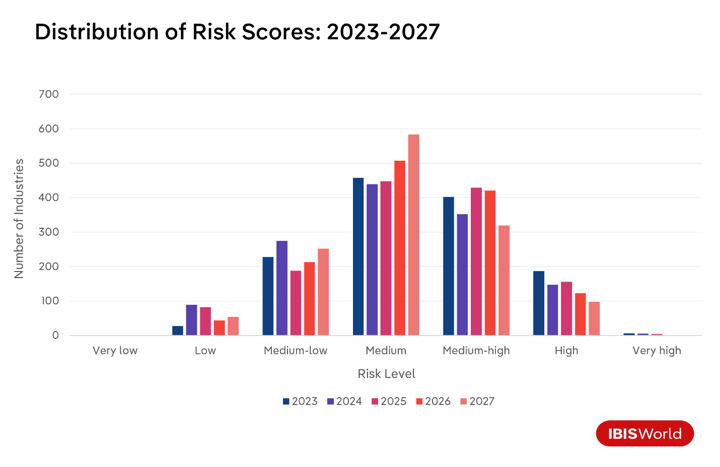
- Aggressive interest rate increases compounded economic uncertainty in 2023. Central banks tightened policy to combat persistent inflation, pushing 45.5% of industries into the medium-high risk category or above.
- Inflation and interest rates both moderated in 2024, with rate cuts beginning in September. Despite this easing, year-over-year price growth remained at 2.9%—above the Federal Reserve's 2.0% target. This sustained inflation limited relief for businesses and consumers, leaving 38.6% of industries at medium-high or higher risk.
- The implementation of tariffs created new economic headwinds in 2025. While selective trade pauses and negotiated deals offered partial mitigation, uncertainty persisted around rising input costs and weakening trade growth. Consumer demand has become increasingly price-sensitive, constraining operators' ability to easily pass through tariff-driven costs without risking volume losses. This pricing pressure and reduced consumer spending appetite increased risk exposure, with 45.1% of industries classified as medium-high or higher risk.
- Inflationary pressure is keeping the economy on edge and the prospect of a rate hike has stoked fears of rising costs, tempering growth expectations. Industries also contend with inflation risks stemming from the energy crisis and tariffs announced in 2026. However, those tariffs are narrower and less far-reaching than the 2025 round. Yet, consumer spending has maintained its momentum even as households draw down savings, keeping spending conditions stable and pulling the share of industries at medium-high risk or higher down to 41.5% in 2026.
Sector rankings:
Construction
Outside of data centers, the construction outlook looks negative and narrow. Rising costs, labor shortages and regulatory barriers around zoning and permitting are creating headwinds for developers. Homebuilders face weaker sales conditions on top of these cost pressures and many have conceded discounts and incentives to move inventory, which erodes the appeal of those revenue streams. Manufacturing facility construction has also lost steam as government funding programs sunset. Local bans and moratoriums on data centers add another risk vertical, since environmental opposition threatens the viability of these projects over the outlook period. Together, these pressures point to growing risk for the Home Builders and Land Development industries.
Information
The surge in AI applications and software is fueling interest among companies seeking workforce efficiencies, even as capturing those gains often requires spending more on subscriptions and tokens to give staff access to chatbots and coding agents. Spending on AI software and SaaS keeps climbing despite the risk of overspending, and this pattern supports growth in these services, as well as in the cloud and data hosting capacity they depend on. This dynamic benefits the Software Publishing and Data Processing & Hosting Services industries in the US.
Transportation and Warehousing
Freight rates spent several years under pressure from overcapacity, and a wave of carrier exits has since corrected the imbalance. Spot rates are climbing again as capacity leaves the market, so the carriers that remain are positioned to reap the benefits by offering logistics support to shippers who need it. Escalating spot and contract rates on truck activity reinforce this. Risks persist, including tight driver labor pools and broker liability for accidents following a Supreme Court ruling in summer 2026, which exposes carriers with loose operating practices to multimillion-dollar lawsuits. As long as capacity stays constrained, conditions favor the Long-Distance Freight Trucking and Local Specialized Freight Trucking industries in the United States.