
Key Takeaways
- US real GDP rose 2.0% YOY in Q1 2026, supported by steady consumer spending on essential goods and services, stable government outlays and rising AI-related investment that lifted private domestic demand. At the same time, declines in both residential and nonresidential construction spending restrained overall momentum, preventing stronger headline growth.
- Inflation accelerated as the Iran conflict pushed up energy costs and clouded the outlook, prompting the FOMC to hold policy rates unchanged during the quarter to balance its dual mandate of low inflation and maximum employment.
- Labor markets remained broadly steady, with sectors such as healthcare underpinning job gains even as layoffs in select areas added pressure, reinforcing the FOMC's assessment that rate cuts were not yet warranted given ongoing employment growth despite economic headwinds.
Labor market:
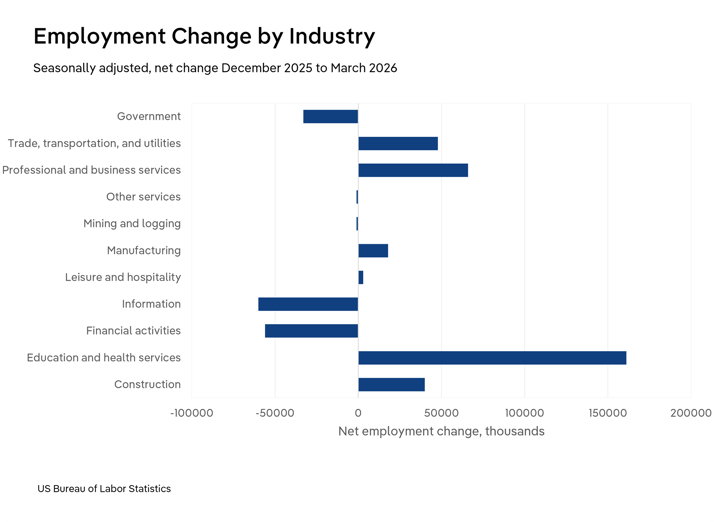
- Employment in the private sector grew 0.3% from December to March, adding 345,000 jobs as gains in large, labor-intensive industries more than offset losses in smaller sectors.
- Healthcare and construction led job growth, aided by the resolution of a Kaiser Permanente hospital strike that had sidelined 30,000 workers, rising staffing needs at outpatient facilities serving a rapidly expanding 85+ population and renewed hiring tied to construction projects—particularly data center buildouts—that came back online.
- The unemployment rate edged down to 4.3% in March 2026, 0.1% lower than in December, but ongoing layoffs in technology roles exposed to AI, including permanent position eliminations, limited further improvement in headline labor market conditions.
- Average wages rose 2.2% year over year in Q1 2026, a slower pace than the 3.0% increase recorded in Q1 2025, reflecting firms' efforts to manage labor costs amid higher inflation and tighter cost-control strategies.
Consumer spending:
- Real personal consumption expenditures rose 0.3% quarter over quarter in Q1 2026, indicating that households continued to spend even as savings rates fell and spending patterns shifted toward nondiscretionary categories, with consumers increasingly drawing on savings to cover core goods and services rather than broad-based discretionary purchases.
- Durable goods spending increased 1.6% over the quarter, supported by tax refund season and a sharp 36.8% quarterly jump in used vehicle purchases—boosted by a growing supply of EVs in the secondary market—which offset weaker new vehicle sales. Given that motor vehicles and parts account for 3.7% of PCE, this provided a notable lift to overall consumer outlays.
- Nondurable goods spending rose 1.1% quarter over quarter, driven largely by higher outlays on gasoline and other energy goods as the Iran conflict tightened global oil supply, pushed up crude prices and fed directly into household fuel bills.
- Services spending grew 1.6% in the quarter, led by rising, often unavoidable costs for healthcare, housing and utilities, which forced consumers to reallocate budgets away from discretionary services such as food services, accommodation and recreation.
Inflation:
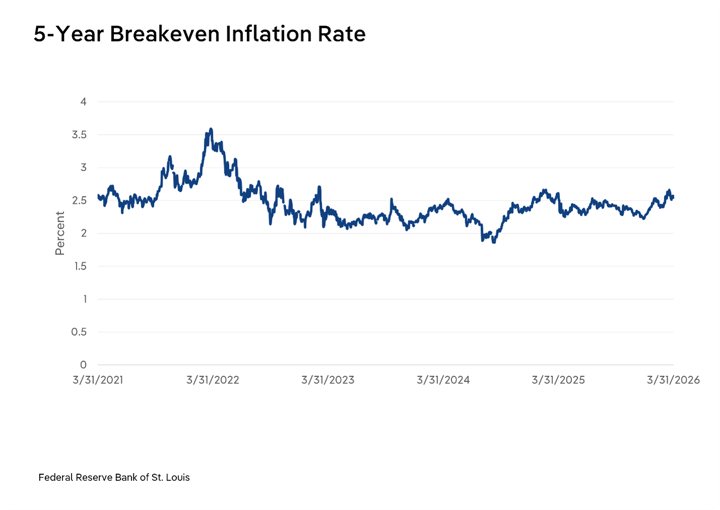
- Inflation became harder to manage in March 2026, with headline CPI rising 3.3% year over year, above the FOMC's 2.0% target and marking the strongest year-over-year gain since May 2024 after several months below 3.0%.
- Energy prices surged 12.5% year over year in March. This is the fastest increase since November 2022, pushing energy costs back toward levels last seen since the start of the Ukraine conflict. As supply disruptions linked to Iran and intermittent closures of the Strait of Hormuz have tightened global markets, lifted benchmark prices and sharply increased gasoline prices 18.9% YOY.
- Services less energy services rose 3.0% year over year in March 2026, driven largely by higher transportation costs. Transportation services increased 4.1% over the year as the conflict pushed up jet fuel prices, prompting airlines to raise fares and boosting their contribution to quarterly inflation.
Residential construction:
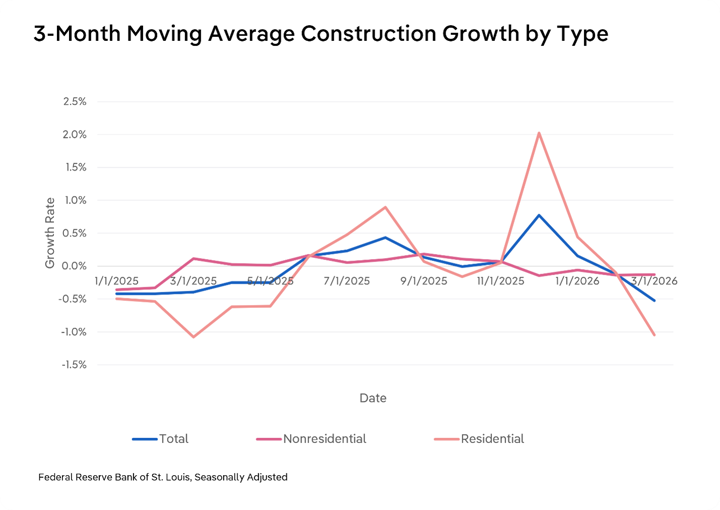
- Construction investment in residential housing fell 0.7% quarter over quarter in Q1 2026, as unusually cold January and February weather, slower completion rates and a thin project pipeline weighed on activity. However, housing starts picked up later in the quarter, helping limit the decline in homes under construction and in overall residential spending.
- Home prices tell a split story: median sale prices were still near decade-high levels but declined 4.7% year over year in Q1 2026 as improving inventory and a shift by builders toward smaller, more affordable homes provided some price relief for buyers despite rising construction costs.
- Demand started to firm by March, but average quarterly figures still showed weaker sales of both existing and new homes compared with the prior quarter. This slowdown reflected depressed January activity and buyers waiting for deeper price corrections, with emerging buyer preference tilting toward new homes whose prices eased relative to existing stock in a highly price-sensitive environment.
Nonresidential construction:
- Nonresidential construction investment declined 0.3% quarter over quarter as elevated borrowing costs increased financing risk for marginal projects and eroded valuations for developments with limited federal support, particularly in clean energy manufacturing, where construction spending fell 6.5% and became the largest drag on nonresidential activity.
- Data center construction grew 7.5% over the quarter. It surpassed office construction for the first time, highlighting a shift in commercial building demand as technology companies step up capex on facilities and hyperscale sites needed to support large-scale AI deployment.
- Healthcare construction spending rose 1.7% quarter over quarter as the aging US population and higher valuations for medical services drove demand for new facilities, with projects such as ambulatory surgery centers in the South and Midwest helping to sustain this segment's growth.
Financial markets:
- The FOMC elected to keep the federal funds rate unchanged at its first meeting of 2026, holding the level set in December 2025. Despite this, the Executive branch has pushed for cuts.
- Policymakers have cited upside inflation risks linked to new tariffs and a labor market that is only treading water, concluding that raising rates could further weaken employment, while cutting prematurely could undermine progress on inflation. Leaving rates steady best aligns with their dual mandate of low inflation and maximum employment.
- The S&P 500 fell 4.6% over the quarter as investors cooled on the "Magnificent 7," which now represent 35.3% of index capitalization. Amid a repricing of SaaS names following the rollout of AI models that can serve as lower-cost substitutes, forcing listed firms to defend the value of heavy AI-related capex in the face of slower earnings growth. At the same time, high-profile legal verdicts that have held social media platforms such as Meta liable for child safety violations further weigh on valuations and darkened the near-term outlook for these stocks.
- The US dollar traded choppily over the quarter. The dollar started from a weak position after a "Sell America" phase tied to last year's tariffs and diplomatic tensions. Because of President Trump’s policies, the currency remained under pressure before safe-haven demand, triggered by the Iran conflict, drove a rebound in dollar valuations as investors sought perceived safety in US assets.
Risk ratings:
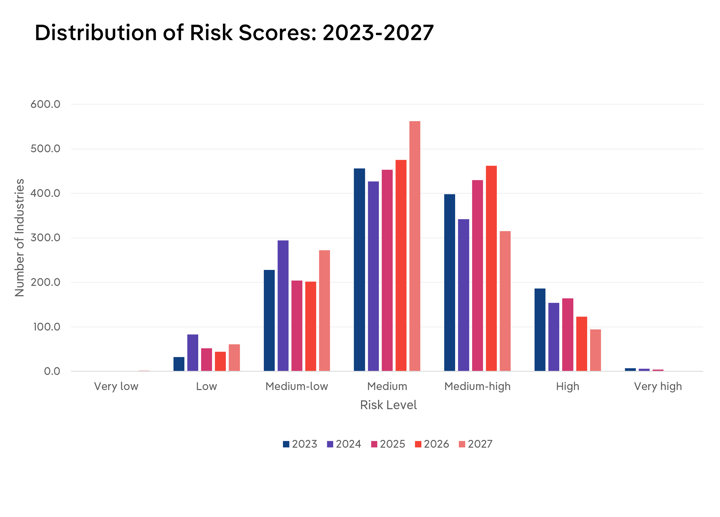
- Aggressive interest rate increases compounded economic uncertainty in 2023. Central banks tightened policy to combat persistent inflation, pushing 45.2% of industries into the medium-high risk category or above.
- Inflation and interest rates both moderated in 2024, with rate cuts beginning in September. Despite this easing, year-over-year price growth remained at 2.9%—above the Federal Reserve's 2.0% target. This sustained inflation limited relief for businesses and consumers, leaving 38.4% of industries at medium-high or higher risk.
- The implementation of tariffs created new economic headwinds in 2025. While selective trade pauses and negotiated deals offered partial mitigation, uncertainty persisted around rising input costs and weakening trade growth. Consumer demand has become increasingly price-sensitive, constraining operators' ability to easily pass through tariff-driven costs without risking volume losses. This pricing pressure and reduced consumer spending appetite increased risk exposure, with 45.8% of industries classified as medium-high or higher risk.
- Iran’s conflict-driven disruption to energy markets is expected to raise oil, gas, chemicals and related input costs in 2026, adding inflationary pressure for households and businesses reliant on shipments through the Strait of Hormuz. A ceasefire could alleviate some risk, but uncertain timing keeps the outlook fragile.
- Heavy capital spending on data centers and AI-focused companies will support growth in industries that supply or complement these technologies, while higher inflation will restrain consumer spending and weigh on less-exposed sectors. Overall, 44.8% of industries are projected to fall into medium-high or higher risk bands in 2026, highlighting an uneven mix of geopolitical risk, inflation and technology-led growth.
Sector Rankings:
Mining
Regulatory shifts and the rapid build-out of energy-intensive data centers are expected to reduce some perceived risk around energy-heavy sectors in 2026, as rising crude oil demand amid conflict-driven supply concerns in Iran supports higher valuations for US oil and gas producers. Additional export-oriented investment in liquefied natural gas infrastructure, including new export terminals slated to come online during the year, is set to expand growth opportunities for natural gas-related operations if these projects advance as planned. At the same time, Department of Energy orders that extend the operating lives of large coal-fired power plants beyond their prior retirement dates will keep coal in the generation mix as an essential fuel source, supporting revenue prospects for Coal Mining alongside Oil and Gas Extraction in 2026.
Information
The growth of AI is expected to drive significant demand for complementary services, such as data processing and hosting, as these providers regularly handle large, growing volumes of data generated by AI applications. As adoption accelerates over the year, the valuations of AI-focused software solutions and the services that support them are likely to rise, with data hosting and related infrastructure increasingly sought to enable efficiency gains for corporate users. These dynamics are creating a two-sided growth environment that benefits industries such as Software Publishing and Data Processing and Hosting Services, which sit at the core of delivering and scaling AI-enabled solutions.
Construction
Growing data center construction will support contractors and related trades that secure build-out work this year. Still, overall construction conditions will remain uneven as rising project costs and only partial relief in mortgage rates continue to weigh on single-family homes. Affordability constraints are holding back pent-up demand in the single-family segment, with many buyers effectively in a waiting rotation as elevated construction costs, higher gas prices and stubborn mortgage rates make new homes harder to buy and build. These pressures are expected to limit growth in single-family housing starts over the year, constraining both buyer demand and builders' willingness to initiate new projects and leaving home builders and housing developers more exposed to downside risk.