


Key Takeaways
- Higher ticket prices and rising living costs are making concertgoers more selective about live entertainment spending.
- Increasing production costs and softer ticket demand leave artists vulnerable when tours are booked into venues that exceed their draw.
- Regulatory scrutiny of Live Nation and Ticketmaster could reshape ticketing fees, venue competition and the financial viability of future tours.
Well-known artists are increasingly canceling or scaling back North American tours, often citing scheduling conflicts, creative commitments and other logistical reasons. Yet substantial unsold ticket inventory has fueled speculation that weak demand is increasingly influencing some high-profile cancellations.
In May 2026, Post Malone canceled the first few shows of his stadium tour with Jelly Roll, stating he was doing so to finish his upcoming album The Eternal Buzz. The tour was delayed about three and a half weeks, but no new music has been released since the announcement.
Previously, in the summer of 2025, a similar tour featuring Post Malone and Jelly Roll sold out, suggesting weaker interest among their audiences this year. Repeating a similar stadium run less than a year later without a new release or other major promotional hook challenged demand, as fans who attended the earlier tour had less reason to purchase tickets again. Online discussion of Jelly Roll's comments also prompted some to question Post Malone's decision to tour with him, suggesting that an artist's controversies can deter prospective concertgoers.
When The Pussycat Dolls canceled all but one North American reunion date, they were a bit more forthcoming. In May, The Pussycat Dolls released a statement that many took to mean ticket sales were underperforming, as the group detailed that the decision came after taking an "honest look" at the run. Although the group did not explicitly cite sales, Variety and other outlets pointed to substantial unsold inventory and reported weak ticket demand as the apparent driver. These cancellations reflect the narrowing margin for error in touring, where artists can no longer rely on name recognition alone to fill large venues at elevated ticket prices.
Ticket prices have become a bigger strain on consumers' entertainment budgets
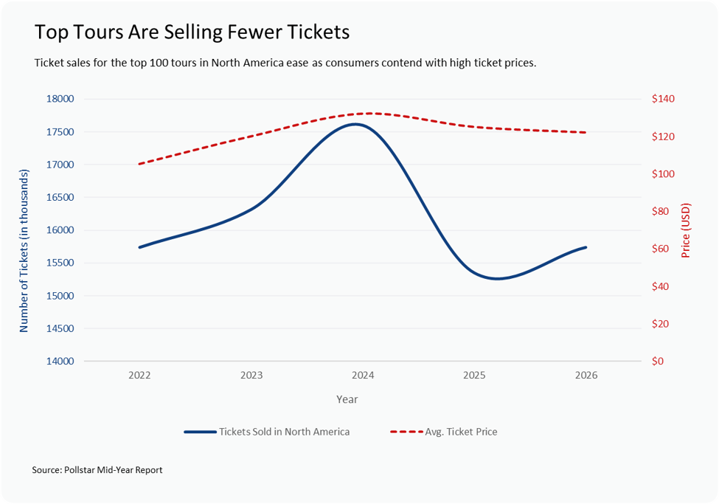
Before the COVID-19 pandemic, attending a major concert was significantly more affordable for the typical consumer. As reported by Pollstar, the average ticket price for the Top 100 tours in North America was $91.86 in 2019. By 2026, that figure had climbed to $122.15, an increase of 4.2%, after ticket prices surged during the post-pandemic live-entertainment boom.
Pent-up demand initially supported both higher prices and strong attendance. Average ticket prices reached a recent peak of $132.18 in 2024, while ticket sales largely kept pace. Since then, demand has softened: prices have edged down, but average concert attendance has fallen more sharply as higher costs and a crowded touring calendar may be testing consumers' willingness to buy tickets.
Tour production costs have risen, leaving artists vulnerable when venues fail to sell enough seats to cover expenses. An arena tour with expensive staging, trucking and crew costs needs high ticket prices to break even. Elaborate staging, audio and video technology, interactive effects, drones and props can all create a memorable event but seriously inflate production costs. In 2023, Billboard senior director Dave Brooks estimated that the production of Taylor Swift's Eras Tour cost well over $100 million to develop.
For artists touring smaller venues, the highest costs are typically personnel and transport. In 2024, Los Campesinos! spent 45.0% of their budget on a sleeper bus, along with fuel and driver wages, as well as another 18.3% on crew wages. These rising fixed costs make ticket pricing a key part of tour economics: artists must either charge enough per seat to recover costs or accept a slimmer margin.
Consumers accepted higher ticket prices during the post-pandemic touring surge because live events had been unavailable for so long. That appetite has since cooled, while higher household costs in 2025 have made consumers less willing to splurge on a night out. The Bureau of Labor Statistics reported that consumer prices overall rose 2.7% from December 2024 to December 2025. Food prices rose 3.1%, restaurant and takeout food prices rose 4.1% and electricity prices increased 6.7% over the same period.
As the cost of living rises, consumers cope by limiting discretionary spending and prioritizing household essentials, making live events a more selective purchase rather than a routine outing. Attendance is becoming less predictable even for artists with recognizable names, as consumers become more selective about which shows justify the cost.
A two-speed touring market
Concerts are socially valuable events that fans want to experience, share online and discuss with peers. Artists with large fanbases and strong cultural relevance are the most insulated from weakening concert demand. Olivia Rodrigo's upcoming tour was in such demand that she added 20 shows to the schedule, including 10 nights at Barclays Center. Harry Styles is an artist in such high demand that he is set to play 30 shows at Madison Square Garden beginning in late August 2026.
For mid-level artists, the landscape is harder to navigate. They must compete for consumers who are increasingly focused on value, while facing higher operating expenses and fewer opportunities to absorb a weak-selling date. Tame Impala's 2026 North American arena tour illustrates the challenge: despite the act's established fan base and new album, several shows had tickets remain unsold up to the show date, with resale entry prices around $120. A tour that is oversized, insufficiently differentiated from a recent run or priced beyond what fans consider reasonable may be more vulnerable to postponements or cancellations.
Weekend festivals and one-day events can offer artists a way to benefit from concentrated demand. Rather than asking fans to attend a single-headliner arena show, a tightly curated festival combines several artists, a more immersive social experience and the scarcity of a one-off date.
Olivia Rodrigo's sold-out inaugural Daisy Chain Fields festival in Irvine, California, illustrates the model: the one-day event featured a women-led lineup that included Chappell Roan, Doechii, Mitski, Garbage, Bikini Kill and The Breeders. It's clear that cultural identity and charitable purpose differentiated the event from other festivals, showing how major artists can tap into their audience's interests to create buzz.
The live-music business is increasingly separating into two markets. At one end, the biggest acts can still generate enough urgency to sell premium tickets, support elaborate productions and fill multiple nights in major venues. At the other end, artists with established but less intense fan demand face a more fragile equation, in which one poorly matched venue, costly production decision, or weak market can turn a tour into a financial liability.
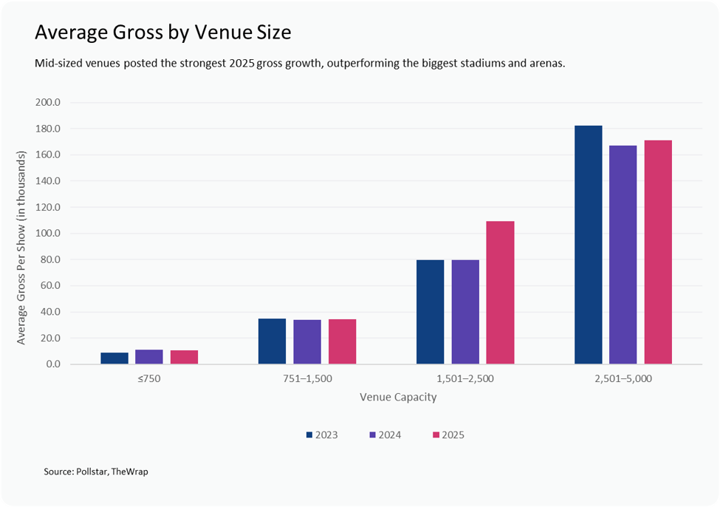
According to Pollstar, mid-size venues (1,501–2,500 capacity) delivered the strongest growth in average gross per show in 2025, while the largest venues saw lower grosses than in 2023. Promoters who have been benefiting are those putting on shows in rooms large enough to generate meaningful ticket revenue but small enough to support an exclusive fan experience.
Arena and stadium tours face a complicated landscape, leaving even established artists struggling to fill seats as consumers become more selective. Artists with proven but not arena-scale demand should consider prioritizing mid-size routing, using multiple nights or additional markets rather than moving prematurely into larger venues.
Ticketing reform could reshape touring dynamics
The shifting economics of touring are unfolding amid heightened scrutiny of the dominant ticketing and promotion model. The US Department of Justice (DOJ) sued Live Nation and Ticketmaster in 2024, alleging that the companies unlawfully monopolized markets across live entertainment and seeking remedies intended to restore competition for fans, venues and artists.
In 2026, the DOJ reached a proposed settlement with Live Nation that included a $280 million fund for participating states, restrictions on certain ticketing practices, a cap on specified service fees and the divestiture of 13 amphitheaters. The case will not by itself resolve artists' problems with weak demand. Still, its outcome will impact how promoters, venues and ticketing platforms compete, potentially affecting the fees, venue access and deal terms that shape the cost of putting on a show.
Final Word
Live music remains a valuable form of entertainment for consumers. The biggest tours will continue to generate extraordinary revenue. But the post-pandemic period showed that exceptional demand for a small number of blockbuster events should not be mistaken for unlimited demand across the broader touring market. For artists outside the top tier, the commercial challenge is no longer only getting fans interested. It is convincing them that this particular show, at this price, is worth choosing over every other use of their limited discretionary income.