


Key Takeaways
- Pallion sits atop the list for the second consecutive year, more than doubling its revenue in 2025-26 and extending its lead by capitalising on a surge in gold prices.
- While growth was concentrated among larger companies, mergers and acquisitions remained a major driver of expansion.
- Mortgage brokers and non-bank lenders benefited from rising demand for refinancing and strong house price growth, though rising interest rates tempered growth in the latter half of the year.
- Elevated inflation constrained the construction sector, but higher-density apartment construction exhibited strong growth amid increasing apartment approvals and completions.
*The 2026 Top 500 Private Companies list reflects figures as at 24 August 2026.
Welcome to IBISWorld’s 2026 special report on Australia’s Top 500 private companies.
In a financial year dominated by geopolitical conflicts, energy market volatility and high interest rates, Australia’s largest private companies managed to grow overall. The Middle East conflict constrained shipments through the Strait of Hormuz, the passage previously crossed by around one-fifth of global oil and LNG trade, weighing on overall performance in the latter part of the financial year. Surging global crude oil prices subdued economic activity and stoked inflationary pressures. Beginning in February 2026, the RBA raised the cash rate to curb inflation, lifting borrowing costs for businesses and consumers alike.
The Top 500 achieved combined revenue of $425.4 billion, up 7.3% from the previous year’s total of $396.3 billion. Just under 80.0% of private companies on the list experienced revenue growth, down from 85.0% of the top 500 companies in 2025, highlighting a difficult economic environment. This trend also reflects that growth was concentrated among the top movers – notably those in the Fuel Retailing and Gold and Other Nonferrous Metal Processing industries – which were able to leverage market volatility to their advantage. The revenue cut-off for the list rose, though likely driven more by inflationary measures than by organic growth, given that the Consumer Price Index averaged 3.5% in 2025-26.
Inside the top 10
In the 2026 list, the top five companies are unchanged from previous years. Gold metal processing firm Pallion reigned at the top for the second consecutive year, recording a 107.7% skyrocket in its revenue to more than $38.1 billion. The price of gold skyrocketed in 2025-26 as rising economic uncertainty stemming from the conflict in the Middle East pushed up investor interest in the safe-haven asset. Precious metals have long been viewed as a safe investment amid volatile periods, helping insulate against currency fluctuations and preserve purchasing power. Pallion successfully capitalised on these elevated prices, increasing metal product processing volumes and building on its 94.6% climb in revenue in 2024-25. According to the Department of Industry, Science and Resources, the Australian price per ounce of gold climbed 53.6% in the year through March 2026, while domestic mine production rose 22.0%, highlighting strong price-driven growth.
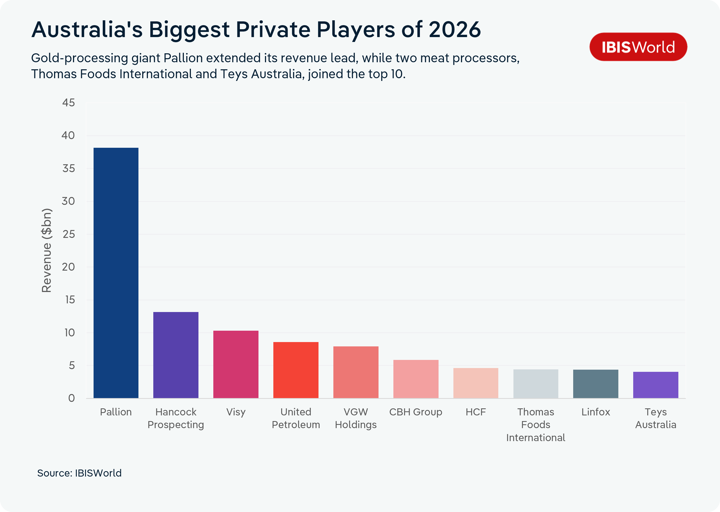 Hancock Prospecting, Visy, United Petroleum and VGW Holdings retained their positions in the top five. While all of the top 10 reported revenue growth, CBH Group (#6) was the only other company, alongside Pallion, to record double-digit revenue growth. CBH Group, the largest national agricultural cooperative based in Western Australia, posted a 30.1% climb in revenue, pushing up the Grain Storage industry’s growth in 2025-26. Strong winter grain production lifted CBH’s crop handling volumes, and favourable harvest conditions also strengthened CBH’s fertiliser sales, consolidating its position in the top 10.
Two new entrants joined the top 10: meat-processing giants Thomas Food International in eighth place and Teys Australia in the number 10 spot. Australian meat is renowned for its quality, and robust export demand alongside record domestic beef prices propelled growth in the Meat Processing industry. Beef production reached 2.9 million tonnes, and cattle slaughter surged to its highest level since 1978, according to Meat & Livestock Australia. Meat processors benefited from multiple free trade agreements (FTAs), with 87% of exports going to FTA partner countries.
The eastern seaboard remains dominant, though Western Australia’s companies are heavy hitters
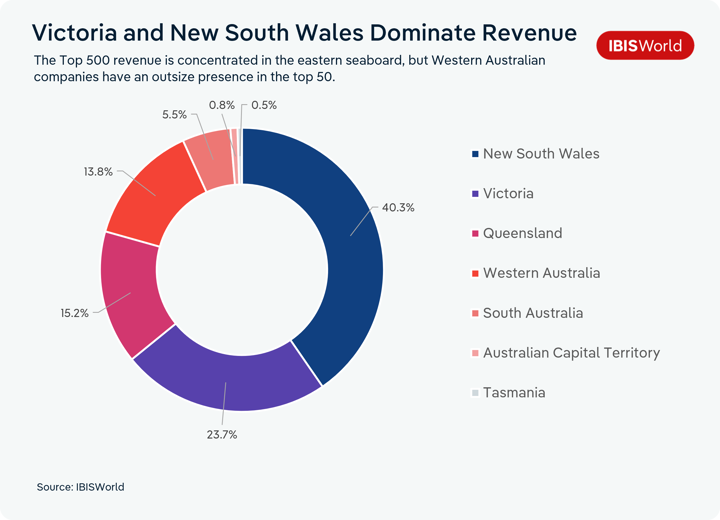
The private sector remains concentrated across the eastern seaboard, with New South Wales, Victoria and Queensland together accounting for 79.2% of total revenue, up slightly from 78.6% in 2025. New South Wales’s share increased, driven by Pallion’s revenue surge, which caused Victoria’s and Queensland’s shares to inch downwards.
Western Australia accounted for only 13.8% of Top 500 revenue but 20.8% of revenue in the top 50, highlighting the dominance of large-scale, well-established WA giants like Hancock Prospecting, CBH Group and VGW Holdings. By contrast, Victorian enterprises accounted for 23.7% of total revenue but made up just 14.9% of the top 50 entries, reflecting the presence of many medium-size businesses in the state. Compared with national averages, a higher share of Victorian and Western Australian enterprises on the list recorded revenue growth.
Power moves: Mergers and acquisitions have accelerated Top 500 growth
The attrition rate among the Top 500 has been volatile in recent years, rising from 37.8% in 2021-22 to a substantial 44.0% in 2022-23, then returning to 24.2% in 2024-25. In 2025-26, the attrition rate dwindled to 12.0%, meaning that the vast majority of companies on the 2025 list reappeared on the 2026 list.
The attrition rate appears to be returning to pre-pandemic levels, signalling that companies have solidified their inclusion in the list, though consolidation has helped propel growth across the list.
Merger and acquisition activity led to some of the highest annual revenue increases on the list. South Australia-based construction company Ahrens (#91) recorded a 57.6% revenue boost, underpinned by its acquisition of Vaughan Constructions. Meanwhile, Opal HealthCare (#28) jumped 15 places, achieving an annual revenue hike of 31.3% to $2.5 billion. Opal HealthCare solidified its position as the largest aged-care operator in the nation by acquiring Australian Aged Care Group, adding 379 beds in Victoria and bringing its portfolio to 142 care communities. Similarly, Amart Furniture (#94) expanded by acquiring rival Freedom Furniture, which is expected to bring the combined retail network to 126 stores.
Another notable mover up the list was Enerven Energy Infrastructure (#145), which recorded a 54.4% jump in revenue to $688.7 million through its ongoing delivery of energy-grid and battery-storage projects. The company has benefited from contracts to construct and expand battery storage facilities, supported by ongoing investment in renewable energy infrastructure, particularly reinforced by the recent conflict-induced volatility in energy markets.
Continued demand for data-centre capacity supported robust growth in the Cloud Hosting and Data Processing Services industry, with CDC Group (#127) leveraging demand across its government, critical-infrastructure and private-sector customer base to achieve revenue growth of 38.6% to $765.8 million.
Leader Computers (#92), a computer wholesaler, recorded a 25.8% jump in revenue, benefiting from ongoing PC replacement demand amid Microsoft's official end of support for Windows 10 in October 2025.
The Middle East conflict has fuelled volatility
Australian companies faced particularly challenging conditions in the latter part of the financial year as the Middle East conflict disrupted operations. The conflict between the United States, Israel and Iran, beginning in late February 2026, effectively closed the Strait of Hormuz, impacting energy markets, freight travel, supply chains and export routes.
Energy market disruptions divided performance
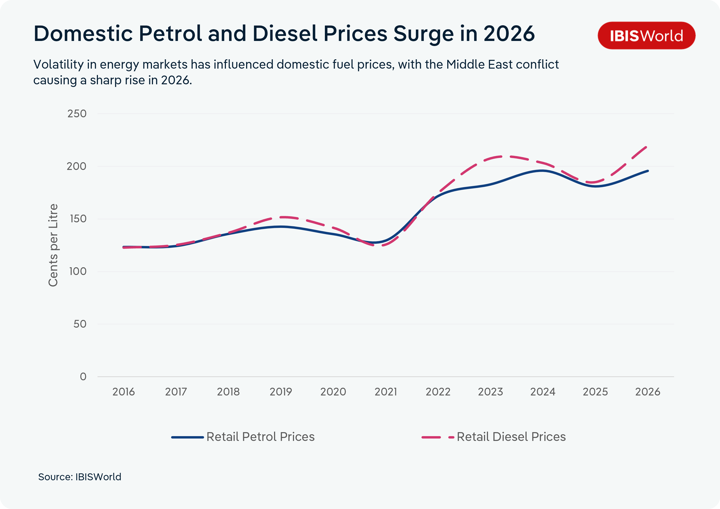
Disruptions to shipping through the Strait of Hormuz, alongside heightened risks arising from the Middle East conflict, lifted global crude oil and refined fuel prices, increasing operating costs across freight and logistics supply chains. The Road Freight Transport industry was particularly exposed because diesel is a highly variable cost, with retail diesel prices jumping 18.6% in 2025-26. Freight operators attempted to navigate a volatile cost environment by passing on rising prices through fuel levies, which adjust freight charges based on wholesale or terminal-gate diesel prices. However, despite these measures, higher fuel prices weighed on freight operations through demand-side constraints. Volumes dwindled as clients reduced shipping frequency or deferred shipments, limiting average annual growth for road freight operators to 2.6% and restricting revenue to nominal increases.
Fuel retailers, by contrast, were better positioned to pass through higher product costs to consumers as retail fuel prices adjusted relatively quickly to movements in international energy prices. This benefited fuel retailing companies like United Petroleum, which retained its position in fourth place. Other crude oil product-based industries, like the Petroleum Product Wholesaling industry, similarly passed on the mounting cost of their inputs to their downstream markets.
 Airports defy disruptions to deliver growth
The conflict between the United States, Israel and Iran also disrupted international travel, sending shockwaves through the aviation sector. Despite these headwinds, the Airport Operations industry delivered robust revenue growth. Even as the Middle East conflict caused temporary disruptions in the second half of the year, resilience in international travel provided a buffer. Melbourne Airport recorded its highest-ever international passenger volume in 2025-26, contributing to 16.1% revenue growth and a 14-place jump in its ranking to 52nd, while Sydney Airport (#42) fared similarly well, recording its highest number of first-quarter international passengers in 2026. International travel to Australia and by Australians to overseas destinations have both skyrocketed over the past five years, more than doubling through 2025-26.
High interest rates and surging fuel costs squeeze households’ discretionary spending
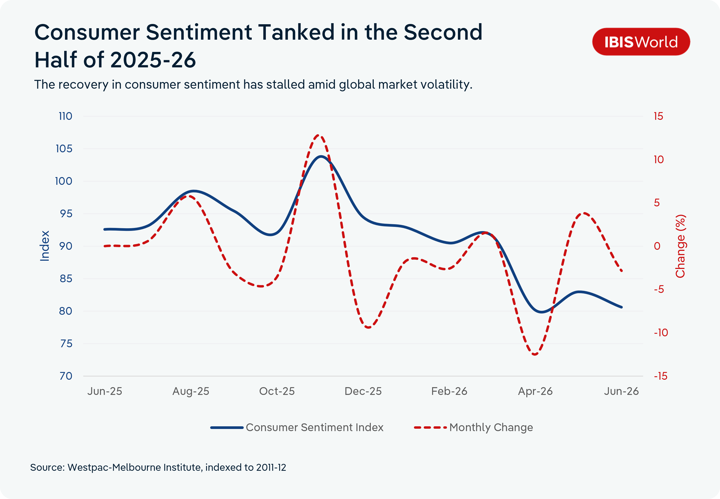
The broader consumer-facing sectors faced headwinds in 2025-26. Structurally high interest rates for most of the year constrained household budgets, and elevated fuel prices as the impacts of the Middle East conflict flowed through the economy further limited household discretionary spending in the latter part of the year.
Tanking consumer sentiment, resulting from inflationary pressures and fuel shortages in 2026, particularly limited spending on discretionary items. Major clothing retailers Cotton On Group (#34) and Lorna Jane (#463) reported revenue declines, putting downwards pressure on the overall performance of clothing retail companies, which grew by an average of 0.9%, a decline in real revenue, given that the Consumer Price Index rose at a faster rate.
 Companies in the Motor Vehicle Retailing industry fared relatively better, highlighting how declines in performance were largely limited to retailers of discretionary items. The Motor Vehicle Retailing industry also benefited from expansions in dealership networks through strong consolidation activity, like Alto Group’s (#104) acquisition of dealerships in Wollongong, which continued to drive higher throughput across existing dealership networks.
Public funding and consolidation activity continue to drive growth in the health sector
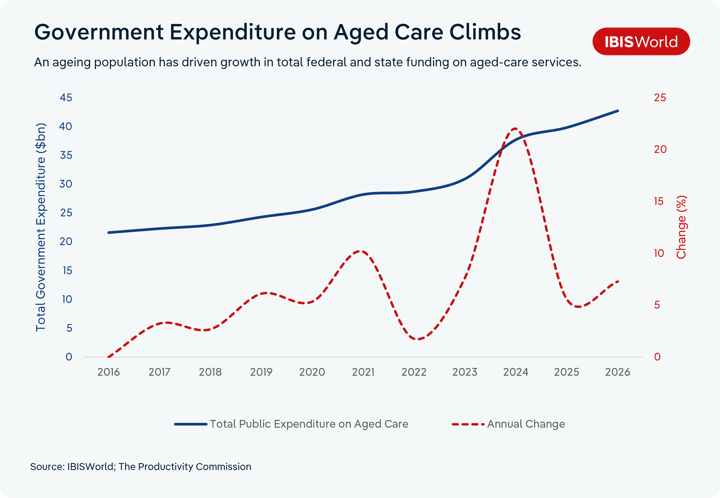
The health sector continued to expand, driven by robust government support. The Aged Care Residential Services industry experienced strong annual growth of 7.4% on average, well above inflation. Increasing consolidation activity among the major providers helped lift their revenue base, as seen in Opal HealthCare's acquisition of the Australian Aged Care Group. Similarly, Villa Maria Catholic Homes (#282) added more than 250 homes and expanded its retirement living facilities to over 860 residences by acquiring Point Cook Village in Melbourne, and Hall & Prior Aged Care Group (#233) completed two acquisitions, in New South Wales and Queensland, helping expand its geographical coverage.
Consolidation has helped aged-care operators remain financially viable amid growing pressures on profitability by allowing providers to spread costs. The Australian National Aged Care Classification (AN-ACC) base price, which underpins the subsidy paid to providers, rose 4.7% in October 2025, driving strong revenue performance across the aged-care service operators. Both the Private and Public General Hospital industries also exhibited growth, underpinned by continued demand and government spending. With the 2026-27 Budget announcing $3.7 billion to deliver additional aged care beds and $25.0 billion for public hospitals, health sector providers are on track to leverage continued public investment and accelerating demand from an ageing population to drive growth in the coming years.
 The Health Insurance industry also expanded, at an average of 6.0%, underpinned by a 28.6% revenue expansion for Teachers Health Fund (#63) following its merger with Queensland-based Teachers’ Union Health in July 2025. The merger made Teachers Health Fund the largest industry-specific private health insurer in the country.
Growing demand for higher-density housing propels apartment construction, as houses lag behind
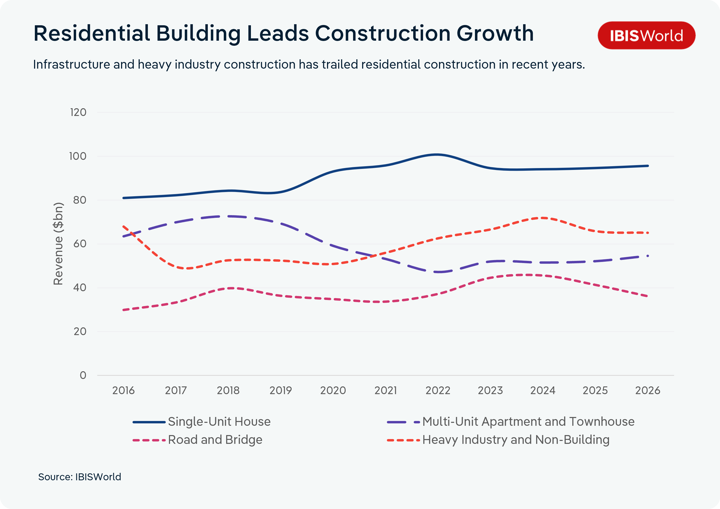
Despite a year marked by high interest rates, Australia’s construction sector fared relatively well. Companies in the Multi-Unit and Townhouse Construction industry achieved double-digit average growth of 10.1% in 2025-26, reflecting a long-term shift towards higher-density living as the population expands, as well as rising completion rates. A standout performer was Dasco Australia (#279), which recorded a 51.2% hike in revenue, supported by the delivery of major apartment works like Willoughby Grounds and ongoing projects like Jardin, Frenchs Forest.
Apartment approvals grew 13.2% in 2025-26, alongside a 10.5% surge in completions of private sector residential dwellings, which includes the broader multi-unit dwellings segment except houses, like apartments, townhouses and semi-detached dwellings.
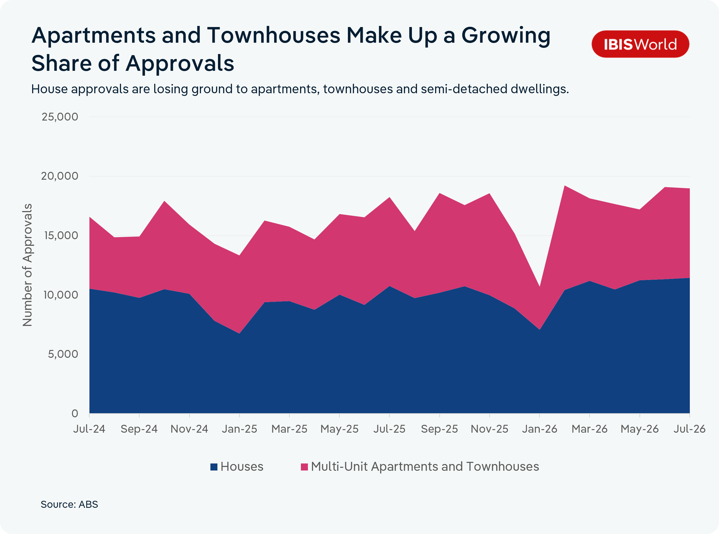 While companies in the Multi-Unit and Townhouse Construction industry successfully leveraged a robust demand pipeline, house construction companies faced more challenging conditions. House completions fell 6.1% over the year to March 2026, according to the ABS, and house construction companies on the list grew a modest 1.9% on average, translating to a real revenue decline under the current inflationary environment.
Similarly, most entries in the Heavy Industry and Other Non-Building Construction industry reported revenue declines. The Commercial and Industrial Building Construction industry’s performance also weakened, with strong acquisition and merger activity led by Ahrens and McNab Group (#78) supporting average growth of only 4.5%.
An inflationary environment, coupled with labour and materials shortages, constrained building activity, particularly among non-building construction companies. According to the ABS, the value of engineering construction work declined 5.1% in the June quarter 2026 year on year, indicating weaker underlying demand. Rising interest rates also weighed on private non-residential construction capital spending, limiting growth, with Westpac stating that the sector's weakening performance is being masked by mining-related heavy construction.
 Brokers and non-bank lenders gain ground with higher interest rates
While the RBA has kept the cash rate elevated at recent meetings, interest rates in 2025-26 can be characterised by a two-phase cycle, with easing in August 2025 followed by stability that persisted until February 2026.
The easing in interest rates at the beginning of the financial year spurred borrowers to refinance, particularly as house prices surged. The Mortgage Brokers industry grew 15.3% on average over the year, with Yellow Brick Road (#347) and Lendi Group (#245) both reporting double-digit growth. For instance, refinancing activity remained elevated in the December 2025 quarter. The number of internal investor refinancing commitments rose 26.8% year on year, while internal owner-occupier refinancing commitments increased 22.7%. The value of total refinanced loans reached a record $68.4 billion, up 16.9% from a year earlier. Strong refinancing and mortgage-market turnover supported demand for mortgage-broking services, contributing to revenue growth in the industry.
Non-depository financing also exhibited strong growth, with standout performer Athena Home Loans (#345) reporting a 12.0% revenue increase and jumping 91 places. Lenders capitalised on the high-interest environment in the latter part of the financial year, though high rates typically increase lenders’ funding costs, which can pressure their profit margins. Non-bank lenders are growing faster than their traditional counterparts in the National and Regional Commercial Banks industry, supported by the Australian Prudential Regulation Authority’s revised operating framework for major banks, introduced in 2023. This framework has essentially limited the pool of potential clients for major banks by tightening the conditions borrowers must meet to qualify for a loan. Non-depository lenders have capitalised on this change and witnessed sustained growth over the past three years, with the flexibility they offer supporting customer uptake, though borrowers typically face higher rates in exchange.
Major consultancies face reputational damage and subdued demand
Australia's consulting and accounting firms, while still dominated by the same major players, experienced stunted growth due to reputational damage and softer demand for consulting services. High-profile integrity and security controversies in 2025-26 weakened public confidence in the large firms, at the same time as government and corporate clients sought to reduce their dependence on major consulting providers.
KPMG (#33) and PwC (#37) recorded revenue declines, reflecting both these reputational pressures and a weaker consulting environment. KPMG’s consulting revenue fell 16.9% in 2025-26, despite continued strong double-digit growth in its audit and tax divisions. More broadly, subdued economic conditions limited spending on discretionary advisory and consulting work, while some organisations shifted such work in-house or adopted AI-enabled alternatives. As a result, accounting-services companies on the list averaged revenue growth of just 3.4%.
These conditions supported a partial rebalancing of the market towards mid-tier service providers. BDO Australia (#151) and Grant Thornton Australia (#236) reported revenue growth of 10.0% and 8.8%, respectively, as clients diversified their professional-services suppliers. This shift reflects both a search for alternatives and a broader effort by government agencies and other customers to reduce reliance on the largest firms, as evidenced by a decline in federal contracts awarded to the Big Four consultancies in 2025-26.
Final Word
Australia’s largest private companies have demonstrated resiliency, lifting annual combined revenue despite a volatile operating environment shaped by geopolitical conflict-related energy market disruptions, renewed inflationary pressures and high interest rates. Growth remained concentrated in the top companies, with the first 50 entries accounting for approximately half of the Top 500 revenue in 2025-26.
Industries that were exposed to favourable commodity prices, strong export markets and public investment were able to propel growth, with other large companies benefiting from the ability to pass on higher input prices. Mergers and acquisitions were an important contributor to expansion across sectors. This points to a private sector that is increasingly relying on scale and consolidated operations to manage higher costs and demand uncertainty.
Looking ahead, inflationary pressures are set to persist in the short term, with the RBA projecting that inflation won’t fall within the target band until 2027-28. While a relative easing of monetary policy may improve consumer sentiment, the private sector is likely to face continued challenging operating conditions in the coming year as the effects of the Middle East conflict ripple through the economy.