


Key Takeaways
- Small retailers are the Budget’s winners. Business rates relief will free up cash for convenience stores and newsagents, though it doesn't arrive until April 2027.
- Larger stores lose out. Supermarkets and department stores sit far above the new rates threshold, so rising wage and rates bills will still squeeze their thin returns.
- High streets remain under pressure. With costs rising, large chains are likely to close stores and cut staff.
Going into the Budget
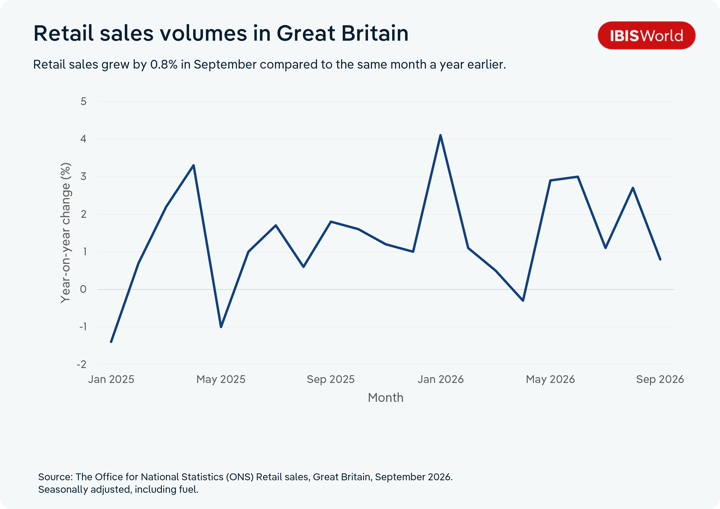
UK retailers entered the Autumn Budget on 28 October 2026 with modest sales growth and mounting costs. The Office for National Statistics (ONS) reported that retail sales volumes in September 2026 were 0.8% higher than in September 2025. Food prices weren’t the main source of pressure, with the ONS putting food inflation at 1.3% in September 2026. Costs were the larger concern.
The British Retail Consortium (BRC) said that retailers face £41 billion in business taxes in 2026-27. It also forecasts that retailers’ electricity bills will climb by £440 million in 2026, to £3.16 billion in 2026, driven by network and policy charges. The BRC estimates that more than 120,000 retail jobs have been lost since 2024 and that one in seven shops stood empty in October 2026.
What the Budget announced
Business rates, a tax on commercial property, were the main focus for retail. From April 2027, retail, hospitality and leisure properties in England with a rateable value of up to £18,000 will pay no business rates, up from a £12,000 limit. HM Treasury estimates that this change removes 70,000 more businesses from paying rates. Larger properties receive a real-terms freeze in 2027-28 and 2028-29, so their bills shouldn’t climb faster than inflation.
Labour costs will keep climbing. The National Living Wage rises by 3.9% to £13.21 an hour from April 2027, with no change to employer National Insurance. From October 2027, online marketplaces like Amazon and eBay must collect VAT on qualifying sales by UK sellers. The measure targets sellers that avoid VAT and undercut shops that charge it. Import tariffs are suspended on more than 100 products, including chocolate and baked beans, until December 2028.
What it means
The rate changes favour small retailers far more than large chains. Business rates are one of the largest fixed costs for convenience stores and newsagents. Removing that bill frees up cash at a time when profit is already thin. Independent retailers run 71% of the UK’s 50,925 convenience stores, according to the Association of Convenience Stores (ACS). The ACS also said that convenience stores’ total business rates costs had nearly doubled over the previous two years, so the relief will reach a large share of high-street shops when it’s needed most.
Supermarkets and department stores gain little, because their rateable values sit far above the new limit. The BRC calculates that the real-terms freeze still means a 3.5% rise in rates in April 2027, adding around £250 million to retailers’ bills. Higher wages add to this pressure. When the wage floor rises, employers usually lift pay for staff just above it to keep pay scales in place and employer National Insurance rises with that pay. Supermarkets feel this the most, as they employ 1.3 million people. They also earn just 3.3p of profit for every £1 of sales, which leaves little room to absorb higher costs.
Price competition from Aldi and Lidl limits how far the large supermarkets can pass costs on to shoppers. They’re likely to keep price rises small and accept lower profit. To limit the hit, they may install more self-checkouts and cut staff hours.
Reaction and outlook
The BRC welcomed the removal of 70,000 small businesses from business rates but criticised the Budget overall. Its chief executive, Helen Dickinson, said on 28 October 2026 that the Chancellor had “failed to provide the breathing space he promised”. She noted that around 500,000 medium and large stores provide most retail jobs and pay most of retail’s business rates. The BRC also said the tariff cuts will barely offset the higher costs supermarkets face.
With wages, energy and rates all set to rise into 2027, large chains are likely to continue closing stores and reducing staff numbers. Price rises are more likely in non-food goods, where competition from discounters is weaker. Although small shops will benefit from real relief, this won’t come until April 2027.
Final Word
The Autumn Budget has split the retail sector into winners and losers. Small retailers will gain from a meaningful cut to their business rates bills, while large chains are left with little relief and rising labour and property costs on top of already thin margins. For supermarkets and department stores, the squeeze is hard to avoid.
Independents’ relief is also delayed, with the changes not taking effect until April 2027. Until then, many small shops will continue to operate under high cost pressure.