
Key Takeaways
- Defence spending is on the up. The UK is committed to increasing defence spending along with NATO allies after years of reducing the defence budget.
- Budgeting for war proves challenging. Despite the publication of the long-awaited Defence Investment Plan, major financing decisions remain to be made and there’s no clear roadmap for investment after 2029-30.
- Industrial growth prospects prove lacklustre. Major capacity and supply chain constraints loom over the commitment to make defence an engine for growth.
A fairly peaceful environment post WWII has allowed most Western European countries to systematically reduce their military spending. However, the Russia-Ukraine conflict, China’s military modernisation and the US-Iran conflict at the centre of wider unrest in the Middle East have put defence spending back in the spotlight. Many of the world’s largest economies are in the midst of a massive reallocation of resources towards defence and the UK is no exception.
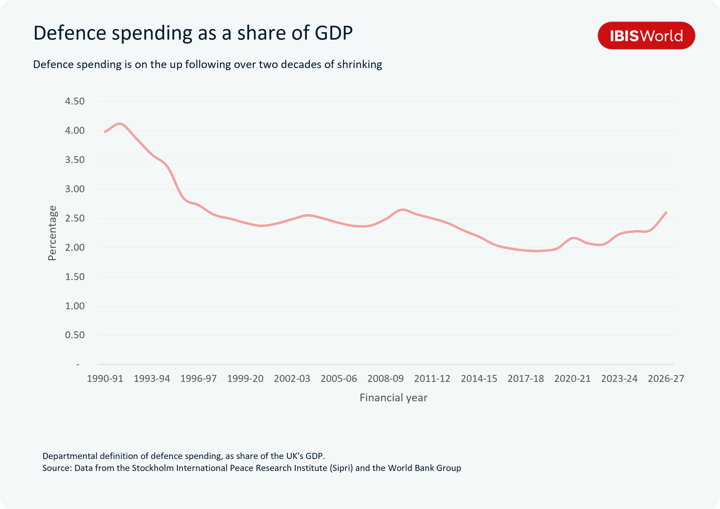
As a NATO member, the UK has committed to increase defence spending to 3.5% of GDP by 2035 from 2.6% in 2026-27. The UK’s Defence Investment Plan (DIP) outlines the roadmap to achieve this massive increase in spending and how it will power industrial development and create jobs across Britain.
However, scepticism is widespread. The UK’s previous commitment to reduce the fiscal deficit means defence spending will come from budget cuts elsewhere, potentially crippling social care programmes and major capital investment projects. Additionally, the country’s industrial production value has shrunk consistently since 1990, meaning the UK might not be fully prepared for a major ramp-up in heavy industry, leaving many to wonder if defence spending can really boost the UK industrial economy as the DIP promises.
Empty barracks? How we got here
With defence spending back in the spotlight, several narratives have emerged about the UK’s past fiscal policy and military funding. This includes the view that the UK has “hollowed out” its armed forces, as stated in 2023 by then Defence Secretary Ben Wallace, a phrase that has only grown in popularity when discussing the need to expand defence spending. This narrative (and phrasing) was echoed by then Defence Secretary John Healey during a speech in Westminster in November 2025, following the Ministry of Defence committing an additional £1.5 billion in investment to defence manufacturing in June of that year.
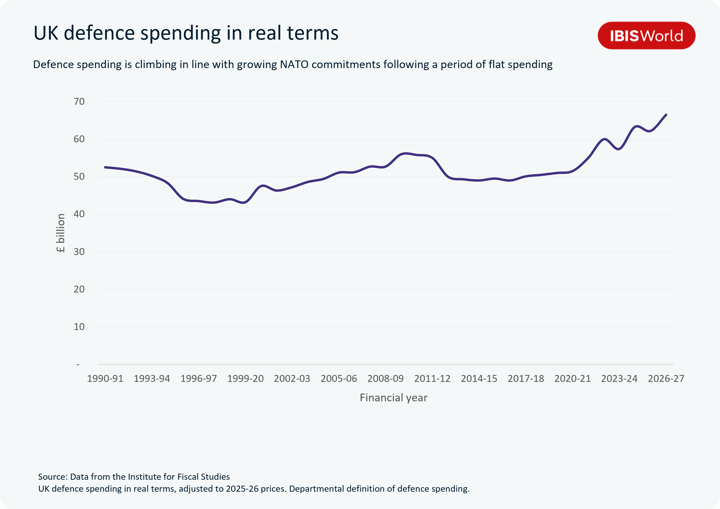
In reality, defence spending has grown modestly in real terms over the past four decades, but this growth has been offset by greater growth in the overall British economy, causing defence spending as a share of GDP to tumble. Military spending as a share of GDP declined consistently between the mid-1950s and 2000, then remained mostly flat, falling from nearly 10% in the 1950s to 2.3% in 2024-25. During this period, the UK has also remained one of NATO’s largest defence spenders, only behind the US and Germany. While it’s true that the UK isn’t battle-ready, this is simply the result of relatively peaceful times, which allowed the UK, like most other Western European countries, to focus public funds on other areas.
While military personnel numbers have dwindled, it’s mostly because the UK has been trading personnel numbers for equipment sophistication for the past 35 years. For example, the Challenger 3, live tested in 2024 and scheduled to reach initial operating capacity in 2027, is set to be the most lethal tank ever fielded by the British Army. However, the number of Challenger 3 tanks commissioned, 148 units through 2030, falls short of the estimated minimum for the UK’s armoured division of 170 to 300 tanks. This shift isn’t unique, but the result of several decades of cooperation, mainly through NATO and close US-UK relations.
In this cooperative context, it made sense for the UK to rely on its allies for some defence capabilities, while specialising in others. For example, the British carrier strike group represents a sovereign defence capability with a full range of aircraft and vessels deployed. However, the rest of the Royal Navy, while featuring several modern vessels with significant power, lacks the necessary aircraft or submarines to protect its vessels.
Budgeting for battle
Putting the past aside, the reality Britain faces today is that of an increasingly unstable geopolitical landscape for which the country isn’t prepared to stand on its own. In June 2025, the UN Secretary-General, Antonio Guterres, stated that the world is facing the highest number of armed conflicts since the end of WWII. This was highlighted in the UN’s July 2026 plenary meeting report, which stated that the world faced more than 120 conflicts in 2025. On top of the growing number of conflicts, international relations are increasingly volatile and conflicts are more multifaceted. War takes not only the form of traditional open armed conflict but also of urban warfare and cyberattacks. As a direct result of this landscape, the UK has committed to increasing defence spending to 3.5% of GDP by 2035, with an interim goal of at least 2.7% of GDP from 2027-28 onwards.
On 30 June 2026, the British government published the long-awaited DIP outlining the major investment choices the government has made over the country’s defence. The main tagline of the DIP is to back British jobs and business as the country moves to warfighting readiness. To achieve this, the DIP sets out investments in defence totalling £298 billion over the next four years. Some of the flagship projects included in this investment are £11 billion to build at least six new munitions and weapons factories, £64 billion to build new submarines, £5 billion to develop drones and autonomous systems and £1.6 billion in defence innovation.
The benefits extend beyond the battlefield. The government aims to create nearly 60,000 new jobs by 2029-30 (compared to 2023-24) through higher defence spending and the prioritisation of domestic suppliers. The DIP also outlines five core criteria agreed with HM Treasury to ensure that each investment choice supports domestic growth. The criteria include investing in research and development (R&D) and frontier industries, prioritising skill development in the country and market competitiveness and strengthening regional growth beyond London.
The investment plan won’t come cheap. The DIP has also confirmed the baseline plan for how the government will fund the increase in defence spending, which includes a 1% reduction across most departments’ capital budgets, plus additional cuts to the Department for Transport (DfT) and the Department for Energy Security and Net Zero (DESNZ) and select asset sales from 2027-28. This is set to add up to £15 billion in extra funding for defence through 2029-30. However, it also means that other departments will have to foot the bill by reducing their long-term investment plans. For example, the DfT is consulting on major reductions to the third Road Investment Strategy (RIS3), including the potential cancellation of the A38 Derby Junctions and A46 Newark Bypass schemes, worth about £700 million.
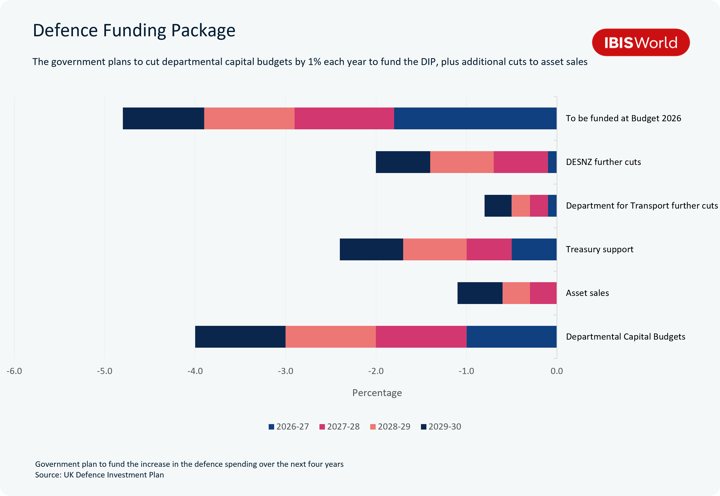
From a fiscal perspective, there are two main concerns about the proposed investment plan's funding. There’s a general concern about the UK’s ability to meet the committed 3.5% of GDP spending target by 2035, without significantly pushing up the fiscal deficit. Notably, the government hasn’t set out how it will fund approximately a third of the required increase in defence spending, which averages £1.2 billion per year. The decision is set to be made as part of the 2026 Autumn Budget, meaning that major spending, tax and borrowing decisions remain to be made.
Many, including former Defence Secretary John Healey (who resigned over the DIP falling short of what he considers necessary) and economists from the Institute for Fiscal Studies, are left wondering exactly how the government is going to fill this gap. This is particularly concerning, given that the DIP only outlines the plan through 2029-30, with spending set to reach 2.7% of GDP in 2027-28. From there to 3.5% in 2035, which is a big leap, there’s no government plan so far.
Since borrowing for a permanent increase in defence is unlikely, the most likely avenues to get to the 3.5% target are to increase taxes or to continue cutting spending elsewhere, both of which can pose significant challenges. For example, expanding taxes is an unpopular political move and, economically, higher taxes tend to shrink spending and aggregate demand, which makes it odds with the goal of boosting the economy through defence spending.
From a wider perspective, there’s the issue of the defence multiplier. In economic and fiscal studies, it’s often observed that public spending across different categories has a multiplier effect on economic growth. This means that government spending results in a greater impact on the country’s total demand and production than the amount spent. Given that the DIP frames defence spending as an engine of growth, it is important to examine how the defence multiplier compares with other forms of spending. Studies suggest that military R&D can generate up to twice its value in additional GDP over time, while spending in health, science and education tends to yield higher returns. This could call into question the effectiveness of defence spending as a growth engine.
Building defences: Challenges to boosting the British manufacturing industry
Beyond the fiscal challenges, the key question is whether defence spending can really boost the British economy. As outlined by the DIP’s core objectives, there’s a strong focus on reshoring defence manufacturing, developing domestic and regional supply chains and developing skilled workers. Additionally, the ambition is for the UK to develop cutting-edge military technologies and to become an exporter. These are hefty ambitions given the current state of the British industry.
The first and one of the main challenges to overcome is the current structure of the British manufacturing industry, which has seen its capacity and output decline steadily over the past few decades. Compared with other advanced economies, the UK has one of the lowest value added from the overall manufacturing sector, accounting for just 8% of GDP in 2025, down from 17% in 1990. In contrast, Switzerland’s manufacturing sector accounted for 19% of GDP in 2025, followed by Germany (18%) and Italy (15%).
Manufacturing value-added multipliers are also lower in the UK than in comparable countries like Germany and France. In other words, compared with other advanced economies, the UK manufacturing sector sources less, as a proportion of its value added, from other domestic industries. This ties back to another major issue in boosting the economy through defence manufacturing: a major lack of complete and efficient domestic supply chains. This is the result of several factors, including globalisation, offshoring and the rise of global supply chains since the 1980s. But regardless of the cause, it means that the UK is highly reliant on imported manufacturing feedstocks.
Defence manufacturing, in both its simplest and most advanced forms, requires large amounts of industrial inputs, like metals, plastics, chemicals, composites and engineered materials. The structural decline of these industries in the UK means that domestic supplies are often less price-competitive than foreign options.
Even when there’s an economically viable option in the UK, major infrastructure and even past defence projects have failed to use British suppliers. According to UK Steel’s analysis of the Ministry of Defence (MoD)’s steel procurement statistics, almost £10 million of steel products could have been purchased from UK suppliers but were bought abroad in 2023. This suggests that even growing defence spending might not fully translate into a significant value-added manufacturing multiplier, unless procurement is focused on supporting the whole manufacturing value chain.
Even before the DIP, there were positive signs that the government was moving towards reshoring its strategic supply chains. The 2025 Strategic Defence Review and Defence Industrial Strategy position steel as an industrial security priority, recognising that over-reliance on imported materials could undermine future force readiness. The DIP also explicitly states the intention to “reform defence procurement” as a part of their Backing British goal, although there’s no more detail beyond that.
However, even with the political will to reshore procurement, the issue remains that the manufacturing sector may have become too fragmented and small to support the defence manufacturing ramp-up. British production capacity is severely limited since Tata Steel closed its operations in Wales in 2024 to switch to electric arc furnaces, leaving only one blast furnace operating in the UK in 2026. Tata Steel's current restructuring is set to slash around a quarter of the UK’s steel production over the four years through 2028-29, when production is set to restart.
While steel production is set to ramp up in the medium term, other key supplies needed for defence manufacturing remain more uncertain. For example, the UK has had no domestic ammonia production since CF Fertilisers closed its last site in Billingham in 2023. Ammonia is the essential building block for manufacturing military-grade explosives, gunpowder and high-strength polymers like Kevlar. Ammonia is made using natural gas, so prices have soared with the supply shocks caused by the Russia-Ukraine conflict and the closure of the Strait of Hormuz, jumping by 79.9% in the year to July 2026. Global demand for ammonia has also soared as a result of mounting demand for fertiliser, which is also made with ammonia. This leaves the UK as a price taker and completely reliant on volatile supply chains for a key defence input. With the DIP outlining a plan to build six new munitions and weapons factories, securing a reliable supply of ammonia will be essential.
Moving towards warfighting readiness
Solutions are available but will require novel thinking and prioritisation. First, on clear and trustworthy fiscal commitments. Industry bodies have criticised the DIP for outlining investment only through 2029-30, which is insufficient to provide investors with security. Second, a clear prioritisation of how to bolster defence capabilities with a fairly tight budget and ensuring that the investment has a positive, multiplying effect on British industry.
On the fiscal side, the UK can look at the EU for inspiration. The European Commission has relaxed its fiscal rules through 2028 to allow member states to balance out their budgets in line with higher defence spending. While sustained borrowing isn’t really an option to fund the defence spending ramp-up, in the short term, it can help the UK increase its planning flexibility and invest early in crucial infrastructure and major capital projects that will pay off sooner if the government commits to investing promptly.
Research by the RUSI highlights that technology should be at the centre of the defence drive. Not only because of the recent lessons on how drones and uncrewed systems can be effective complements to artillery and significantly improve defence capabilities at much lower cost than a single tank or jet. As a plus, R&D activities have a strong synergetic potential, which could support a more connected industrial landscape. The DIP is already on the right track here, committing £1.6 billion through 2029-30 to accelerate the development and adoption of advanced technologies across defence. This includes embedding AI and quantum technologies across the Armed Forces and major projects like ASGARD, Taskforce RAID and Frontier, which also have independent funding.
Focusing on building a resilient and sovereign defence industry through collaboration and support for domestic manufacturers will also be key to truly making defence an engine for growth. The UK has already made significant strides in this direction, re-establishing domestic manufacturing of heavy gun barrels with a new factory in Telford using UK steel from Sheffield Forgemasters, which was acquired by the MoD in 2021 and has performed significantly better than other steel companies, owing mostly to its defence product manufacturing. This is a great example of a short, secure domestic production supply chain that can be replicated across the country.
On their side, British manufacturers can collaborate through industry associations to secure government contracts and to lobby for the use of British suppliers in strategic defence applications. Steel manufacturers have been doing this, particularly lobbying for more access to defence contracts. Other manufacturing industries that are more fragmented would benefit greatly from collaboration; for example, industrial and technical textiles are essential for uniforms and safety equipment, yet the industry is made up of SMEs that might struggle to negotiate on their own. Therefore, a regional cluster approach might be ideal for supporting a more dynamic manufacturing and R&D ecosystem.
France has proven that SMEs, universities, research institutions and manufacturing giants can come together and have a real impact through the country’s 55 “competitive clusters”, including major R&D and manufacturing operations like the Aerospace Valley. The UK already has many poles with strong industrial tradition and capability, like Birmingham, Sheffield, Sunderland and Bristol. By focusing on regional clusters, the UK can also ensure that growth goes beyond London and is distributed across the country.
Final Word
Defence spending, both how much to spend and where, is set to remain one of the biggest pressures facing the UK in the medium term. This is compounded by political uncertainty following Prime Minister Kier Starmer’s resignation in June 2026, with the takeover by Andy Burnham marking the fifth prime minister in the past five years. As things stand, many questions remain to be answered, particularly at the 2026 Autumn budget, which will define the future defence spending and investment plan and will decide the other departments that will foot the bill.
If the UK is to reach 3.5% of GDP spent on defence in 2035, this will require finding an additional £25 billion per year compared with the newly announced plans. Given the clear difficulties of finding less than a sixth of this per year as part of the DIP process, this will be a key challenge for the government going forward.
Research suggests that the commitment to a single, urgent goal can significantly drive innovation and production. For example, when the COVID-19 pandemic spurred a pharmaceutical boom, it resulted in the creation of a new vaccine in record time. Likewise, the UK’s commitment to becoming warfighting-ready could significantly boost the British economy. However, this won't be an automatic result; the government and domestic manufacturers will have to collaborate to create a truly resilient and, as much as possible, sovereign defence manufacturing industry.