

Key Takeaways
- UK pubs and sports bars are forecast to pour 55 million extra pints during the 2026 World Cup, the strongest summer trading seen in two years.
- The boost lands on a hospitality sector that’s carrying a £3.4 billion hangover from the Autumn Budget 2024, with pubs closing at a rate of nearly two a day so far in 2026.
- Pubs and bars win the matchday boom, while supermarkets and takeaways feed the stay-at-home crowd.
As Mexico kicked off against South Africa at the Estadio Azteca to open the 2026 World Cup, pubs across the UK braced for the busiest 39 days of their year, with 104 matches scheduled across the tournament. Greene King chief executive Nick Mackenzie told the Financial Times that the company is already seeing an "influx of early bookings" across its 2,600-plus pubs. The British Beer and Pub Association (BBPA) expects drinkers to pull an extra 55 million pints if England reaches the final. A win could push that higher, though a defeat rarely dampens the bar takings by much.
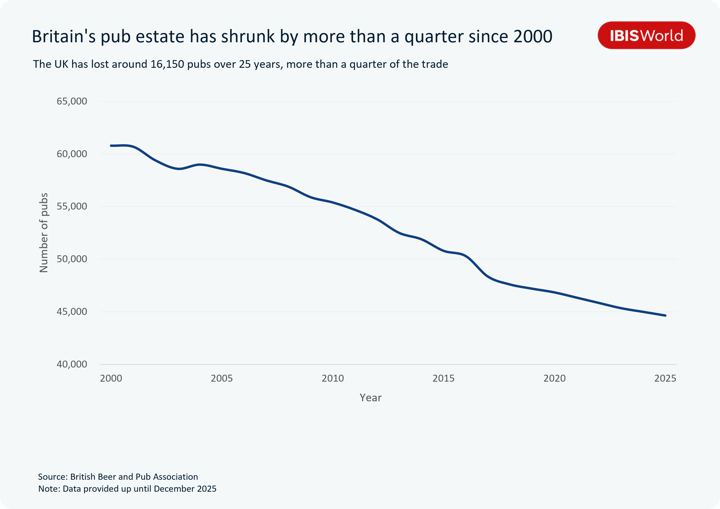
Late North American kick-offs squeeze the prime trading window. England's group fixtures land between 9pm and 10pm UK time, with a number of knockout games running into the early hours of the morning. The pub estate carrying that lift is also smaller and facing higher costs than the one that watched Euro 2024. The BBPA's pub count fell from 45,000 in 2024 to 44,650 in 2025, with another 161 closures following in Q1 2026. Higher employer National Insurance contributions, a steeper minimum wage and reduced business rates relief from the Autumn 2024 Budget have layered a £3.4 billion annual cost burden on the sector. A business rates revaluation from the 2025 Budget pushed those bills higher still from April 2026, though a government relief package announced in January 2026 cut new business rates bills for pubs by 15% in 2026-27 and froze them in real terms for a further two years, meaning three-quarters of pubs saw their bills fall or remain the same.
The World Cup provides a temporary boost to the economy, but the late North American kick-off times decide who shares in it. Pubs win the games at sociable hours while the post-midnight fixtures keep fans at home, where supermarkets and takeaways pick up the spend instead. Despite the wins, the deeper fractures in UK hospitality will outlast the trophy lift.
Where UK Hospitality Stands Going into the Tournament
UKHospitality data shows that £3.4 billion in fresh annual costs hit the hospitality sector from April 2025, adding around £2,500 to the cost of employing each full-time staff member. The bulk came from higher wages, employer National Insurance contributions and the cut in business rates relief from 75% to 40%. Those rises bite all the harder because pubs’ profit margins were thin to begin with – after tax and overheads, a pub keeps just 2.4% profit on each pint it pulls.
A second wave of cost increases from the Autumn 2025 Budget landed in April 2026. A UKHospitality survey in February 2026, covering businesses that operate more than 20,000 sites, showed how they planned to respond to the changes in April. Of those surveyed, 64% expected to cut jobs and 51% to cancel investment. A further 42% planned to reduce trading hours just as the World Cup offers a reason to extend them, while 15% feared forced closure.
Data from the Office for National Statistics (ONS) shows accommodation and food services lost around 124,000 payrolled employees in the year to May 2025, the largest fall of any sector. The ONS also reports that at £12.39 an hour, hospitality was the lowest-paying major sector in the UK over that period. The minimum wage swelled to £12.71 in April 2026, overtaking that average and adding extra weight to the wage bill, with UKHospitality estimating that wage hikes represent £1.4 billion in additional costs for hospitality businesses. The loss of workers shows that the strain is having a real effect.
Property costs are mounting too, with the Financial Times reporting that a typical small pub will face a 65% increase in its business rates bill over the three years through 2028-29 as the pandemic-era rates relief is withdrawn and a 2026 revaluation raises the rateable values that bills are based on. However, a government relief package announced in January 2026 cuts bills by 15% in 2026-27 and freezes them in real terms for a further two years, with the BBPA estimating that three-quarters of pubs will see their bills fall or remain flat as a result, though the longer-term trajectory remains upward. David Roberts, a hospitality specialist at international law firm CMS, told the Financial Times in April 2026 that "it's starting to feel like a permacrisis," with each new cost landing before the last has been absorbed and no clear end in sight. Wetherspoons founder Tim Martin, quoted in the same piece, called the hospitality sector "possibly more vulnerable than it's ever been."
PwC's Spring 2026 Consumer Sentiment Survey showed net spending intention for "eating out" at -32% in April 2026 and for "going out" at -30% over the next 12 months, a cautious backdrop heading into the tournament. Drinks are under pressure too, as Drinkaware’s 2025 Monitor shows that 45% of UK drinkers now reach for low- or no-alcohol options, double the 22% recorded in 2021, chipping away at the beer sales the tournament boost leans on.
What the World Cup Could Deliver
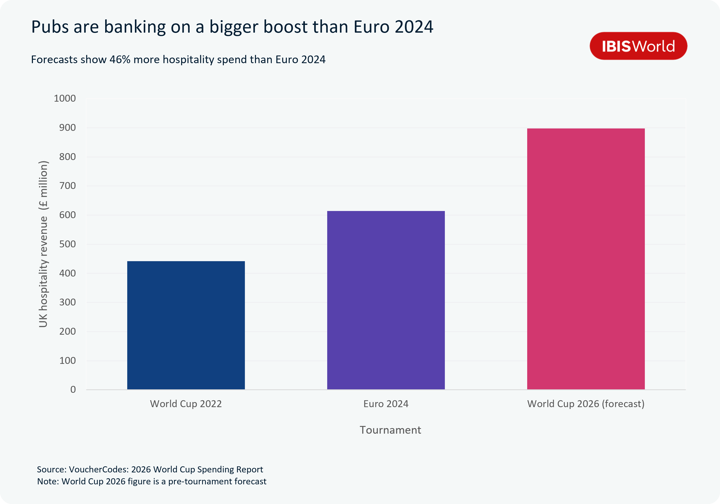
Pubs are the natural home of tournament football. Groups stay longer, buy more rounds and share a screen together, which is good for the atmosphere and better still for the bar. UKHospitality data shows hospitality sales across Great Britain rose an average of 21% on England's Euro 2024 matchdays compared with the previous year, with drinks sales up at least 40% during every England fixture. Barclays merchant data showed UK pub, bar and club spending almost tripled on the day of the England-Spain final, with card transactions up 195.6% year-on-year.
Forward indicators for 2026 show optimism. Young's, which runs around 280 pubs across London and the South East, reports advance bookings 35% ahead of the equivalent point before Euro 2024. A survey by booking platform Zonal puts the number of Britons planning to watch at least one match in a pub or bar at 9.3 million.
While Euro 2024 ran for 31 days with European evening kick-offs that mapped neatly onto UK on-trade peak hours, the 2026 World Cup runs for 39 days with most fixtures landing between 5pm and 5am UK time. The extra days bring more fixtures to trade on, but the spread of kick-off times means pubs are unlikely to see a consistent uplift across the full tournament, with the benefit concentrated on fixtures that fall within conventional trading hours.
Tournaments have rewarded UK pubs before, but only when the kick-off times obliged. The Financial Times reported that the last World Cup staged during the UK summer, in 2018, lifted UK beer volumes by 3% for the year as England reached the semi-finals and the weather held. The 2023 Rugby World Cup in France also shows the boost pubs can get, with The Morning Advertiser stating that UK-friendly kick-offs delivered an average 15% pub-sales uplift across the knockout stage. In contrast, the 2019 Rugby World Cup in Japan struggled despite England reaching the final, because morning UK kick-offs sat outside conventional pub trading hours.
How far England and Scotland go decides the size of the hospitality boost, with each knockout round worth more than the last. The 2026 tournament uses a 48-team format with 12 groups of four, then a five-round knockout running from 28 June to the New Jersey final on 19 July. England sit in Group L with Croatia, Ghana and Panama; all three group fixtures kick off in the 9-10pm UK window between 17 and 27 June.
Scotland’s fixtures aren’t quite as favourable; they kicked off their tournament against Haiti at 2am on 14 June, with the two remaining group games against Morocco and Brazil both at 11pm UK time. However, Scotland had a one-off bank holiday on 15 June to mark its first men’s World Cup since 1998, with fans given the Monday off to recover from the early morning kick-off, turning a normally quiet trading day into a busy one for pubs. The later slots still leave room to trade, with UKHospitality Scotland recording a 38% year-on-year rise in sales on Scotland's Euro 2024 matchdays and expecting similar demand this summer. Most Scottish councils have extended licensing hours to cover the late starts, so pubs can make the most of what the schedule offers.
England's pathway through the knockout stage looks manageable if they top Group L, though a second-place finish could bring an early clash with Spain, the tournament favourites and the side that beat them in the Euro 2024 final. A defeat there would end the run early and take the beer boost with it.
VoucherCodes’ forecasts show that UK hospitality venues could take home £898 million over the tournament, driven by the expanded 48-team format and 39-day schedule, with a deeper England finish pushing the total higher. The Home Office's Licensing Act 2003 (FIFA World Cup Licensing Hours) Order 2026 extends pub closing in England and Wales to 1am for England or Scotland knockout matches and to 2am for those kicking off at 10pm UK time. Group-stage extensions in England and Wales still require individual Temporary Event Notices. The order was issued over the objections of the head of UK football policing, who warned the Times that a blanket extension risked saturating town centres.
Industries Affected
Pubs and Bars in the UK
Pubs and bars are the clear winners and the matchday numbers show why. The Morning Advertiser shows UK pub sales can climb 550% in the build-up to kick-off and peak at 960%, with some matchday evenings reaching 1,000% compared to a standard trading day. It also puts world lager sales up 150% in UK pubs during Euro 2024. The BBPA forecasts an extra 55 million pints if England reach the final, worth around £275 million in incremental beer sales, and potentially more if they manage to bring it home. The evening kick-offs favour groups with a strong food offering, like Mitchells & Butlers, which the Financial Times expects to benefit more than drinks-only pubs as fans settle in to grab a bite to eat alongside their pints.
Pubs are finding new ways to extend dwell time and draw in customers, from outdoor fan zones with large screens and live music to matchday promotions, goal-triggered drink deals and corporate hospitality packages. Low- and no-alcohol options are increasingly part of the offer too, with venues advised to treat alcohol-free orders with the same care as full-strength drinks to cater for the growing share of fans choosing to moderate.
For all the opportunity on offer, though, staffing remains pubs’ biggest vulnerability, with 64% of venues planning to cut jobs ahead of the tournament, raising concerns about whether enough staff will be behind the bar when it matters most.
Supermarkets in the UK
Not everyone heads to the pub, which is where supermarkets come in. The on-trade and off-trade have long competed for the same spend and with many fixtures starting after midnight UK time, more fans will watch from home with shop-bought beer and food than in past summer competitions, when UK-friendly kick-offs drove them to the pub. The cost gap reinforces this shift, with a pub pint costing more than its supermarket equivalent, a difference that matters most for the lower-profile group-stage matches, where the draw of a night out is weakest.
Changing drinking habits also come into the fold, with YouGov research showing that 38% of UK drinkers chose low- and no-alcohol options semi-regularly in 2024, up from 29% in 2022 and led by the under-35s as younger people increasingly moderate their drinking. VoucherCodes projects £2.9 billion in UK retail spend across the 39-day tournament, with £1.95 billion of it going on groceries. Convenience Store magazine reported that 56% of engaged shoppers plan to watch from their own living room, with later kick-off times cited as a contributing factor.
Takeaway & Fast-Food Restaurants in the UK
The late kick-offs that empty the pub also fill the delivery apps. With much of the tournament watched from the sofa, takeaway and fast-food restaurants, a £24 billion industry in the UK, pick up the orders. Just Eat recorded a 40% jump in breakfast orders after both the Euro 2020 and Euro 2024 finals. It expects the tournament's small-hours kick-offs to do the same as fans watching through the night reach for delivery the next morning.
The bigger chains are preparing for the home audience with matchday promotions and app deals. Domino's took a record 18.5 million orders in the final quarter of 2022, its highest ever quarterly total, helped by the last men's World Cup, growth in app ordering and value deals aimed at cost-conscious customers.
Final Word
The World Cup will deliver a boost, but it won’t reset the trajectory of UK hospitality. The headline forecasts show £898 million in hospitality spend and 55 million extra pints in prospect. Those gains, though, are unevenly shared. Pubs, supermarkets and takeaways take most of the upside, while other industries see little.
How big the economic uplift turns out to be rests largely on England and Scotland’s success. Crash out in the group stage and miss most of the extra spend; reach the final and the forecasts climb towards the top. For a tournament worth hundreds of millions to the UK, the difference comes down to a few knockout games.
A few good weeks can’t offset the staffing and energy bills the hospitality sector carries all year. The pub estate that the tournament lands on is already more than a quarter smaller than the one that watched Beckham's free-kick goal against Greece in 2001. No run to the final will reverse a decline that deep. What the tournament can do, however, is offer the industry a breather before it’s back to the uphill battle against rising costs.