
Key Takeaways
- The UK economy has been more resilient than many expected. GDP forecasts for 2026 have been upgraded, but the 2027 outlook could mean the worst is yet to come.
- The UK government is still expected to meet its fiscal targets. This alleviates uncertainty for businesses, but rising inflation and gilt yields have eroded some of the government's buffer.
- Households will receive some relief on energy bills, at the expense of banks. The bank tax surcharge will temporarily rise to 6% to fund a one-off £100 payment to 20 million households.
On 28 October 2026, the UK Chancellor of the Exchequer, John Healey, delivered the 2026 Autumn Budget. It outlined the government’s plans for taxes and spending, with a major focus on the cost of living and the cost of doing business, while adhering to its self-imposed fiscal rules.
The budget has been delivered amid a delicate economic backdrop. The ongoing conflict in the Middle East, which began in February 2026, has increased fuel prices and driven up inflation, with many now expecting the Bank of England to raise interest rates in November as a result.
Despite these challenges, the UK economy has performed more robustly than many expected. According to the ONS, in August 2026, UK GDP was estimated to be 2.1% higher than in August 2025, with real GDP growing 1.8% in the three months to August 2026 compared to the same period a year ago. Tech spending has been a major driver behind this, with the ONS reporting that computer programming, consultancy and related activities were the industry with the largest positive contribution to GDP growth in the three months to August 2026.
The IMF has also raised its forecast for UK GDP growth in light of this resilience, stating in October that the UK economy would grow by 1.3% in 2026, up from 1% in July. The IMF has been vocal in its praise for the UK’s approach to reducing government borrowing, which offers some basis for optimism about the economic outlook, but protecting that credibility leaves the government’s spending decisions tightly boxed in.
The economic backdrop behind the Budget
The Office for Budget Responsibility (OBR) followed the Chancellor’s announcement with the latest economic and fiscal forecast for the five years to 2031-32, providing critical insight into how these changes are expected to affect the performance of UK industries.
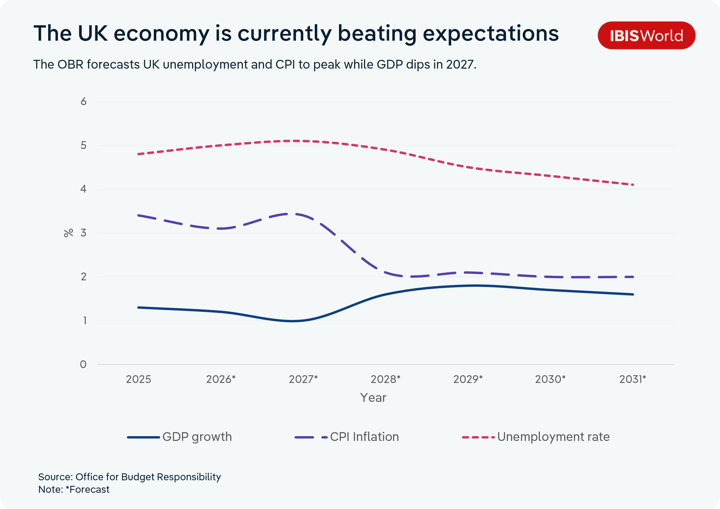
The independent spending watchdog forecasts GDP to grow by around 1.2% in 2026, slightly above its March estimate, due to the resilience the UK economy has so far demonstrated. However, it expects this figure to drop to 1% in 2027, around a 0.6 percentage-point downgrade, as the impact of higher global energy prices and interest rates filters through. For UK business and consumers, this means that the worst could be yet to come.
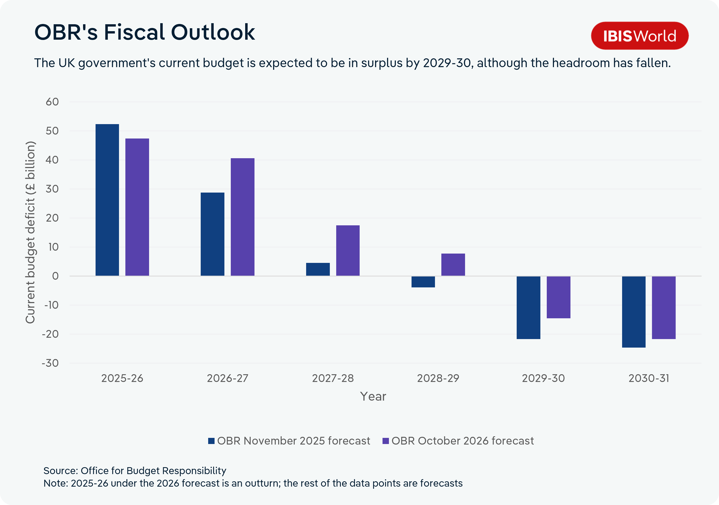
Importantly, the OBR expects the government to meet its self-imposed fiscal rules, with the current budget to be in surplus in 2029-30 by a margin of £15 billion, and public-sector net financial liabilities to fall as a share of GDP in 2029-30 by a margin of £24 billion. However, the fiscal headroom for the current budget to be in surplus has been downgraded as gilt yields and inflation rise (inflation jumped to 3.5% in September, up from 3.1% in August), driving up borrowing costs.
Taxes
- From January 2027, the surcharge that banks pay on their profits will rise from 3% to 6% for 15 months. This is to fund a one-off payment to households to help with energy bills.
- Tax rates on income from property and savings will be lifted by two percentage points from April 2027, on top of a two-percentage-point rise announced last year.
- The threshold at which retail, hospitality and leisure businesses begin to pay business rates in England will be lifted from £12,000 to £18,000. However, adult game centres and vape shops are excluded from this.
- The tax rate on higher-stakes gambling machines will rise from 20% to 25%.
- Import taxes will be removed on over 100 food products, as well as kerosene and fertilisers, to help bring the cost of food shopping down.
- Fuel duty will once again be frozen, extended until July 2027. The 5p temporary cut has been in place since 2022, but it was scheduled to be phased out from January 2027.
- Online marketplaces, like Amazon and Temu, will face heightened requirements to ensure sellers are not using their platforms to avoid paying VAT.
Industries most affected
- Banks in the UK
- Cafes & Coffee Shops in the UK
- E-Commerce & Online Auctions in the UK
- Gambling & Betting in the UK
- Petrol Stations in the UK
- Pubs & Bars in the UK
- Supermarkets in the UK
- Takeaways & Fast-Food Restaurants in the UK
Energy
- To help with rising energy bills, 20 million households in England in council tax bands A-D will receive a one-off £100 payment. Funding is also being provided to provide this in Scotland, Wales and Northern Ireland. This is funded by a tax increase on banks.
- The standing charges on household gas bills will be removed in England, Scotland and Wales. The cost will be added to the unit rate instead, so how much you pay will be based on usage. The treasury estimates that 60% of households will save an average of £45 annually.
- In April 2027, a new scheme to remove up to 25% off electricity bills for 10,000 businesses will launch, with payments backdated to cover energy costs this year. Eligible industries include energy-intensive manufacturing frontier industries, such as motor vehicle manufacturing.
- The VAT cut on electricity bills has been extended to July 2027.
Industries most affected
Other key announcements
- The legal minimum wage and the new, flat-rate state pension will both rise by 3.9% from April 2027.
- The £15 billion Defence Investment Plan will be fully funded by reprioritising government budgets. Details of how the government will meet a NATO commitment to spend 3.5% of GDP on defence by 2035 will be set out at the Spending Review next year.
- Plans to lower the tax-free cash Isa limit to £12,000 for under 65s have been scrapped. The limit will remain at £20,000.
- Pensioners whose income is equivalent to the full new State Pension will be given a new tax-free allowance.
- Investments into projects relating to AI worth more than £600 million were announced, including an extra £120 million for the UK’s AI Security Institute and £100 million for a national AI Biosecurity Lab.
- Devolved areas are to get more power, with all business rates to be retained locally by the end of 2030 and a share of income tax receipts to go to mayors from 2028.
- The Chancellor announced the launch of the Your First Home equity loan scheme, offering a government-backed equity loan worth 20% of the property’s value to first-time home buyers purchasing a new-build home with a deposit of at least 2.5%. The scheme is backed by £4.7 billion of funding.
- The Social and Affordable Homes Programme will receive an additional £1.5 billion of funding, bringing total investment in the programme to more than £40 billion.
Industries most affected
Final Word
Overall, the Chancellor has largely avoided any new, widespread changes to taxes or spending, instead opting for several smaller, targeted measures. That said, gains for the winners are at the direct expense of the losers. For example, the one-off energy payment to households is being funded through a tax increase on banks. On the whole, businesses are likely to be pleased that the government is sticking to its fiscal rules, and the UK’s resilience is allowing it to beat growth expectations. The question is how long that can last, as the outlook for 2027 is clouded by ongoing geopolitical uncertainty.