


Key Takeaways
- Energy support is targeted. A one-off payment for households in lower council tax bands and the removal of gas standing charges offer relief, but expected price rises in 2027 could quickly erode the benefit.
- Manufacturers face uneven support. The British Industrial Competitiveness Scheme will deliver savings for qualifying energy-intensive businesses but most manufacturers miss out, leaving many exposed to further price shocks.
- Energy relief is temporary. Most measures expire in July 2027. With gas prices expected to climb and the Strait of Hormuz still disrupted, this means the Budget only offers temporary breathing room.
Going into the Budget
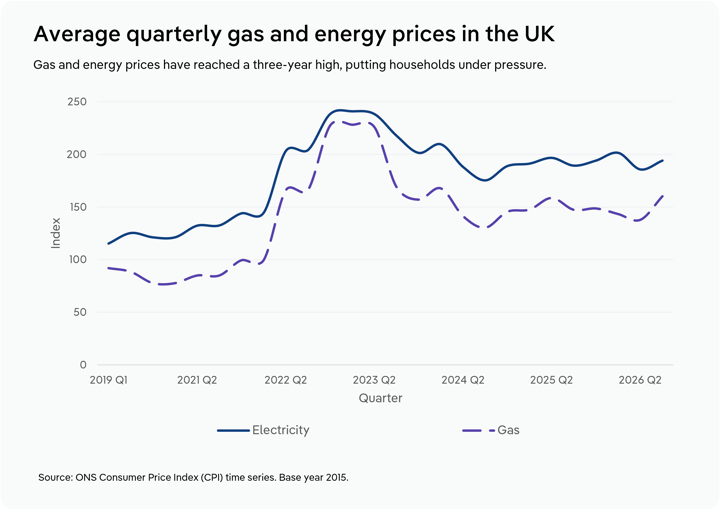
British households and manufacturers have grappled with high energy prices in recent years. Energy prices rose sharply from mid-2021 and peaked during the energy crisis caused by the Russia-Ukraine conflict in 2022. This was followed by lower, more stable prices over the next few years, but they remained well above pre-crisis levels. As a result of these swings, UK electricity prices are among the most expensive on the continent, ranking fourth-highest in the second half of 2025.
Energy prices started rising again following the start of the US-Iran conflict in February 2026. Heating oil prices have shot up following the closure of the Strait of Hormuz, rising to 90 pence per litre in mid-August 2026, a 77.5% year-on-year jump. Gas prices have climbed more slowly, up by 12.7% in the year to September 2026, but are expected to rise substantially in January 2027 in line with higher seasonal demand and reduced gas inventories.
Mounting prices mean energy bills have once again become a chief concern for households and energy-intensive industries already struggling with high costs, making it one of the Budget’s dominant issues to tackle.
What the budget announced
- A one-off £100 Household Energy Payment for up to 20 million households in council tax bands A–D in England, paid straight into bank accounts from January. The £2.6 billion cost will be met by temporarily doubling the bank surcharge from 3% to 6% for 15 months.
- 0% VAT on household electricity extended from March to July 2027, worth roughly £50 off the annual cap in April.
- Gas standing charges to be scrapped. Ofgem has been asked to remove the roughly £108-a-year fixed charge by the end of 2027, moving the cost onto unit rates. The fixed charge is paid by households even if they use very little gas, so the change should give consumers more control over their energy bills.
- A 20–25% electricity discount for 10,000 energy-intensive manufacturers through the British Industrial Competitiveness Scheme (BICS) from April 2027, backdated to cover 2026-27.
- In the longer term, there will be no new policy costs on bills until a Cost Control Framework arrives in 2027, the planned Gas Shipper Obligation levy will be dropped and a consultation on fixed-price contracts for renewables will loosen gas's grip on power prices.
Will the Budget measures help keep the lights on?
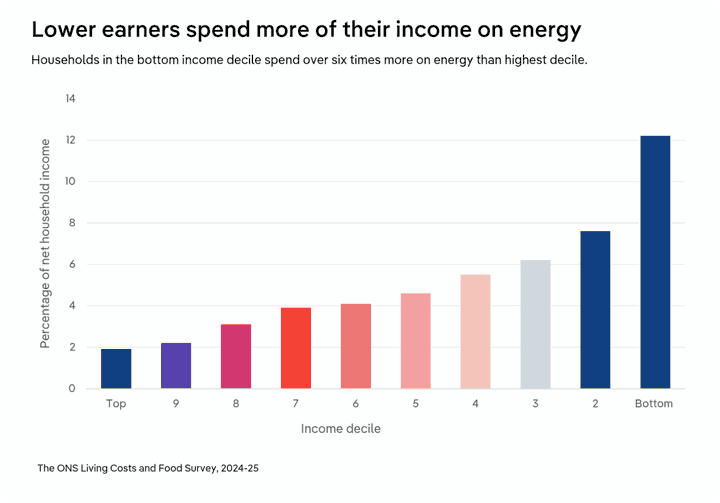
Targeted support for households aims to aid the households most in need. The Treasury says the payment reaches 88% of households in the bottom three income deciles, but some poorer families in larger homes miss out while some comfortable households qualify. The lower-income deciles spend more of their income on energy, so it remains essential to tackle costs for those households.
Potential price increases in 2027 also threaten to erode the relief to households’ energy bills. A band A–D household could get around £150 in total from the combined one-off payment and VAT cuts, but if January's cap rise is as steep as some suppliers expect, much of that will be absorbed within a single quarter.
The current support also comes with a long-term trade-off. The Budget has cut £1 billion from the Warm Homes Plan to help fund the Defence Spending Plan. This will slow the improvement work that helps reduce energy consumption.
 For industrial energy users, the impact is highly uneven. BICS will offer meaningful savings for companies that qualify, including those in frontier and highly energy-intensive industries like industrial gas production, primary form plastic manufacturing and motor vehicle manufacturing. However, the majority of British manufacturers won’t see qualify.
Make UK warns that the current eligibility criteria could leave some energy-intensive businesses without vital support at a time when 13% of manufacturers report that another energy price shock could prove terminal for their business.
The energy outlook
The picture remains somewhat uncertain for British households and businesses. While most organisations have welcomed the support pledged to reduce energy bills, further energy price increases in 2027 could erode the benefits. The End Fuel Poverty Coalition said the £100 would "barely dent" January's expected rise. While Energy UK welcomed the standing charge change for many customers, it warned that low-income, high-use households must be protected.
For manufacturers, high energy bills will remain front of mind. Make UK argues that the Budget failed to tackle industrial energy costs, but industries that qualify for the BICS are set to benefit from significant support heading into 2027.
Still, the outlook hinges mostly on gas prices. Most support is temporary, creating a cliff edge in July 2027 when the VAT cut and fuel duty freeze end. Until the Strait of Hormuz fully reopens and global oil and gas supplies normalise, this Budget offers households some breathing space, but not cheaper energy across the board.
Final Word
The Budget’s energy relief is targeted and short-lived. Support for lower-band households and qualifying manufacturers will help, but many consumers and most manufacturers are left with little or no support and the Budget doesn’t tackle the underlying causes of high energy costs.
The bigger risk is timing. Most measures expire in July 2027 and with gas prices expected to swell in the new year, much of the benefit to households could be absorbed within months. Longer-term reforms, such as scrapping gas standing charges, may provide more lasting change, but the cuts to home efficiency funding could slow efforts to reduce energy use.
Ultimately, the outlook hinges on global energy markets. Until supply disruption in the Strait of Hormuz eases, the Budget offers a degree of breathing room rather than cheaper energy across the board.