
Key Takeaways
- Record gold prices reshaped the top of the list. The Perth Mint moved past Ampol into first place, while precious-metal refiner Pallion almost doubled its revenue.
- The Top 100 earned a combined $395.7 billion, up from $376.0 billion the previous year. But the growth was uneven, splitting the sector into clear winners and losers.
- Defence manufacturers and companies growing by acquisition rose strongly. By contrast, fuel refiners, steelmakers and COVID-era pharmaceutical product manufacturers went backwards.
IBISWorld's 2026 Top 100 Manufacturers List spans 62 industries, the same breadth as last year. The Meat Processing industry is now the most represented industry on the list, with six companies, narrowly ahead of the Pharmaceutical Product Manufacturing industry. Taken together, the top 100 manufacturers earned approximately $395.7 billion in 2025, up from $376.0 billion the previous year. However, this headline growth masks that the sector is pulling in two directions at once. Commodity processors and defence contractors enjoyed a strong year, fuelling this growth, while fuel refiners, steelmakers and the pharmaceutical product manufacturers that found success during the pandemic experienced a major slowdown.
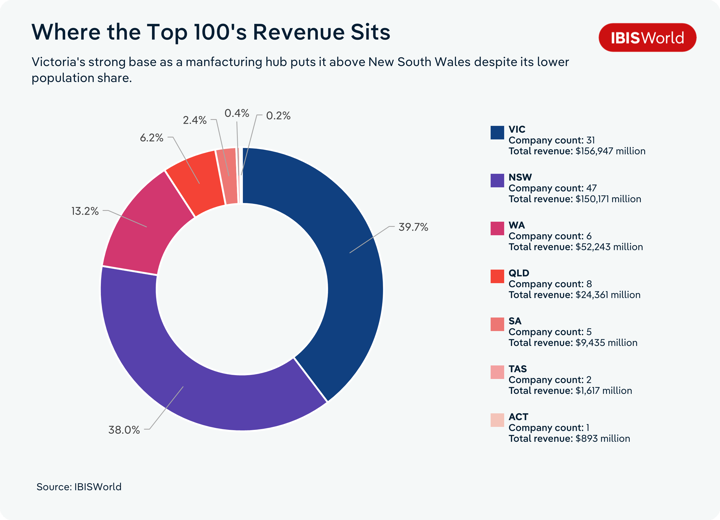
The Top 100 made about $15.6 billion in after-tax profit and employed roughly 409,000 people. Victoria accounts for the largest share of revenue, at $156.9 billion, or 40% of the list, while New South Wales is home to the most companies, at 47. Western Australia’s presence is smaller in number but heavy in value, reflecting the concentration of gold refining and alumina production in the state.
Gold overtakes oil at the top
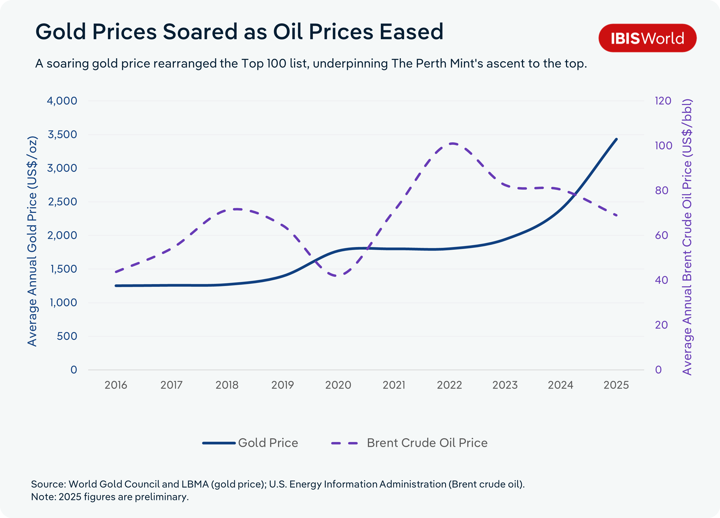
The most visible change this year occurred at the top. The price of gold climbed to a series of record highs through 2025, driven by heavy buying from central banks and investors seeking a safe-haven asset amid global uncertainty. Because a precious-metals refiner’s revenue moves with the price of the metal it handles, the surge fed straight through to Australia’s two large gold refiners.
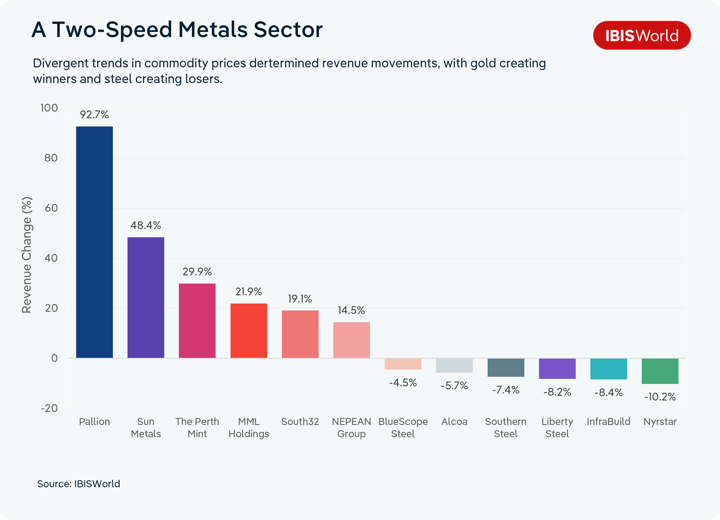
The Perth Mint, whose activities primarily consist of refining and trading gold and other precious metals, ranked number one on the 2026 Top 100 list on the back of a 29.9% jump in its revenue to just under $33.0 billion. Pallion, Australia’s largest precious-metals refiner, almost doubled its revenue to $18.4 billion and climbed to sixth place. Both businesses turn over very large sums at slim margins, so their figures are better read as a measure of gold’s strength in price than as a leap in profitability. Even so, the sheer size of the increase carried them strongly up the list.
In taking the top spot, The Perth Mint displaced Ampol (2nd), the fuel refiner and retailer that led the 2025 list. Ampol’s revenue slipped by 10.3%, though there’s more to the story than this headline figure would suggest. Even as lower oil prices reduced the value of fuel sold, the company’s Lytton refinery earned wider margins per litre, meaning underlying earnings held up while revenue dipped.
Beyond gold: a two-speed metals sector
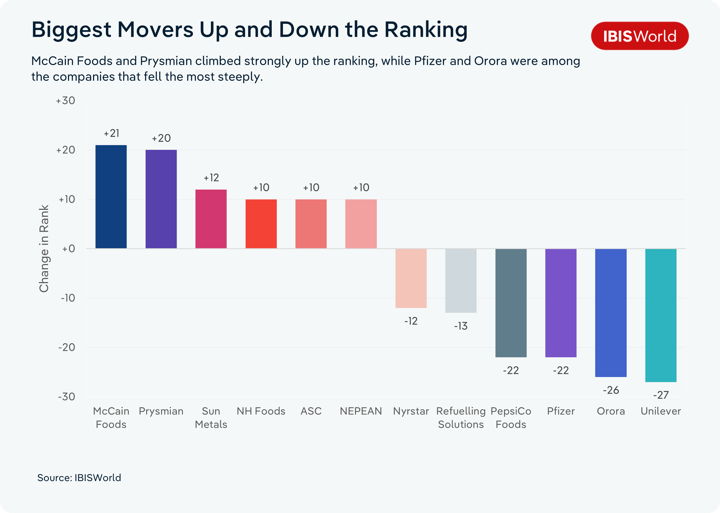
Looking beyond gold, the broader metals sector moved in multiple directions. Among the winners, diversified miner South32, ranked tenth, lifted its revenue by 19.1% on the back of higher realised alumina prices, and Sun Metals (58th) grew by almost 50% after expanding its zinc refinery in Townsville, QLD.
Steelmakers went the other way. BlueScope Steel (7th), Liberty Steel Group (18th) and InfraBuild (19th) all recorded year-on-year revenue declines as domestic construction activity softened and imported steel undercut domestic supply for local builds. The troubled Whyalla steelworks spent much of the year in administration. Feeling the brunt of high operating costs and intense competition from China, zinc and lead smelter Nyrstar Australia (100th) also struggled, needing a government support package to remain operational.
Gold refiners’ near-term outlook depends on whether prices hold. For the rest of the sector, the Commonwealth’s Future Made in Australia program, which offers incentives to process critical minerals and produce green metals, will lend support once its measures take effect from 2027-28.
Food: a steady backbone
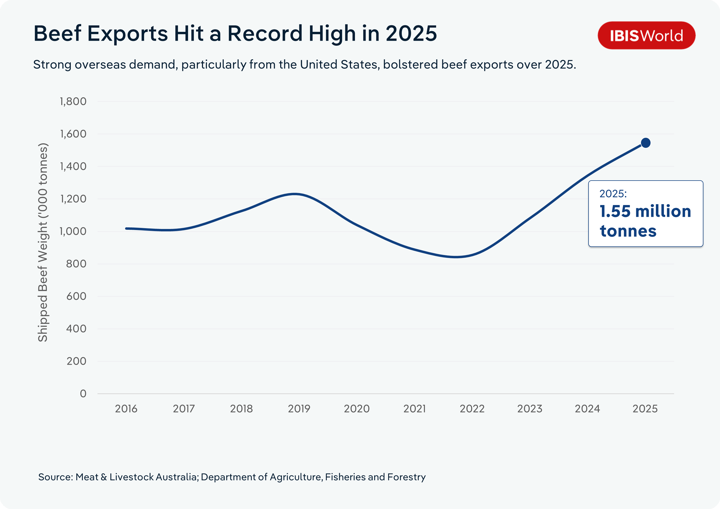
Outside the volatility in metals, food manufacturing remains the steady core of the Top 100. On the global stage, Australia remains a premium producer of high-quality meat. Meat processing is the single most-represented industry in the Top 100, with six companies, led by JBS Australia in eighth place, which recorded a 17.3% rise in revenue. Thomas Foods International (21st) and Teys Australia (22nd) sit close behind, having seen similar revenue growth over the year. All three benefited from record beef exports through 2025 as a rebuilt national cattle population met strong overseas demand. The United States was a major buyer, with a fall in its domestic beef production over the year to a multi-decade low contributing to robust demand for Australian beef.
Healthcare shows steady demand and a COVID-19 hangover
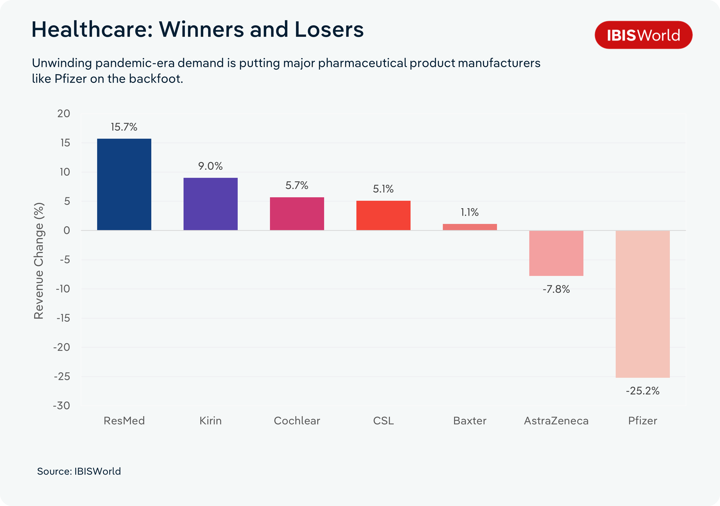
Pharmaceutical and medical-device manufacturing emerged with very different results over the year. On one side, CSL (3rd), the largest pharmaceutical product manufacturer on the list, grew its revenue by 5.1% on the strength of its plasma therapies, gene therapy products and confirmed plans to spin off its Seqirus vaccine business as a standalone company. Device makers also did well. ResMed Australia (24th), which makes sleep-apnoea equipment, grew its revenue by 15.7% and hearing-implant maker Cochlear (40th) recorded a 5.7% revenue uplift. ResMed Australia’s results run against the common assumption that weight-loss drugs would erode demand for its products; in practice, the drugs have drawn more people into screening for sleep disorders.
On the other side sits Pfizer Australia (88th). Year on year, its revenue fell 25.2%, the largest drop on the list, driven by unwinding demand for its COVID-19 vaccine and antiviral treatments. AstraZeneca Holdings’ Australian arm (85th) also faced unwinding demand, but its revenue only fell by 7.8%, reflecting the more stable mix of pharmaceutical products in its Australian operations compared with Pfizer Australia’s greater exposure to declining COVID-19-related demand.
Underpinning the steadier names is a long-running demographic shift. Approximately 4.9 million Australians are now aged over 65, close to 17% of the population, and that share is continuing to climb, expected to exceed 23% of the population by 2062-63. An ageing population supports durable demand for medicines, implants and other medical equipment, which helps explain why the healthcare sector’s underlying performers grew even as its pandemic winners retreated.
Defence: a clean sweep for shipbuilders
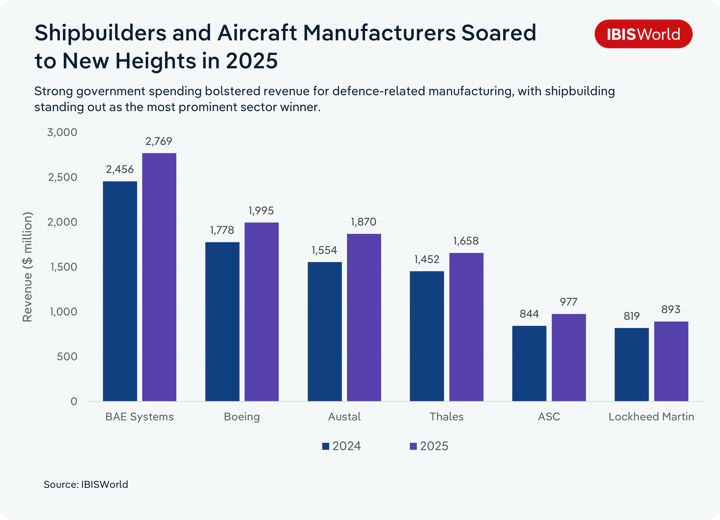
Defence manufacturing was one of the clearest sector winners. Every company on the list involved in shipbuilding recorded revenue growth: BAE Systems Australia (34th) grew by 12.8%, Austal (50th) by 20.4%, Thales Australia (56th) by 14.2% and ASC (74th) by 15.8%. The two aircraft manufacturers on the list, Boeing Australia (48th) and Lockheed Martin Australia (83rd), also grew.
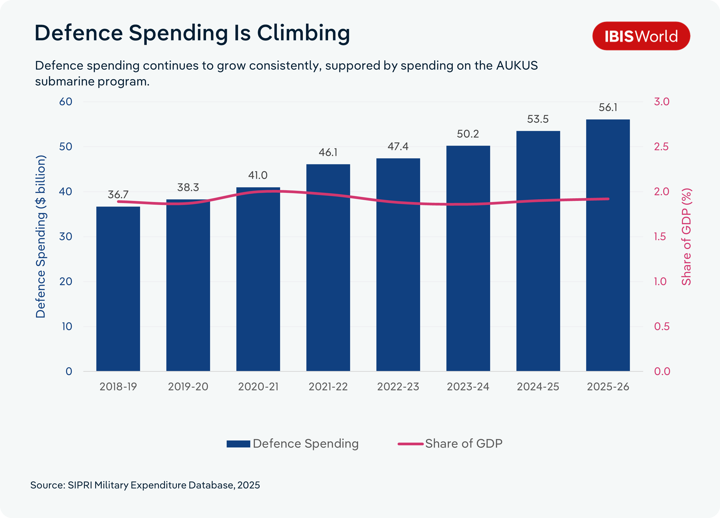
Government spending was the prominent driver behind this growth. According to SIPRI data, Australia's defence spending reached $56.1 billion in 2025-26, about 1.9% of GDP, and has grown by more than half over the past seven years. Broader definitions put the figure higher, at close to $59.0 billion once agencies like the Australian Signals Directorate and the Australian Submarine Agency are included and around $63.2 billion across the full defence portfolio. Much of the work flows through the AUKUS submarine program, a commitment worth up to $368.0 billion over its life, which is generating activity at the Osborne shipyard in South Australia and Henderson in Western Australia.
Each company's 2025 revenue was underpinned by a specific slice of this government spending pipeline. BAE Systems Australia ramped up construction of the first of six Hunter-class frigates at Osborne, begun in 2024, with the first ship due in the early 2030s. ASC's growth came from expanding submarine sustainment work, ahead of the $11.0 billion Collins-class life extension program that began in 2026. Austal's 2025 revenue grew on the back of its US shipbuilding work. Thales Australia, which builds Bushmaster vehicles and munitions, was lifted by fresh 2025 orders, including 44 more Bushmasters as well as steady munitions production.
Defence contracts often run for many years, even decades, and the revenue they provide depends on political commitments holding. A United States review of AUKUS in 2025 created a period of uncertainty before the pathway was formalised. Disruption can also come from overseas ownership risk, like South Korea’s Hanwha, which spent the year increasing its shareholding in Austal. For now, though, the direction of defence spending is clear – and it’s feeding straight into the order books of Australian defence manufacturers.
Building products and the deals that rearranged the ranks
Building product manufacturers performed well in 2025. However, much of their growth stemmed from corporate deals rather than everyday building activities, a dynamic that explains some of the largest moves on the Top 100 list.
James Hardie Industries, a fibre cement manufacturer, saw revenue growth of 23.1%, moving it to 12th place. The rise, however, had little to do with higher sales of cladding (which were largely flat), the segment from which the company derives most of its revenue, and instead reflected a major revenue lift from its purchase of AZEK, a US decking and outdoor-living company. This purchase was completed in July 2025 and is included in the year's revenue.
Two other companies similarly gained from acquisitions. Saint Gobain (37th) doubled its revenue after taking in CSR, a Gyprock plasterboard maker, and CRH (47th) more than matched this revenue growth rate when it absorbed the cement and lime producer Adbri. Their revenue growth rates were the steepest on the list. Amcor (4th) is another example of a company that achieved revenue growth, though at a lower 10.5%, when it landed a merger with the US packaging group Berry. What these examples show is not necessarily a booming market but one where companies are growing by swallowing or merging with others, the same move that carried last year's fastest riser, rail maker Alstom (59th).
Cement and concrete producers Holcim (43rd) and Heidelberg Materials Australia Group (36th) both grew at a comparatively gentle pace, at 1.7% and 4.1%, respectively. Their demand is contingent on Australia’s pipeline of large transport infrastructure projects, like the Melbourne Metro Tunnel project and the Sydney Metro – Western Sydney Airport project. These projects and similar ones maintain demand for local cement, aggregates and concrete.
Another demand source is home building, which by comparison has been a low point of demand. In the first year of the Federal Government's National Housing Accord, to June 2025, just over 174,000 homes were completed, according to ABS building activity figures, more than one-quarter below the 240,000-a-year pace the target demands. This shortfall kept a lid on demand for many building products.
Standing out more acutely in the sector was Orora, which fell 26 places to 46th position after separating from its North American packaging business. However, the drop is more a reflection of a smaller business than of a weak year: the company’s profit rose sharply, showing that a drop on the list isn’t always indicative of how a business is trading.
Final Word
The 2026 Top 100 Manufacturers List reflects a sector that’s still growing but is increasingly divided into distinct lanes. The gains were concentrated in gold and other metals, defence and companies that grew through acquisitions or mergers. The declines were found in fuel refining, steelmaking and manufacturers that were still running off pandemic-era demand, which has faded. The gap between these groups is what defines the year.
Several questions will shape the future of the manufacturing sector. Whether gold prices can continue to hold or rally to new heights will be decisive for which manufacturer remains at the top. The pace at which defence spending continues, particularly the AUKUS spending, will be crucial for big names. The Future Made in Australia incentives, due from 2027-28, may begin to appear in the results of the metals and clean-energy manufacturers. And a strengthening in home building, if it comes, would lift prospects for building product manufacturers. Automation and artificial intelligence remain slower-moving themes in Australian manufacturing and appear more likely to shape margins over several years than to reshape the ranking in any single year.