
IBISWorld Platform
Answer any industry question in minutes with our entire database at your fingertips.


Answer any industry question in minutes with our entire database at your fingertips.
Feed trusted, human-driven industry intelligence straight into your platform.
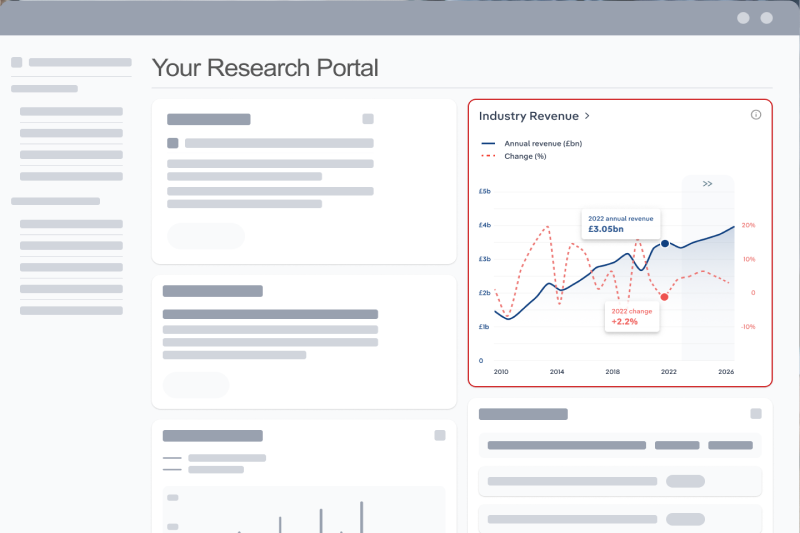
Streamline your workflow with IBISWorld’s intelligence built into your toolkit.
IBISWorld's research coverage on the 3D Printing & Rapid Prototyping Services procurement and pricing environment in the United States includes market dynamics, buyer power scores, supply chain vendors with pricing trends and forecasts.
This procurement coverage of the 3D Printing & Rapid Prototyping Services market in the United States includes Standard filament, Silk PLA, Color-Changing PLA and Specialized PLA. Standard coding in this coverage includes ISIC-741-Specialized design activities, NACE-74.10-Specialised Design Activities, NAICS-541420-Industrial Design Services and UNSPSC-81103203-Research and development engineering service.
Common market terminology included in the 3D Printing & Rapid Prototyping Services procurement coverage includes Additive (A substance added in small quantities for the purpose of 3D printing.), Bioprinting (The process by which cell patterns are created using 3D printing technology.), Polyamide (A type of polymer used extensively in 3D printing services that is known for its durability.), Stereolithography (A process of creating three-dimensional objects from a liquid polymer using a laser beam.), Translucence (The property of an object that allows light to partially pass through.), Selective Laser Sintering (A 3D printing technique that uses a laser to heat powdered materials, joining them together into solid parts.) and Fused Deposition Modeling (A 3D printing technique that involves heating materials in a spool and depositing them on a surface to form a new part.).
The top companies covered in the 3D Printing & Rapid Prototyping Services procurement report as suppliers are Melrose Industries PLC, General Electric Company, Basf Se, United Parcel Service, Inc. and 3D Systems Corporation.
The Opportunity Assessment chapter provides a comprehensive market analysis of the 3D Printing & Rapid Prototyping Services market in the United States category, including buyer power scoring, market pricing trends, vendor landscape, cost structure, and strategic negotiation levers.
The market pricing trends include the Market Price (2026) per prototype, a five year price forecast and a supply chain risk score. Vendor coverage includes a market share and cost structure breakdown.
Analysis includes a comprehensive SWOT analysis of and recent developments impacting the 3D Printing & Rapid Prototyping Services market environment.
The Buyer Power Score chapter assesses key components impacting 3D Printing & Rapid Prototyping Services procurement including the recent price trend, forecast price trend, availability of substitutes, switching costs, product specialization, average vendor risk, market share concentration, supply chain risk, price driver volatility and recent price volatility.
These components generate a Buyer Power Score that ranges from -5 (strongly favoring sellers) to +5 (strongly favoring buyers) plus a recommended strategy for procurement specialists.
The Price Environment chapter covers detailed pricing analysis and datasets on 3D Printing & Rapid Prototyping Services market environment. This includes insights into market pricing Market Price (2026), price forecasts, volatility, specialization, substitutes and switching costs.
Datasets in the Price Environment chapter include vendor cost structure, breakdowns of wage rates by geography and specialty, key external economic and labor drivers impacting the market and market pricing models.
The Supply Chain & Vendors chapter covers the concentration, risk and diversity of the 3D Printing & Rapid Prototyping Services market. This includes datasets on the market’s top suppliers, detailed analysis on the key sourcing risks and supply chain dynamics, with environmental, social and governance (ESG) considerations and scores.
The Business Requirements chapter covers vendor relationships, qualifications, service level agreements and key performance indicators. These inputs provide insight into the planning process through the buying lead time, vendor relationship and vendor qualifications. The sourcing process include key RFP elements like an organizational overview, project budget, selection criteria, project schedule, proposal format, inventory control, cost containment, regulation, quality control, distribution and key contract clauses.
More than 6,000 businesses use IBISWorld to shape local and global economies
We were able to supplement our reports with IBISWorld’s information from both a qualitative and quantitative standpoint. All of our reporting now features some level of IBISWorld integration.

IBISWorld delivers the crisp business knowledge we need to drive our business. Whether it be serving up our major clients, winning new business or educating on industry issues, IBISWorld brings real value.

IBISWorld has revolutionised business information — which has proved commercially invaluable to exporters, investors and public policy professionals in Australia and overseas.

When you’re able to speak to clients and be knowledgeable about what they do and the state that they operate in, they’re going to trust you a lot more.

The 2026 benchmark market price for 3D Printing & Rapid Prototyping Services is $5.32 per prototype. Prices have increased at a CAGR of 2.16 from 2023-26.
The top vendors in the 3D Printing & Rapid Prototyping Services market include Melrose Industries PLC, General Electric Company, Basf Se, United Parcel Service, Inc. and 3D Systems Corporation.
The top industries supplying the 3D Printing & Rapid Prototyping Services market are 3D Printer Manufacturing in the US, Semiconductor & Circuit Manufacturing in the US, Nonferrous Metal Foundry Products Manufacturing in the US, Aluminum Manufacturing in the US, Plastic & Resin Manufacturing in the US, Inorganic Chemical Manufacturing in the US and Organic Chemical Manufacturing in the US.
Moderate vendor risk from input costs and fluctuating demand. Suppliers in this market face financial pressure from high material costs and variable customer demand, balanced by strong competition among vendors. This results in moderate vendor risk overall, with smaller firms more vulnerable to disruptions than larger providers. Buyers should assess vendor financial health carefully and diversify sourcing strategies to reduce exposure to instability.
Aesthetic and design significantly affect the pricing of 3D printing and rapid prototyping services, as more intricate and visually appealing designs often require advanced technology, longer production times, and skilled labor, leading to higher costs. For example, bespoke designs in the automotive or biomedical sectors may command premium prices due to their unique aesthetics and functionality, while simpler prototypes may be priced lower, with measurement factors including complexity, material choice, and finishing processes.