IBISWorld Platform
Answer any industry question in minutes with our entire database at your fingertips.

Over the five years through 2025-26, the labour productivity index is forecast to increase at a compound annual rate of 0.1%, to average 98.9 points. Sustained labour productivity increases over the aforementioned period were driven by developments which have enabled workers across a plethora of sectors to produce more, including new capital investment and technological advancements to support and enhance the efficiency of manual labour. However, disproportionate growth between traditionally lower and traditionally higher productivity jobs across the UK economy meant that expansion in the UK's average productivity across the labour market overall, was relatively modest. Meanwhile, a near-record national employment rate in the pre-pandemic years, twinned with a low unemployment rate, resulted in somewhat of an output gap – that is, the labour market was approaching a point where each additional job added did not create enough productivity to cover its cost, in effect making every successive job after said point inefficient, or otherwise adding limited benefit.In 2020-21, a year in which public health restrictions mandated to contain the spread of COVID-19 were their most stringent in the UK economy, the labour productivity index actually increased by 2.1% year-on-year. At the onset of the pandemic, in particular over Q2 (April-June) 2020, full lockdown measures led to a significant contraction in output across several key sectors, notably services, manufacturing, and industrial production. The challenges and costs that the pandemic placed on business operations, in addition to prevalent furloughing as firms leveraged temporary stimulus support, naturally meant many industries experienced a decline in output per hour worked. Post-Q2 2020, however, the unwinding of some restrictions which allowed certain sectors like construction, industrial production, some retail and some hospitality to resume activity, in either a limited or other greater capacity, led to an increase in hours worked relative to the Q2 2020 dip, steering labour productivity back towards positive growth.However, in 2021-22, labour productivity declined for the first time since 2012-13. The labour productivity index increased by 0.1% year-on-year as the supply chain issues meant output growth was slowed over the year. This, combined with the phasing out of the Coronavirus Job Retention Scheme caused an increase in hours worked for those not subsequently made redundant. Meanwhile, even though the unemployment rate had risen to above 5% in mid-2020, for the first time since early-2016, recruitment efforts were stepped up heading into 2021-22 as the economy reopened. In this respect, many of the additional jobs added post-pandemic did not add enough productivity to cover the cost of employment which, in turn, has raised output per hour worked. In 2022-23, the labour productivity index is projected to remain flat.
Curious about what drives these trends? IBISWorld's analyst coverage on the labour productivity includes detailled analysis on the current performance, outlook and industries affected.
2000-2031
This report analyses the productivity of labour in the United Kingdom. The data is sourced from the Office for National Statistics (ONS), in addition to estimates produced by IBISWorld with reference to labour market projections reported by the Office for Budget Responsibility (OBR). The data is an index of seasonally adjusted output per hour worked – calculated as gross value added (GVA) divided by the number of hours worked - with a base year of 2019 (i.e., Calendar year 2019 = 100). Figures for each year are calculated as an average over each financial year (i.e., April through March).
IBISWorld Industry Reports are available in multiple formats to fit seamlessly into your workflow.

Answer any industry question in minutes with our entire database at your fingertips.
Feed trusted, human-driven industry intelligence straight into your platform.
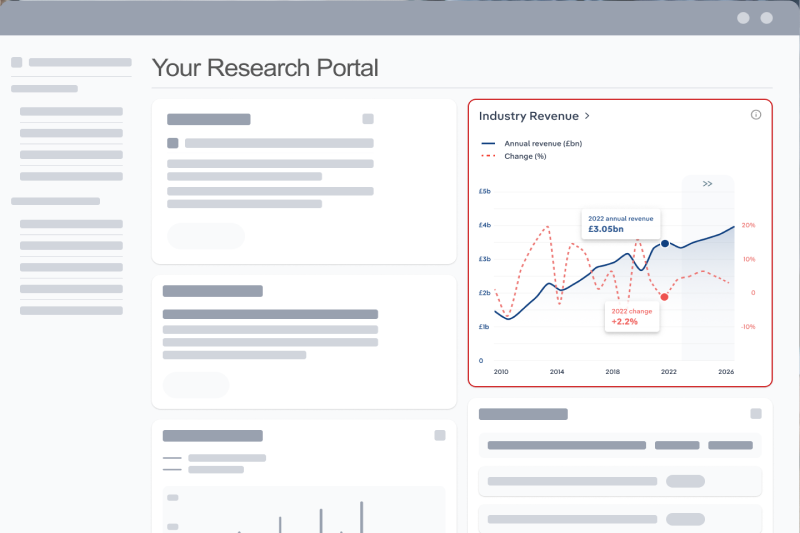
Streamline your workflow with IBISWorld’s intelligence built into your toolkit.
Explore industries with similar markets, supply chains, and economic drivers to gain broader context and insights.
| Industry | Country | Last 5-yr CAGR | Forecast 5-year CAGR | Revenue |
|---|---|---|---|---|
| Employee Assistance Programme Services in the UK |

|
XX% | XX% | $XX |
| Employment Placement Agencies in the UK |
|
XX% | XX% | $XX |
When the stakes are high, you need intelligence that cuts through the noise—wherever you work.
The labour productivity in the UK in 2026 was 98.9 index points.
The labour productivity in the UK grew by 0.1% in 2026.
IBISWorld’s data and analysis on labour productivity in the UK includes forecasted growth rates over the next five years.