
IBISWorld Platform
Answer any industry question in minutes with our entire database at your fingertips.

IBISWorld expects that the domestic price of wool will fall 1.1% during 2025-26 to average 1,150.8 c/kg, according to ABARES forecasts. This marks a continuation of subdued conditions in the wool market, as global demand for luxury textiles remains weak in China and Europe. Persistent cost-of-living pressures in advanced economies have constrained discretionary spending, while a relatively firm Australian dollar has further weighed on export competitiveness. At the same time, ABARES anticipates local production will edge higher, compounding oversupply concerns. Wool prices briefly surged earlier in the period but have since entered a sustained contraction. Prices peaked in 2021-22 on the back of renewed demand for luxury apparel, with Chinese, US and European buyers driving strong orders as consumers returned to workplaces and formal attire sales recovered. However, competition from synthetic fibres continued to intensify, limiting longer-term demand growth. Australian farmers also faced supply constraints, as dry conditions and high lamb prices reduced breeding and encouraged a shift towards meat production, restricting wool output during the upswing.The industry has also been challenged by oversupply and volatile global conditions. Mounting pressure from superfine wool production has kept global fibre markets well stocked, placing downwards pressure on prices. Trade tensions, particularly tariff adjustments on textiles exported from China to the United States, have weighed on global demand for raw wool inputs. Farm-level production decisions and climate variability remain critical to industry performance. Farmers adjust flock structures depending on the relative returns of wool and sheep meat and strong lamb prices in recent years have incentivised a greater focus on meat. However, increasingly variable rainfall and pasture availability have constrained flock sizes, curbing overall production capacity. Over the five years through 2025-26, IBISWorld forecasts the domestic price of wool to decline at a compound annual rate of 0.7%, underscoring the persistent demand and structural challenges facing the industry.
Curious about what drives these trends? IBISWorld's analyst coverage on the domestic price of wool includes detailled analysis on the current performance, outlook and industries affected.
1974-2033
This report analyses the domestic price of wool as measured by the Eastern Market Indicator (EMI) price for clean wool. The data for this report is sourced from the Australian Bureau of Agricultural and Resource Economics and Sciences (ABARES) and is measured in nominal Australian cents per kilogram (c/kg) per financial year.
IBISWorld Industry Reports are available in multiple formats to fit seamlessly into your workflow.

Answer any industry question in minutes with our entire database at your fingertips.
Feed trusted, human-driven industry intelligence straight into your platform.
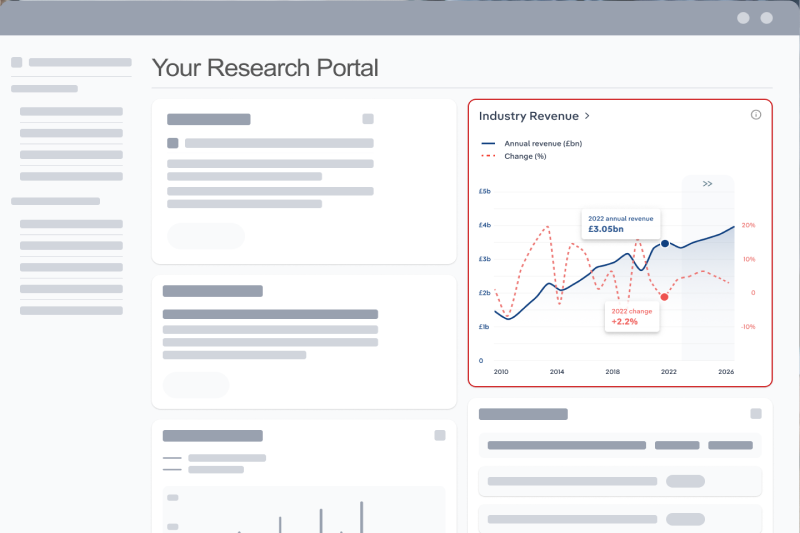
Streamline your workflow with IBISWorld’s intelligence built into your toolkit.
Explore industries with similar markets, supply chains, and economic drivers to gain broader context and insights.
| Industry | Country | Last 5-yr CAGR | Forecast 5-year CAGR | Revenue |
|---|---|---|---|---|
| Sheep Farming in Australia |

|
XX% | XX% | $XX |
| Wool Wholesaling in Australia |
|
XX% | XX% | $XX |
| Wool Wholesaling in Australia |
|
XX% | XX% | $XX |
| Carpet and Textile Floor Covering Manufacturing in Australia |
|
XX% | XX% | $XX |
| Grain-Sheep or Grain-Beef Cattle Farming in Australia |
|
XX% | XX% | $XX |
| Grain-Sheep or Grain-Beef Cattle Farming in Australia |
|
XX% | XX% | $XX |
| Sheep-Beef Cattle Farming in Australia |
|
XX% | XX% | $XX |
| Sheep-Beef Cattle Farming in Australia |
|
XX% | XX% | $XX |
| Synthetic and Natural Textile Manufacturing in Australia |
|
XX% | XX% | $XX |
When the stakes are high, you need intelligence that cuts through the noise—wherever you work.
The domestic price of wool in Australia in 2026 was 1,150.8 cents per kilogram.
The domestic price of wool in Australia declined by -0.71% in 2026.
IBISWorld’s data and analysis on domestic price of wool in Australia includes forecasted growth rates over the next five years.