Mobile Menu

Caterers in Canada - Market Research Report (2015-2030)

Dmitry Diment Dmitry Diment New York, United States Last Updated: November 2025 NAICS 72232CA

Revenue

$3.3bn

2025

$3.3bn

Past 5-Year Growth

Profit

$XX.Xm

Employees

49,308

Businesses

4,879

Wages

$X.Xbn

Caterers in Canada industry analysis

Canada’s catering industry has regained momentum after pandemic-era disruptions. Rising disposable income and stronger business confidence have driven demand for catering services higher, as consumers spend more and the number of Canadian businesses expands. A steady appetite for social and corporate events has encouraged businesses to expand their spending on gatherings that require catering, such as office parties, corporate conferences, team-building seminars and client events. Higher per capita household income and improving consumer confidence have also increased spending on private events, such as weddings and birthdays. With caterers adapting to shifting consumer preferences for healthier and more innovative options by expanding their service offerings, industry revenue is forecast to grow at a CAGR of 10.9% to $3.9 billion through 2025. However, with recession risk persisting because of heightened trade tensions, industry revenue growth is forecast to slow to 0.4% in 2025.

Catering services have evolved in response to shifting preferences. Caterers have increasingly focused on offering healthier options, as well as organic and locally sourced produce, and many have expanded their scope to include event consulting and planning. Despite these changes, caterers have been challenged by rising prices as high inflation pushed the price of everything higher. Meat and vegetable prices were especially volatile, with foodservice operators across Canada experiencing a decline in profitability as ingredient costs outpaced other overhead expenses.

Catering is expected to continue growing as an expanding business environment boosts demand and companies increase their spending on organized events. As consumer spending rises despite recessionary risks, more time-poor individuals will choose catering services over home preparation. Sustainability will continue to be a primary force shaping Canadian catering, as clients place greater emphasis on environmental impact and regulatory agencies introduce stricter guidelines regarding food waste and packaging. Ultimately, growth will hinge on caterers' ability to adapt and expand their services while reshaping the industry to meet the rising expectations of clients. Through 2030, industry revenue is forecast to grow at a CAGR of 1.8% to $4.2 billion.

Trends and Insights

  • Canada’s caterers are gaining strength as rising disposable income and business confidence push demand higher. Strong consumer spending and more active corporate event schedules continue to drive growth across social and professional gatherings.
  • The highest-income households spend most on catering services because they are time-strapped but have money to spend on special occasions. Conversely, households with the lowest incomes have fewer celebrations and incur less spending per event than those in higher-income quintiles.
  • Caterers rely on large urban markets where business activity and higher household income support stronger demand. They often focus on middle and high-income suburbs and work closely with small and medium-sized businesses across these local regions.
  • Canada’s catering industry faces strong external competition from hotels and full-service restaurants. These establishments operate commercial kitchens that enable them to offer catering services that directly compete with independent caterers.
Show more

Get more expert insights that help you cut through the noise.

Get fast answers to complex questions about your business or your client’s industry. Annual memberships include unlimited access to data and analysis for thousands of industries globally.

Get in Touch

Unlock Expert Insights with Full Platform Access

  • Human Driven & Verified Analysis
  • Structured Database Powering Workflows
  • Intelligent Tools Empowering Confident Decisions
  • Insight where-and how- you need them

How you can access insights on the Caterers in Canada industry

The Caterers in Canada Industry Report is available in multiple formats to fit seamlessly into your workflow.

IBISWorld Platform

Answer any industry question in minutes with our entire database at your fingertips.

Screen of the IBISWorld platform user interface Book a demo

API Data Delivery

Feed trusted, human-driven industry intelligence straight into your platform.
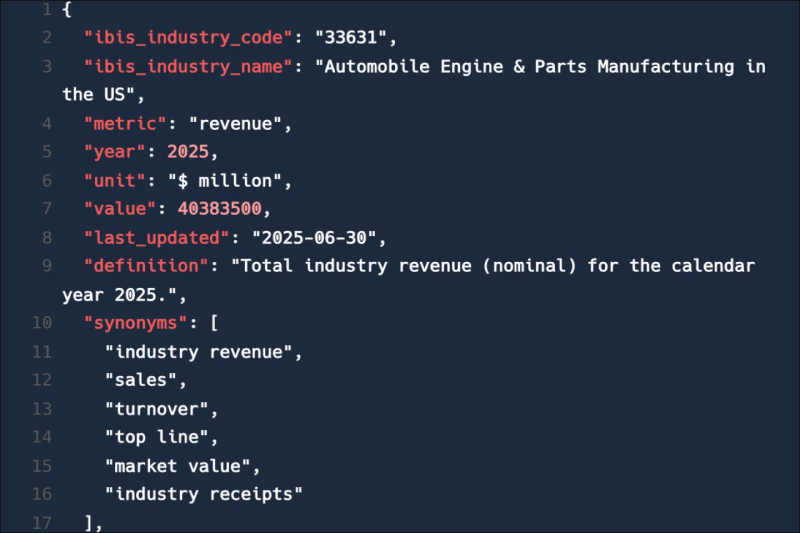
Code example of using the IBISWorld API API documentation

Integrations

Streamline your workflow with IBISWorld’s intelligence built into your toolkit.

Screen of Client Application integrating with IBISWorld data View integrations

Related Coverage

Understand the landscape with full access to an IBISWorld license

Industry Statistics and Trends

Market size and recent performance (2015-2030)

Industry revenue has grown at a CAGR of 7.2 % over the past five years, to reach an estimated $3.3bn in 2025.

Trends and Insights

Corporate profit expansion widens opportunities for catering

  • Caterers serve a mix of corporate and private clients, delivering services for events like office meetings, conferences, weddings and celebrations. Businesses and households alike rely on caterers for convenience and the ability to tailor menus to specific themes and dietary needs. The growing taste for unique experiences is reshaping the scope of offerings in this service-focused segment.
  • Additional trends and insights available with purchase
Caterers in Canada
Revenue (2015-2030)
IBISWorld Logo Source: IBISWorld

Industry outlook (2025-2030)

Market size is projected to grow over the next five years.

Trends and Insights

Consumer appetite for catered solutions will increase as time constraints reshape event planning

  • The expanding business environment will lift the catering industry, as companies increase their spending on organized events. Office parties, conferences, product launches and team-building activities will provide significant growth opportunities. Improved business investment will prompt catering providers to expand their service offerings to cater to a wider range of corporate functions.

Biggest companies in the Caterers in Canada

Company
Market Share (%)
2025
Revenue
2025
Profit
2025
Profit Margin (%)
2025

There are no companies that hold a market share exceeding 5% in the Caterers in Canada industry.

Products & Services Segmentation

Caterers in Canada
Products & Services
IBISWorld Logo Source: IBISWorld

Industry revenue is measured across several distinct product and services lines, including Alcoholic and nonalcoholic beverages , Food prepared for immediate consumption and Food served at events on caterers' premises. Alcoholic and nonalcoholic beverages is the largest segment of the Caterers in Canada.

Trends and Insights

Food delivery catering rises as customers shift events to homes offices and rented spaces

  • This segment covers catering delivered to homes, offices or rented spaces where customers want a flexible setting. Caterers usually cook or assemble dishes in their own kitchens and then transport them safely. This approach suits clients who want control over their event without booking a formal venue.
  • More insights available in the full report

Table of Contents

About this industry

Industry definition

The Caterers industry in Canada provides food services for events such as graduation parties, wedding receptions and trade shows. Industry establishments generally have equipment and vehicles to transport meals and snacks to events and to prepare food at the event site. Caterers who own or manage permanent facilities in which they provide event-based food services are also included.

What's included in this industry?

Products and services covered in the Caterers industry in Canada include Providing single event-based food services, Providing food services in banquet halls with catering staff and Transporting meals and snacks or preparing food on-site.

Companies

Companies covered in the Caterers industry in Canada include .

Purchase this report to view all major companies in this industry.

Related Terms

Related terms covered in the Caterers industry in Canada include food service, wastage and food handling.

Industry Code

NAICS 2007

NAICS 722320 - Caterers in Canada

Performance

Get an indication of the industry's health through historical, current and forward-looking trends in the performance indicators that make or break businesses.

Analyst insights

Canada’s caterers are gaining strength as rising disposable income and business confidence push demand higher. Strong consumer spending and more active corporate event schedu...

In this chapter (4)

  • Current Performance
  • Outlook
  • Volatility
  • Life Cycle

Key metrics

  • Annual Revenue, Recent Growth, Forecast, Revenue Volatility
  • Number of Employees, Recent Growth, Forecast, Employees per Business, Revenue per Employee
  • Number of Businesses, Recent Growth, Forecast, Employees per Business, Revenue per Business
  • Total Profit, Profit Margin, Profit per Business

Charts

  • Revenue, including historical (2015-2024) and forecast (2025-2030)
  • Employees, including historical (2015-2024) and forecast (2025-2030)
  • Businesses, including historical (2015-2024) and forecast (2025-2030)
  • Profit, including historical (2015-2025)
  • Industry Volatility vs. Revenue Growth
  • Industry Life Cycle

Detailed analysis

  • Trends in supply, demand and current events that are driving current industry performance
  • Expected trends, economic factors and ongoing events that drive the industry's outlook
  • Key success factors for businesses to overcome volatility
  • How contribution to GDP, industry saturation, innovation, consolidation, and technology and systems influence the industry's life cycle phase.

Products and Markets

Learn about an industry's products and services, markets and trends in international trade.

Analyst insight

The highest-income households spend most on catering services because they are time-strapped but have money to spend on special occasions. Conversely, households with the low...

In this chapter

  • Products & Services
  • Major Markets

Key metrics

  • Largest market segment and value in 2025
  • Product innovation level

Charts

  • Products & services segmentation in 2025
  • Major market segmentation in 2025

Detailed analysis

  • Trends impacting the recent performance of the industry's various segments
  • Innovations in the industry's product or service offering, specialization or delivery method
  • Key factors that successful businesses consider in their offerings
  • Buying segments and key trends influencing demand for industry products and services

Geographic Breakdown

Discover where business activity is most concentrated in an industry and the factors driving these trends to find opportunities and conduct regional benchmarking.

Analyst insights

Caterers rely on large urban markets where business activity and higher household income support stronger demand. They often focus on middle and high-income suburbs and work ...

In this chapter (1)

  • Business Locations

Charts

  • Share of revenue, establishment, wages and employment in each province
  • Share of population compared to establishments in each region in 2025

Tables

  • Number and share of establishments in each province in 2025
  • Number and share of revenue each province accounts for in 2025
  • Number and share of wages each province accounts for in 2025
  • Number and share of employees in each province in 2025

Detailed analysis

  • Geographic spread of the industry across North America, and trends associated with changes in the business landscape
  • Key success factors for businesses to use location to their advantage

Competitive Forces

Get data and insights on what's driving competition in an industry and the challenges industry operators and new entrants may face, with analysis built around Porter's Five Forces framework.

Analyst insights

Canada’s catering industry faces strong external competition from hotels and full-service restaurants. These establishments operate commercial kitchens that enable them to of...

In this chapter (4)

  • Concentration
  • Barriers to Entry
  • Substitutes
  • Buyer & Supplier Analysis

Key metrics

  • Industry concentration level
  • Industry competition level and trend
  • Barriers to entry level and trend
  • Substitutes level and trend
  • Buyer power level and trend
  • Supplier power level and trend

Charts

  • Market share concentration among the top 4 suppliers from 2020-2025
  • Supply chain including upstream supplying industries and downstream buying industries, flow chart

Detailed analysis

  • Factors impacting the industry’s level of concentration, such as business distribution, new entrants, or merger and acquisition activity.
  • Key success factors for businesses to manage the competitive environment of the industry.
  • Challenges that potential industry entrants face such as legal, start-up costs, differentiation, labor/capital intensity and capital expenses.
  • Key success factors for potential entrants to overcome barriers to entry.
  • Competitive threats from potential substitutes for the industry’s own products and services.
  • Key success factors for how successful businesses can compete with substitutes.
  • Advantages that buyers have to keep favorable purchasing conditions.
  • Advantages that suppliers have to maintain favorable selling conditions.
  • Key success factors for how businesses can navigate buyer and supplier power.

Companies

There are no companies that hold a market share exceeding 5% in the Caterers in Canada industry.

Analyst insights

Almost all caterers in Canada are family-owned and operated, reflecting the industry’s small-scale and locally focused nature. This structure emphasizes personalized service,...

External Environment

Understand the demographic, economic and regulatory factors that shape how businesses in an industry perform.   

Analyst insights

Catering faces a moderate but rising level of regulation. Rules cover food safety and standards, labour conditions, liquor licensing and the proper storage and disposal of wa...

In this chapter

  • External Drivers
  • Regulation & Policy
  • Assistance

Key metrics

  • Regulation & policy level and trend
  • Assistance level and trend

Charts

  • Regulation & Policy historical data and forecast (2015-2030) 
  • Assistance historical data and forecast (2015-2030) 

Detailed analysis

  • Demographic and macroeconomic factors influencing the industry, including Regulation & Policy and Assistance
  • Major types of regulations, regulatory bodies, industry standards or specific regulations impacting requirements for industry operators
  • Key governmental and non-governmental groups or policies that may provide some relief for industry operators.

Financial Benchmarks

View average costs for industry operators and compare financial data against an industry's financial benchmarks over time. 

Analyst insights

Costs and profit vary based on company size and the volume of work completed. Large caterers can buy equipment that depreciates over time, while smaller companies often rent ...

In this chapter

  • Cost Structure
  • Financial Ratios
  • Key Ratios

Key metrics

  • Profit margin, and how it compares to the sector-wide margin
  • Average wages, and how it compares to the sector-wide average wage
  • Largest cost component as a percentage of revenue
  • Industry average ratios for days' receivables, industry coverage and debt-to-net-worth ratio

Charts

  • Average industry operating costs as a share of revenue, including purchases, wages, depreciation, utilities, rent, other costs and profit in 2025
  • Average sector operating costs as a share of revenue, including purchases, wages, depreciation, utilities, rent, other costs and profit in 2025
  • Investment vs. share of economy

Data tables

  • Liquidity Ratios (2018-2023)
  • Coverage Ratios (2018-2023)
  • Leverage Ratios  (2018-2023)
  • Operating Ratios (2018-2023)
  • Assets (2018-2023)
  • Liabilities (2018-2023)
  • Cash Flow & Debt Service Ratios (2015-2030)
  • Revenue per Employee (2015-2030)
  • Revenue per Enterprise (2015-2030)
  • Employees per Establishment (2015-2030)
  • Employees per Enterprise (2015-2030)
  • Average Wage (2015-2030)
  • Wages/Revenue (2015-2030)
  • Establishments per Enterprise (2015-2030)
  • IVA/Revenue (2015-2030)
  • Imports/Demand (2015-2030)
  • Exports/Revenue (2015-2030)

Detailed analysis

  • Trends in the cost component for industry operators and their impact on industry costs and profitability 

Key Statistics

Industry Data

Data Tables

Including values and annual change:

  • Revenue (2015-2030)
  • IVA (2015-2030)
  • Establishments (2015-2030)
  • Enterprises (2015-2030)
  • Employment (2015-2030)
  • Exports (2015-2030)
  • Imports (2015-2030)
  • Wages (2015-2030)

Top Questions Answered

Unlock comprehensive answers and precise data upon purchase. View purchase options.

What is the market size of the Caterers industry in Canada in 2025?

The market size of the Caterers industry in Canada is $3.3bn in 2025.

How many businesses are there in the Caterers industry in Canada in 2025?

There are 4,879 businesses in the Caterers industry in Canada, which has declined at a CAGR of 1.4 % between 2020 and 2025.

How may import tariffs affect the Caterers industry in Canada?

The Caterers industry in Canada is unlikely to be materially impacted by import tariffs with imports accounting for a low share of industry revenue.

How may export tariffs affect the Caterers industry in Canada?

The Caterers industry in Canada is unlikely to be materially impacted by export tariffs with exports accounting for a low share of industry revenue.

Has the Caterers industry in Canada grown or declined over the past 5 years?

The market size of the Caterers industry in Canada has been growing at a CAGR of 7.2 % between 2020 and 2025.

What is the forecast growth of the Caterers industry in Canada over the next 5 years?

Over the next five years, the Caterers industry in Canada is expected to grow.

What does the Caterers industry in Canada include?

Providing single event-based food services and Providing food services in banquet halls with catering staff are part of the Caterers industry in Canada.

How competitive is the Caterers industry in Canada?

The level of competition is high and increasing in the Caterers industry in Canada.

Methodology

How are IBISWorld reports created?

IBISWorld has been a leading provider of trusted industry research for over 50 years to the most successful companies worldwide. With offices in Australia, the United States, the United Kingdom, Germany and China, we are proud to have local teams of analysts that conduct research, data analysis and forecasting to produce data-driven industry reports.

Our analysts start with official, verified and publicly available sources of data to build the most accurate picture of each industry. Analysts then leverage their expertise and knowledge of the local markets to synthesize trends into digestible content for IBISWorld readers. Finally, each report is reviewed by one of IBISWorld’s editors, who provide quality assurance to ensure accuracy and readability.

IBISWorld relies on human-verified data and human-written analysis to compile each standard industry report. We do not use generative AI tools to write insights, although members can choose to leverage AI-based tools within the platform to generate additional analysis formats.

What data sources do IBISWorld analysts use?

Each industry report incorporates data and research from government databases, industry-specific sources, industry contacts, and our own proprietary database of statistics and analysis to provide balanced, independent and accurate insights.

Key data sources in Canada include:

  • Statistics Canada
  • Industry Canada
  • Canadian Business Patterns

Analysts also use industry specific sources to complement catch-all sources, although their perspective may focus on a particular organization or representative body, rather than a clear overview of all industry operations. However, when balanced against other perspectives, industry-specific sources provide insights into industry trends.

These sources include:

  • Industry and trade associations
  • Industry federations or regulators
  • Major industry players annual or quarterly filings

Finally, IBISWorld’s global data scientists maintain a proprietary database of macroeconomic and demand drivers, which our analysts use to help inform industry data and trends. They also maintain a database of statistics and analysis on thousands of industries, which has been built over our more than 50-year history and offers comprehensive insights into long-term trends.

How does IBISWorld forecast its data?

IBISWorld’s analysts and data scientists use the sources above to create forecasts for our proprietary datasets and industry statistics. Depending on the dataset, they may use regression analysis, multivariate analysis, time-series analysis or exponential smoothing techniques to project future data for the industry or driver. Additionally, analysts will leverage their local knowledge of industry operating and regulatory conditions to impart their best judgment on the forecast model.

IBISWorld prides itself on being a trusted, independent source of data, with over 50 years of experience building and maintaining rich datasets and forecasting tools. We are proud to be the keystone source of industry information for thousands of companies across the world.

Learn more about our methodology and data sourcing on the Help Center.

feedback