IBISWorld Platform
Answer any industry question in minutes with our entire database at your fingertips.

IBISWorld forecasts the domestic price of wheat to drop 9.0% in 2025-26 to $304.1 per tonne, driven by a surge in global supply that has outpaced demand growth. Global wheat production is set to climb by 3.9% during this year, outpacing the anticipated 1.3% growth in world consumption. This will exert downwards pressure on global wheat prices, which are forecast to decline by 3.9%. ABARES anticipates that domestic wheat production will rise during the year on the back of favourable growing conditions and rainfall. Since most of the wheat produced in Australia is exported, domestic wheat prices are also heavily influenced by global wheat prices.Global wheat supply has been heavily disrupted by the Russia-Ukraine war over the past few years, leading to volatility in domestic wheat prices. Russia is the largest wheat-exporting nation. Prior to the conflict, the United States Department of Agriculture (USDA) had forecast Russian exports to account for approximately 18% of total wheat exports in 2021-22. Ukraine is also a sizable exporter and had been forecast by the USDA to contribute 12% of global exports in 2021-22. Although exports from Ukraine had halted following the conflict with Russia, the UN-brokered grain export deal in July 2022 enabled ships to travel through the Black Sea and resume their export presence. The Black Sea deal was extended twice through to the middle of July 2023. The deal helped alleviate complete market turmoil but uncertainty over the longer-term security of global grain supply remains. However, despite the lack of access to the Black Sea Corridor, exports from Ukraine rose in 2023-24. Supply disruptions led to domestic wheat prices soaring during 2021-22 and 2022-23. The subsequent decline in the price of wheat has been driven by recoveries in global production.Despite volatility caused by changing weather conditions and global trade disruptions, global production has increased over the past five years at an average of 1.4% per year. Global wheat consumption has also risen in recent years, albeit at a slower pace than supply, placing downwards pressure on global wheat prices, which slipped by an average of 1.8% per year from 2020-21 to 2025-26.Domestic wheat production flourished over the past five years, on the back of persistent La Nina conditions, recovering from a 12-year low in 2019-20, to reach record or near record highs over much of the period. Production was particularly high during 2022-23. Rising harvest volumes have helped place downwards pressure on prices. Overall, IBISWorld forecasts the domestic price of wheat to fall at a compound annual rate of 0.3% over the five years through 2025-26.
Curious about what drives these trends? IBISWorld's analyst coverage on the domestic price of wheat includes detailled analysis on the current performance, outlook and industries affected.
1974-2033
This report analyses the domestic price of wheat produced in Australia, measured in Australian dollars per tonne. The price reflects the production unit value, which is the average gross unit value received from crops harvested in that year. The data for this report is measured in financial years and is gathered from the Australian Bureau of Agricultural and Resource Economics and Sciences (ABARES).
IBISWorld Industry Reports are available in multiple formats to fit seamlessly into your workflow.

Answer any industry question in minutes with our entire database at your fingertips.
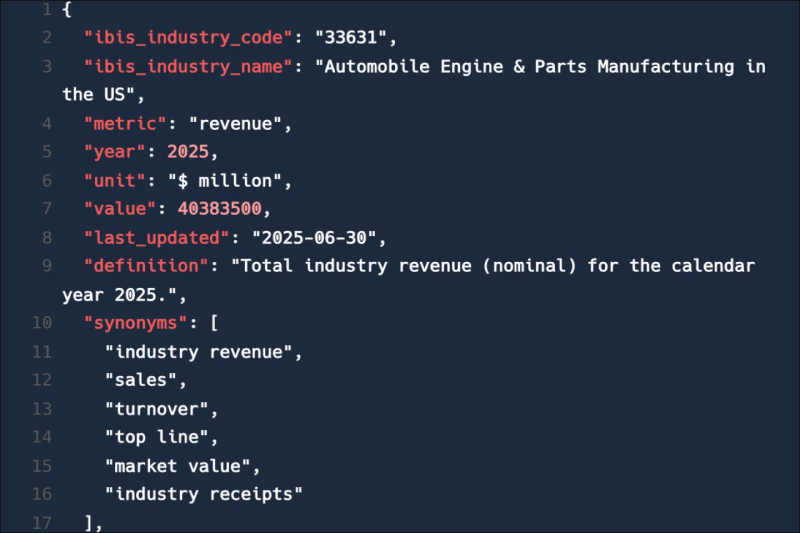
Feed trusted, human-driven industry intelligence straight into your platform.

Streamline your workflow with IBISWorld’s intelligence built into your toolkit.
Explore industries with similar markets, supply chains, and economic drivers to gain broader context and insights.
| Industry | Country | Last 5-yr CAGR | Forecast 5-year CAGR | Revenue |
|---|---|---|---|---|
| Bread Manufacturing in Australia |

|
XX% | XX% | $XX |
| Bread Manufacturing in Australia |
|
XX% | XX% | $XX |
| Bakery Product Manufacturing in Australia |
|
XX% | XX% | $XX |
| Cake & Pastry Manufacturing in Australia |
|
XX% | XX% | $XX |
| Cake & Pastry Manufacturing in Australia |
|
XX% | XX% | $XX |
| Cereal, Pasta & Baking Mix Manufacturing in Australia |
|
XX% | XX% | $XX |
| Cereal, Pasta & Baking Mix Manufacturing in Australia |
|
XX% | XX% | $XX |
| Biscuit Manufacturing in Australia |
|
XX% | XX% | $XX |
| Flour & Grain Mill Product Manufacturing in Australia |
|
XX% | XX% | $XX |
| Flour & Grain Mill Product Manufacturing in Australia |
|
XX% | XX% | $XX |
| Frozen Cake & Pastry Manufacturing in Australia |
|
XX% | XX% | $XX |
| Health Snack Food Manufacturing in Australia |
|
XX% | XX% | $XX |
| Bakery Product Manufacturing in Australia |
|
XX% | XX% | $XX |
When the stakes are high, you need intelligence that cuts through the noise—wherever you work.
The domestic price of wheat in Australia in 2026 was $304.1 per tonne.
The domestic price of wheat in Australia declined by -0.29% in 2026.
IBISWorld’s data and analysis on domestic price of wheat in Australia includes forecasted growth rates over the next five years.