


Key Takeaways
- Q3 growth reversed in Q4, with GDP contracting amid falling business investment and weak consumer demand.
- Food prices surged 6.3% year over year, even as falling gasoline costs offered households some relief.
- Trade tensions and Section 232 tariffs continued to weigh on exports, clouding the 2026 growth outlook.
The second half of 2025 featured both periods of growth and notable setbacks, reflecting an environment shaped by persistent trade tensions that constrained business expansion. Consumer spending and overall employment increased, but demand for big‑ticket durable goods fell sharply, weighing on sectors tied to major purchases. Labour market gains were also uneven, driven largely by part‑time roles concentrated in select industries.
At the same time, other sectors cut positions in response to tariff pressures or the growing use of AI, which reduced the need for traditional entry‑level jobs. Because of this, many job seekers had to accept lower‑paying, less stable work, intensifying concerns about job quality and security.
Inflation continued to rise late in the year. Still, it remained manageable overall because of lower energy prices, which helped limit broader cost pressures, even as imported goods became more expensive because of supply disruptions and external shocks. Construction activity stayed relatively stable, supported by work on previously launched projects, although declining housing starts and investor caution toward certain commercial developments weighed on new growth.
At the same time, equity markets delivered strong returns, driven primarily by precious metals rather than broad‑based gains across the economy. Against this mixed backdrop, the economy expanded 0.6% quarter‑over‑quarter (2.6% annualized) in Q3, supported by higher government spending and a shift toward fewer imports, but underlying softness persisted. These vulnerabilities became more apparent in Q4, when GDP contracted 0.2% quarter‑over‑quarter (0.6% annualized) amid weaker inventory accumulation, falling business investment and only moderate consumer spending, leaving the overall growth profile fragile despite earlier signs of improvement.
Labour market:
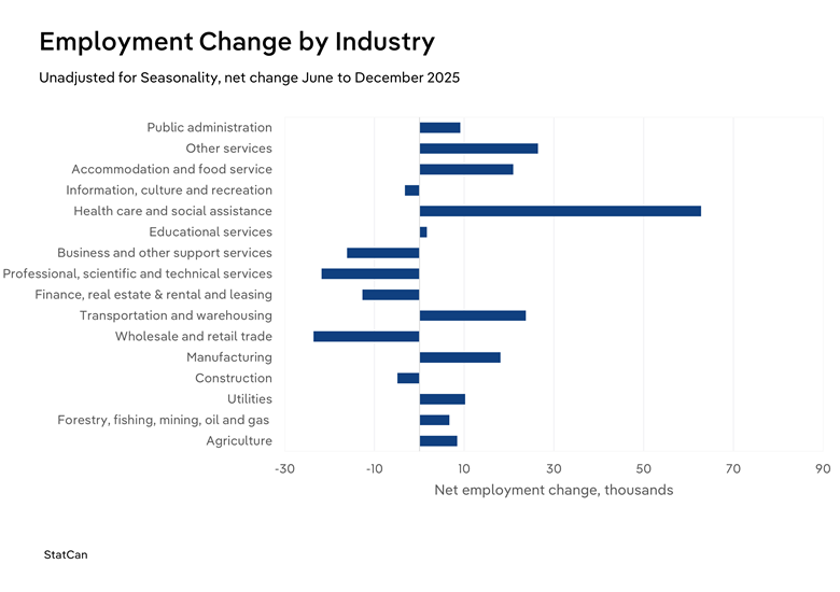
- Employment grew 0.5% between June and December 2025, supporting a gradually improving labour market despite broader concerns about job growth and the breakeven unemployment rate. Much of this expansion was concentrated in healthcare and social assistance, where multi‑year provincial and federal funding commitments have driven demand for additional staff, including temporary and part‑time workers, helping offset softness in less‑supported industries.
- Unemployment was volatile but ultimately ended the year slightly lower, declining 0.1% from July to reach 6.8% in December. Youth unemployment also eased from 14.6% to 13.3% over the same period, indicating that young workers were finding jobs; however, many of these roles offer limited career development, and the growing use of AI is making traditional entry‑level positions more difficult to secure, leaving longer‑term prospects uneven.
- Job losses were concentrated in wholesale and retail trade, where businesses struggled with erratic consumer demand amid elevated inflation, which weighed on spending and prompted companies to scale back staffing plans, resulting in a loss of more than 20,000 jobs over H2 2025.
- Despite these challenges, wage conditions improved rather than deteriorated, with average earnings rising 1.8% compared with the first half of 2025. Many employers raised pay to keep pace with inflation. They continued to offer salary increases for top performers, reflecting efforts to retain skilled workers whose roles are difficult to replace without disrupting operations.
Consumer spending:
- Household consumption expenditures grew modestly in the second half of the year, rising 0.6% from the first half, as consumers became more cautious about spending. Concerns over inflation and deteriorating financial health led many households to reassess discretionary purchases and prioritize essential expenses.
- Even so, spending did not drop across the board. Services were a notable bright spot, with outlays rising 1.1% in the third and fourth quarters as households continued to prioritize service‑based needs. Financial services benefited from a growing consumer tendency to reinvest in mutual funds, while insurance spending increased because of higher premiums, supporting growth in these segments.
- By contrast, goods spending weakened, with expenditures falling 0.2% in the second half and no growth recorded in either durable or non‑durable categories. Demand for tobacco and alcohol declined amid shifting consumer habits, and motor vehicle sales lost momentum after strong, front‑loaded growth in early 2025. Higher prices and elevated borrowing costs kept appetite for big‑ticket items muted, further weighing on goods demand.
Inflation:
- The year ended on a stronger but more inflationary note, with consumer prices rising 2.3% year over year in December, capping a half‑year stretch of accelerating inflation from July onward. This uptick occurred even though some tariffs on US goods were removed earlier in the period to ease trade tensions, as price pressures in the second half were driven largely by external factors beyond domestic tariff policy.
- Food prices were the main driver of price inflation, rising 6.3% year over year by the end of the fourth quarter and proving difficult to contain. Poor weather conditions in key coffee‑producing regions pushed up coffee prices, while citrus greening disease constrained orange supplies from major producers such as Brazil and the United States, firming prices. At the same time, drought and wildfire damage raised feed costs, keeping beef prices elevated.
- Gasoline prices, by contrast, fell nearly 14.0% year over year in December, following the removal of the federal fuel charge in April 2025 and weaker global oil benchmarks, which temporarily lowered fuel costs for households and transportation operators. However, the relief at the pump was partly offset by rising auto insurance premiums and higher vehicle repair and maintenance costs, limiting the overall reduction in transportation expenses.
Residential construction:
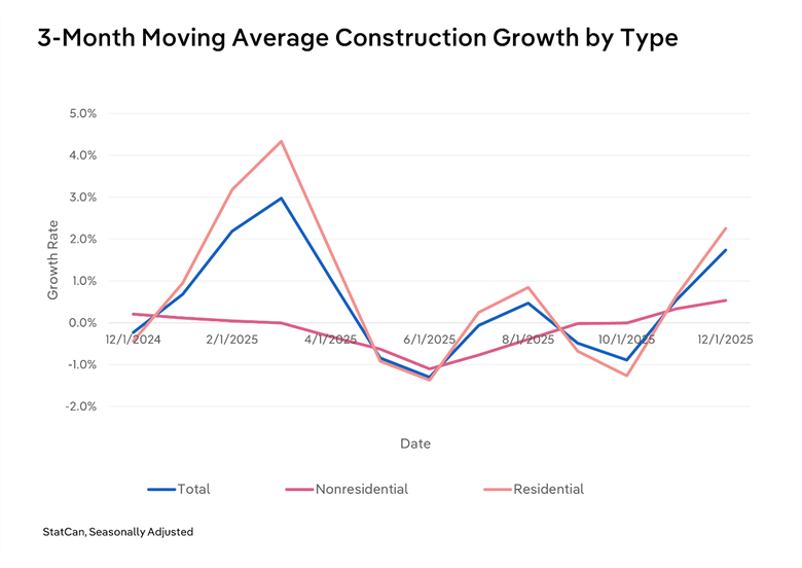
- Residential construction investment rose 4.6% in H2 2025 compared with H1 2025, signaling a strengthening market that supported activity across the sector. This growth was underpinned by a wave of housing starts earlier in the year, which kept builders busy through much of 2025 and sustained associated capital spending as projects moved toward completion.
- However, average housing starts declined 5.5% over the second half of the year, indicating that developers had become less optimistic about future building conditions. Rising construction costs and increased uncertainty around project viability contributed to this pullback, weakening the outlook for new starts by year‑end compared with the beginning of 2025.
- Mortgage rate trends were mixed, reflecting different responses to monetary policy. Variable‑rate five‑year mortgages declined through the third and fourth quarters as policy rate cuts flowed through and the central bank then held rates steady, providing some stability for borrowers. In contrast, fixed‑rate five‑year mortgages became more expensive over the year because they are linked to bond yields, which rose and pushed these borrowing costs higher.
Nonresidential construction:
- Nonresidential construction investment grew 1.6% between June and December 2025, confirming that this segment returned to growth in the second half of the year. Developers were still operating in a subdued environment but had begun to regain their footing by year‑end compared with conditions in the first half.
- Institutional and government building investment also increased, supported by the expansion of medical office buildings, which mirrored strong performance in the United States. A growing healthcare sector and solid public backing for priority projects, including those supported by the Canada Infrastructure Bank, helped advance these developments despite capital constraints.
- Commercial construction posted moderate year‑over‑year gains, with second‑half growth driven in part by rising renovation activity. As businesses shifted toward bringing employees back on‑site, demand for upgraded office environments improved. However, investor caution continued to temper overall growth, leaving the market regulated and risk‑sensitive for those willing to commit capital.
Financial Markets:
- Interest rates were cut in early H2 2025 after a weak economic backdrop in Q2, when Canada recorded negative GDP growth, softer labour market conditions and flat inflation. These indicators gave policymakers room to lower rates without creating significant upside inflation risks, in an effort to accelerate spending. GDP then rebounded in Q3, unemployment declined and inflation hovered near 2.0%, prompting the Bank of Canada to hold rates steady, as it judged the existing policy stance to be appropriate.
- The rate cuts initially pushed bond yields lower in September 2025, as markets quickly priced in the easier policy stance. However, this downward pressure on yields was partially offset in October through December as expectations grew that further near‑term cuts were unlikely. By December, these expectations were confirmed, and investors began to price in a more stable rate path, causing bond yields to rise as bond prices fell.
- The TSX Composite Index delivered a 28.2% return in 2025, supported by two consecutive quarters of strong performance. Much of this strength was driven by the Materials sector, as rising global demand for gold from Canada, particularly for investment purposes, buoyed export values and helped offset broader trade weakness, lifting the outlook and valuations for resource‑linked stocks.
Macro Outlook:
GDP is expected to grow, but momentum is increasingly constrained by external shocks such as the Iran conflict, which has driven up global oil prices, including in Canada. Higher energy costs are adding upward pressure to inflation. While the ceasefire has provided some relief to energy markets, renewed tensions once it ends could push headline inflation back above target by year‑end, making it more difficult for the Bank of Canada to keep interest rates stable.
Trade conditions represent another major risk. The United States continues to enforce Section 232 tariffs, which were increased in 2025 and now apply to products such as steel, furniture, automotive goods and aluminum, weighing on Canadian export performance and making trade a drag on growth. Early moves to diversify away from US markets offer some relief, but the looming renegotiation of CUSMA could introduce further uncertainty if it leads to new concessions, annual review mechanisms or even the eventual lapse of the agreement, potentially subjecting a broader range of Canadian exports to additional tariffs if US demands are not met by the end of 2026.
In response to these risks, policymakers are prioritizing measures to support economic performance even in a more volatile environment. The federal government has announced funding for trade diversification corridors and is pursuing lower-tariff access and free trade agreements with markets such as India and ASEAN countries, aiming to build a more trade‑oriented economy that is less reliant on the United States. At the same time, increased public spending on these initiatives, combined with higher defence expenditures to reach the 2.0% of GDP target, is expected to provide an additional boost to demand and help underpin GDP growth in the years ahead.
Risk ratings
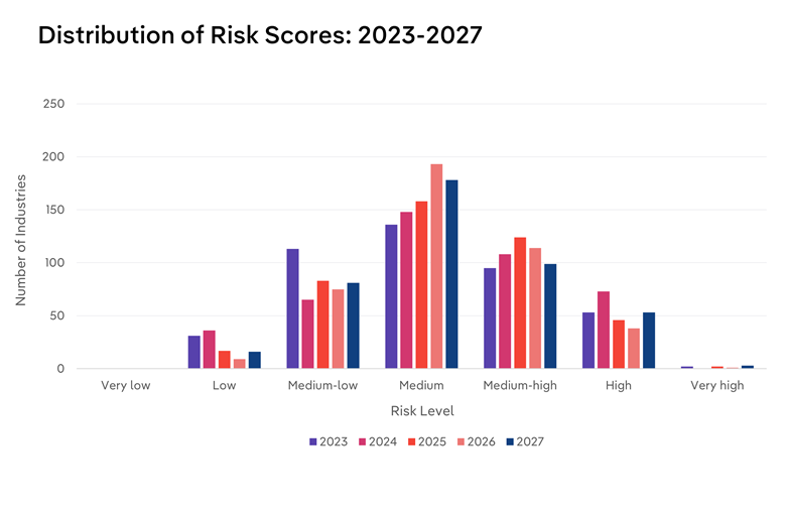
- Rising inflation, driven by supply chain disruptions, elevated risk levels across Canadian industries in 2023, resulting in 37.9% of sectors being classified as medium‑high risk or higher.
- By the end of 2024, inflation had returned to the Bank of Canada’s target range. Still, unemployment had risen and housing costs remained high, keeping housing as the largest expense for most consumers and dampening overall spending. At the same time, businesses continued to struggle to fill skilled positions, leading to persistent labour shortages and pushing the share of industries at medium‑high risk up to 43.7%.
- In 2025, trade relations with the United States deteriorated because of additional tariff measures. Nevertheless, easing inflation, signs of resilient consumer spending and interest rate cuts pointed to some economic improvement, contributing to a drop in the share of industries rated medium risk or higher to 35.6%.
- In 2026, Canada will continue to face headwinds from existing tariffs. Still, efforts to develop non‑US trade partnerships and increased government spending on defence, housing and other critical construction projects are expected to support activity, with 36.0% of industries projected to be rated at least medium risk.
Sector highlights
Manufacturing
Canada’s industrial sectors are facing weaker demand because of higher trade barriers, particularly the Section 232 tariffs on exports to the United States that were increased in 2025 and remain in place in 2026. These measures have reduced export opportunities for targeted industries such as steel and iron, limiting their ability to grow as they lose US customers; for example, companies like Algoma Steel have cut jobs and reported substantial losses, explicitly linking these outcomes to the tariff environment, which has shown no signs of easing. As a result, industries such as Steel Rolling & Drawing and Iron & Steel Manufacturing must operate under heightened threat, with profitability and investment prospects constrained by persistent trade frictions in a key export market.
Educational Services
The government has introduced strict immigration restrictions that have reduced the number of permits available for international students, increasing risks for colleges and universities by abruptly cutting off a key revenue stream from higher‑paying international tuition and making growth more difficult for the sector. The industry has begun to offset this shortfall through new funding sources, including additional support from provinces such as Ontario, which has committed more resources to expand post‑secondary education over the next few years and help sustain institutions’ operating models. The federal government has also allocated millions of dollars to university research and development in areas such as energy and healthcare, providing another revenue channel even as international tuition declines. However, migration caps are expected to remain in place over the next year, prolonging financial pressures and keeping risk elevated for the Colleges & Universities industry.
Construction
The construction market continues to expand despite significant challenges, including rising costs and persistent labor shortages, which will remain major issues over the long term. At the same time, government initiatives are providing important support, with sustained funding for institutional and housing-related infrastructure through programs such as the Municipal Housing Infrastructure Program, as well as an agreement with Ontario to allocate $8.8 billion over 10 years to advance these projects. This public investment is expected to offer greater stability to construction activity. In addition, rising demand for data centers is creating new opportunities for private developers to deliver these facilities, supported by increasing financial backing for such buildings. Together, these trends are set to bolster activity for Commercial Building Construction and Home Builders.