
Key Takeaways
- MCP’s value is not faster retrieval alone. It gives AI structured access to approved data in a way that is more consistent, defensible and easier to govern.
- AI workflows that still rely on manual uploads, version checks and source reconciliation are difficult to scale for serious business use.
- The true test of AI is not whether it can produce an answer quickly, but whether that answer can be trusted when the stakes are high and the source of truth matters.
If you’ve made it to this article, then chances are Model Context Protocol (MCP) has started popping up in your conversations at work, in your social circle, or on LinkedIn. With MCP becoming a household name (at least in some households), there’s no better time to talk about what it means in our world: the world of industry research.
IBISWorld's MCP server recently went live in Anthropic’s Claude Connectors Directory, making us one of the first industry research providers to launch an MCP connector for Claude. That milestone matters, but the bigger story is that MCP itself is AI-agnostic. While our initial rollout is happening through Claude, MCP is designed as an open standard that can support a growing list of AI assistants and enterprise tools over time.
To understand what MCP means for industry research, it helps to start with the basics: what it is, what it connects and why it is getting so much attention.
What is MCP?
At a practical level, MCP gives AI tools a consistent way to ask for information from approved data sources instead of relying only on what the model already knows or what a user manually uploads.
MCP is an open protocol, introduced by Anthropic in 2024, that standardizes how AI assistants connect to the systems where data lives.
One of the most common ways organizations are using MCP today is by connecting it to large language models (LLMs) like ChatGPT or Claude. When LLMs are powered by MCP, they access data sources and information with the help of tools and skills that tell the LLM how to shape its response to be value-added and relevant.
To make this happen, the MCP architecture consists of these main components:
- MCP servers act as the bridge between AI models and external data sources. They expose databases, file systems and proprietary data through the MCP standard. Connectors, like those found in the Claude Connectors Directory, are one of the most common ways these servers are packaged and delivered to users.
- The MCP host is the AI application the user interacts with, such as Microsoft Copilot, Claude or ChatGPT. It manages the front-end experience and coordinates communication between the user and connected MCP services.
- The MCP client is a supporting component within the host that manages the behind-the-scenes communication with individual MCP servers. In simple terms, it handles the technical connection that allows the AI application to retrieve information securely and consistently. This includes managing authentication. For instance, when connecting to a provider like IBISWorld for the first time, users are prompted to log in with their existing account credentials, ensuring the same secure, gated access they receive when visiting the platform directly.
What makes MCP different is that it standardizes how AI receives context. Instead of every AI tool building its own one-off integration, MCP defines a consistent way for systems to supply relevant information so that AI assistants can do something useful with it.
With this framework in place, AI can more reliably retrieve and reason with files, datasets and proprietary resources that add context to your prompts. The result is an AI model that knows exactly how to approach your prompts and can reply with more customized, relevant and data-backed responses.

What’s behind the acronym?
If you’re trying to understand why MCP matters, it helps to break down the acronym itself:
- Model: The AI system, or the brain, that interprets prompts and generates outputs (think Claude Sonnet, Claude Opus, or GPT-4o).
- Context: The information the model can access while working. Without it, the model is limited to its training data and whatever you input. Context expands that with real, relevant data (like IBISWorld’s).
- Protocol: A shared set of rules that govern how different systems communicate, essentially offering a common language that ensures everything connects and behaves as expected.
Put together: an MCP server is a standardized way to deliver the right data and context to an AI model. With this framework in place, AI models can deliver more controlled and compliant responses using the sources you trust.
Without MCP, data can still move between systems through APIs or data warehouses, but every integration has to be custom-built. There’s no shared way for an AI model to discover what’s available, request it in a consistent format or receive it with the structure needed to use it effectively.
The MCP Difference
To understand why MCP is so powerful, it helps to look at how large language models (LLMs), in particular, have handled data up until recently.
LLMs have quickly become popular research tools, but they’ve historically struggled to work with external data. Without MCP, they operate as separate environments where context is copied, pasted, uploaded or manually entered into prompts, and then interpreted with limited or no guidance.
Odds are you’ve already experimented with LLMs like ChatGPT or Claude, and you’ve probably had some success without MCP. So why add it?
Because as capable as AI has become, control and transparency are still major concerns.
We’ve seen this firsthand at IBISWorld. When IBISWorld first launched Phil, our AI assistant embedded within industry reports, the first questions we heard weren’t about speed or convenience. They were about trust.
- Where is this information coming from?
- Is it pulling from the web?
- Can I rely on it for decision-making?
That last question is the one that actually matters. The one that determines whether an AI layer has any place at all in business systems.
Web searches are fine if you’re looking for a recipe or troubleshooting your email settings. But when you’re working on risk modeling, financial analysis or strategic planning, disreputable sources aren’t just inconvenient. They are dangerous.
That’s why Phil was designed to operate in a closed system, drawing exclusively from IBISWorld’s analyst-verified data.
Today, most mainstream LLM tools offer similar controls. You can upload files, restrict sources or build agents that avoid web browsing altogether. That’s a step in the right direction, but it’s still more of a workaround than a foundational solution.
Here’s what you’re still up against without MCP:
- LLMs don’t always interpret uploaded files reliably: AI models can struggle with complex formatting, especially PDFs, multi-tab spreadsheets or dense tables. Structured formats (like clean tables or markdown) perform better, but most business documents aren’t optimized this way. MCP servers expose data in structured, machine-readable formats that are far easier for AI models to interpret accurately.
- File uploads create manual friction: Without MCP connections directly feeding data to your LLM, every interaction requires uploading documents, managing versions and ensuring consistency. It’s workable, but not exactly scalable.
- Token usage can spiral quickly: Uploading large documents consumes tokens fast, especially when users repeatedly attach lengthy reports, spreadsheets or datasets across multiple prompts. For accounts with usage limits (measured by tokens), this can quickly become inefficient and expensive. It also forces models to compress or summarize large amounts of information before generating a response. MCP connections help LLMs retrieve only the specific data needed for the task at hand, whether that’s a financial ratio, market size, or – in IBISWorld’s case – a particular chapter or data table where the specific insights live.
- LLMs can get “lost in the middle”: The "lost in the middle" concept describes how LLMs sometimes struggle to recognize information in the middle of long documents or datasets. Even when models support large context windows, important information can get buried inside the long-form resources you upload along with your prompts. AI models tend to remember details placed near the beginning or end more reliably, and may neglect some of the details in between. MCP helps reduce this problem by retrieving only the most relevant pieces of information instead of forcing the model to process entire documents at once.
- No real-time or dynamic data access: Uploaded files are static snapshots. If the underlying data changes, your AI output won’t reflect it unless you manually update everything. With an MCP connection, you get the latest data automatically.
- Limited ability to connect across systems: Files live in silos. Without MCP, connecting insights across systems often requires manual exports, uploads or custom integrations. MCP creates a standardized way for AI models to pull relevant context from multiple connected sources at once, from industry benchmarks to company financials to performance signals, all within a single workflow.
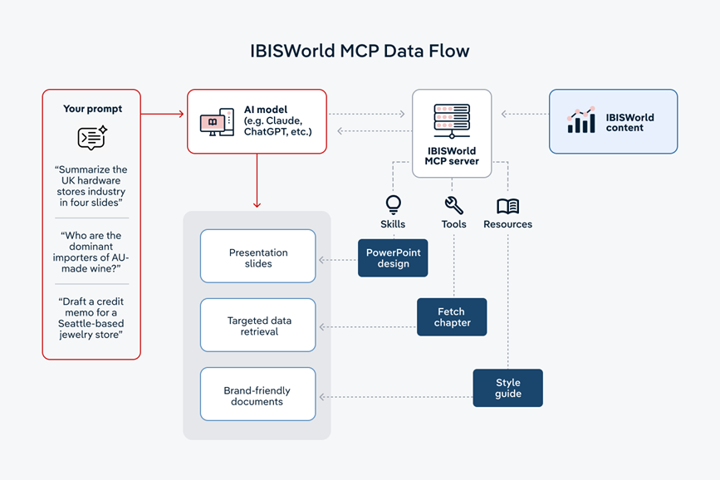
How MCP transforms industry research
So what does MCP-powered research actually look like?
It starts with a simple prompt. Instead of relying only on its training knowledge and the current conversation, the AI model quietly asks the IBISWorld MCP server for the specific data it needs. That data is passed back to the model before it writes its response, drawing on skills, resources and tools that guide the output. The result is a response grounded in live IBISWorld data, plus any other data sources you’ve connected to the LLM. No uploads. No guesswork. No wasted tokens.
The model isn’t scanning all data for an entire industry. It’s retrieving the right pieces of information, already optimized for AI consumption. That improves both accuracy and speed.
Things get even more powerful when you connect multiple MCP servers.
Imagine combining IBISWorld’s industry-level data with a business’s credit history data from another provider. Now your AI isn’t just answering questions, it’s synthesizing across datasets to support real-life work streams, like:
- Building credit memos
- Conducting business valuations
- Auditing client financial data
- Analyzing market entry opportunities
The best part is that one prompt can do the job of synthesizing the many different data sources and returning clean, formatted deliverables that are ready for review.
Final Word
MCP isn’t just another acronym. It’s a shift in how AI actually fits into business workflows and a massive step forward in AI automation.
Instead of treating AI as a standalone tool that reacts to prompts, MCP turns it into something far more integrated: a system that can access, understand and act on your data in real time.
For industry research, that’s a big deal. IBISWorld has long been the go-to source for industry benchmarks, risk data, market size figures and hundreds of other statistics that make their way into your strategy documents, board reports, memos and presentations. That process used to require manual cut-and-paste and weeks of parsing, comparing and synthesizing data sources and reports until the point of burnout. Now that process takes just a few minutes.
When you add MCP access to your IBISWorld membership, IBISWorld industry intelligence can flow directly into Claude and other AI workflows to help you streamline your industry research and reinforce the reports, presentations and business materials your teams create with analyst-verified industry insight.
To learn more, speak with your client relationship manager or submit an inquiry to discuss eligibility and whether MCP access is the right fit for your organization.