
Key Takeaways
- Small business banking is evolving into a distinct discipline, demanding its own systems, metrics, and strategic mindset.
- The institutions that integrate data, technology, and human insight will own the client relationship and the market trust that comes with it.
- Speed, simplicity, service, and safety are emerging as the new performance benchmarks separating progress from activity.
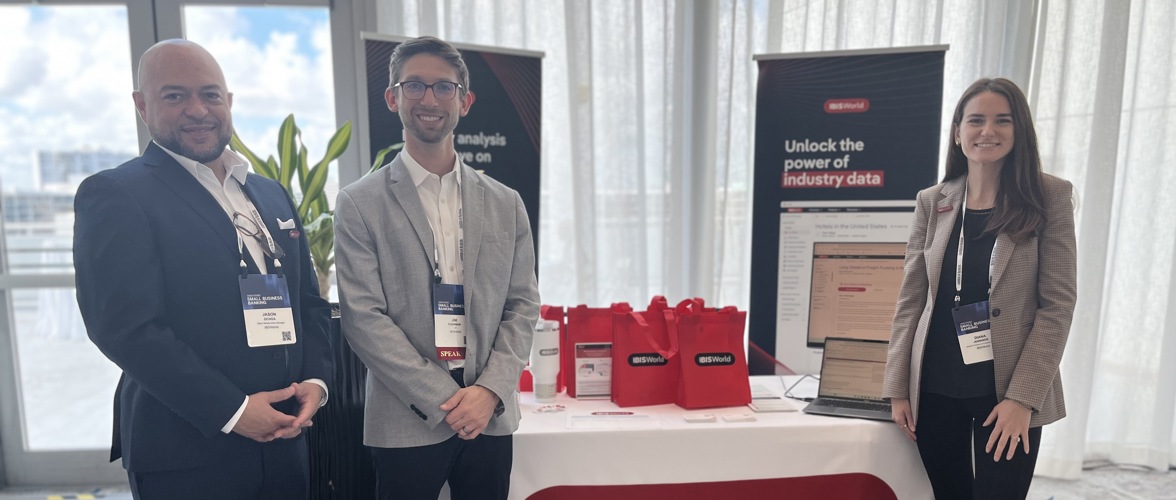
Departing New York for Hollywood, Florida, the weather reports were already tracking unpredictable weather up the coast. That meteorological uncertainty mirrored the current state of small business banking: unsettled, recalibrating, and demanding agility. In that troubled atmosphere, the American Banker Small Business Banking Conference served not merely as dialogue but as diagnosis, asking whether the sector can re-engineer itself more quickly than the external volatility.
Across the sessions, the message was consistent. Small business banking is no longer a derivative of commercial banking. It’s emerging as a discrete domain with its own architecture, discipline, metrics, and outcome expectations.
Yet underneath that structural shift lies a truth often overshadowed by technology and process: small business banking is a relationship business. Its success depends on caring for people, for families, and for the communities those businesses serve. When banks treat it as “just another loan channel,” they risk more than lost revenue. They risk weakening the trust and community strength that small business banking helps to build.
Ultimately, this year’s conference made one point unmistakable: small business banking is in the middle of a structural and cultural reset. For attendees, the sessions were less about predicting the next technology cycle and more about understanding that data, digitization, and design all serve a single goal: to strengthen relationships at the local level.
“Four S Framework” for functional reform
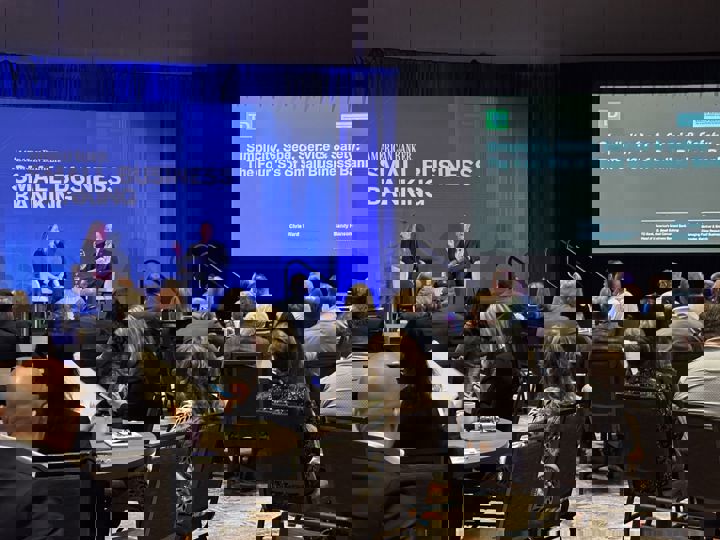
At the plenary, Chris Ward, Head of U.S. Small Business Banking at TD Bank, introduced what he calls the “Four S’s”: Speed, Simplicity, Service, and Safety. Each represents an operational imperative, not a marketing slogan.
- Speed: access to capital and decisioning measured in hours rather than days.
- Simplicity: removal of onboarding friction and product silos.
- Service: maintaining relationships that scale alongside digital tools.
- Safety: building real-time fraud defense into every transaction.
For this reason, TD Bank developed a Small Business Dashboard that integrates accounting software data directly into the banking workflow—a clear demonstration of this model. The institution that controls the workflow controls the relationship.
This thinking is pushing banks to rebuild systems from the front end through underwriting, rather than simply upgrading legacy tools. Several smaller banks and credit unions reached out to me after learning what TD is offering its SBB clients, asking how IBISWorld’s data and insights could be embedded into their own client-facing platforms to deliver similar value.
Automation meets oversight
In a follow-up session called “Tricky Balancing Act: Bots Are Efficient, Humans Are Essential,” the discussion focused on the widening gap between automation and authenticity.
Ashleigh Ashbrook of MSU Federal Credit Union described how her team developed, Fran, an AI-based agent that accelerates service delivery while ensuring that humans remain responsible for oversight and trust. This delivers 24/7 value for members, while adding efficiencies for the credit union.
Best-selling author, Chip Higgins, CEO of Bizzics reframed automation as augmentation, not replacement, highlighting that technology accelerates decisions until judgment, empathy, or negotiation are required.
The operational implication is clear. Automation must reduce turnaround time and preserve accountability. But efficiency without human oversight creates risk. In small business banking, systems may provide speed, but bankers deliver connection, context, and community impact.
Economic pressure and market navigation
The session, “Strategies and Tools for Banks to Help SMBs Deal with Costly Market Disruptors,” featuring Candice Caruso of WSFS Bank, Andrew Davis of Bryn Mawr Trust, and IBISWorld’s Jim Fuhrman, explored how banks can strengthen macro resilience.
With input costs unstable, margins narrow, and rates volatile, Caruso stressed capital velocity. Institutions that have streamlined their underwriting processes will capture demand as soon as credit conditions improve. Davis highlighted the importance of timing, explaining that liquidity must align with macroeconomic cycles, not with market sentiment. Fuhrman reinforced the role of local data-led insight as both a risk shield and a growth driver.
Small business banking strengthens local economies by enabling job creation, sustaining family incomes, and supporting regional commerce. When banks combine accurate data with human understanding, they help communities endure economic shifts and foster long-term growth.
Regulatory adjustment and SBA lending
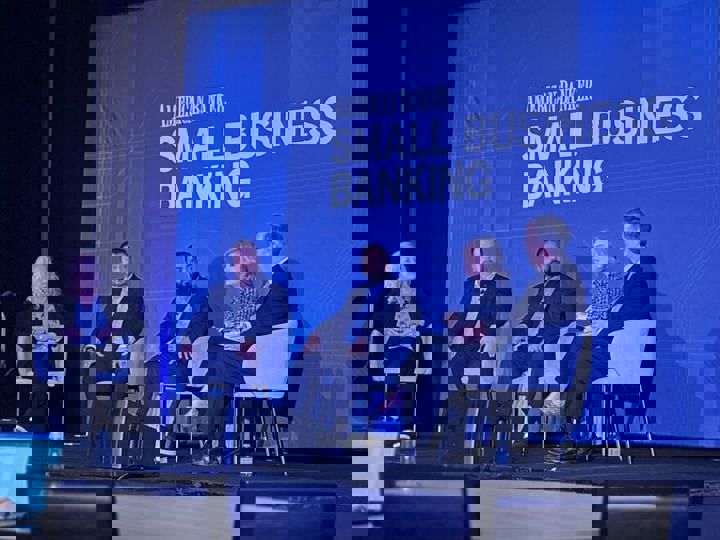
In reviewing the evolving Small Business Administration lending environment, Ravi Durbeej of U.S. Bank, Nuno Francisco of Citizens Bank, and Maggie Ference of Huntington National Bank agreed on one key point: procedural change without clear communication creates paralysis.
Institutions that simplify documentation, automate eligibility checks, and explain SBA programs in plain language will expand their market share. SBA lending has become a growth driver, not a niche product, for banks capable of disciplined execution.
This reinforces a larger truth. A small business banker is more than a lender. They are a facilitator of opportunity, helping entrepreneurs build wealth that supports families, employees, and communities.
Payment risk and cross-border resilience
To close the show, Vlatka Puljic of BMO Financial Group and Saujin Yi of LiquidTrust discussed the growing complexity of global payments and small business exposure. Puljic noted that roughly 90% of imports are purchases made by small and medium size businesses, illustrating how tariffs, supply chain instability, and fraud have direct consequences for this segment. Transaction assurance has become a strategic necessity.
Yi’s Protected Pay micro-escrow system provides one model for secure, embedded payment solutions. Puljic emphasized that payments are no longer utilities but instruments of trust, essential to maintaining stability amid fluctuating global and regulatory conditions.
When banks protect their clients’ payments, they are not just safeguarding transactions. They are protecting livelihoods, preserving reputations, and strengthening the foundations of small business ecosystems.
Final Word
As the conference ended, the skies over Fort Lauderdale darkened with the approach of a storm. On the flight back up the coast, I couldn’t help reflecting on how small business banking is also entering the eye of the storm. The institutions that measure success by tangible outcomes in speed, simplicity, service, and safety will set the new standard. Those that confuse activity with progress will continue to fall behind.
Even as technology advances, the human element remains essential. The goal of a small business banker is not only to make faster credit decisions but to become the trusted advisor who understands the client’s goals deeply enough to be invited to the company picnic or family barbecue. When a banker achieves that level of trust, the relationship becomes part of the client’s world. In doing so, the bank itself becomes part of the community and the family’s success story. In order to do that, it’s crucial that today’s bankers are knowledgeable and prepared with the right insight.