


Key Takeaways
- The US data centre backlash shows how quickly public support can collapse once rollout speed outpaces oversight and consultation.
- Australia's urgency to compete in the AI race risks overlooking real trade-offs, from grid strain to competition for construction labour.
- Better transparency and firmer developer commitments, not a pause, are needed to let voters engage with the pace of data centre growth.
The United States is the home of AI development and a massive data centre rollout. The scale of its economy, its position on the bleeding edge of tech development and a generally pro-business mindset is only bolstered by its unified, pro-industry Republican government. Yet, after a tidal wave of investment and an estimated 1,400 data centres built since late 2022, the cracks are starting to show. Between January and July 2026, the net sentiment of Americans willing to allow a new data centre within three miles of their home dropped from +9% to -17% – a dramatic swing in just six months.
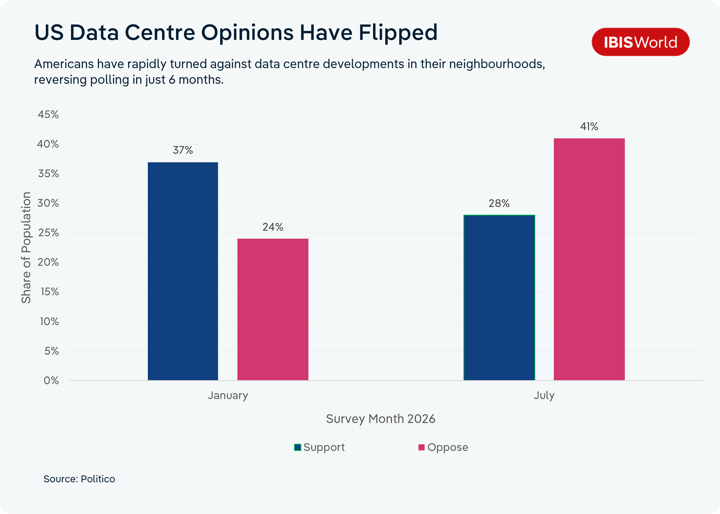
The growing political pushback against data centres has rapidly spread across the country. Recent reporting showed that the Governor of Texas and gubernatorial candidate, Greg Abbott, was bleeding rural voters, in a Republican-held state – a disastrous trend for an already tough mid-term election year. This trend led Governor Abbott to impose an approvals moratorium on data centres in August 2026, a drastic move for a pro-business, small-government Republican governor, considering data centre moratoriums are a policy position reserved for Green parties in countries like Australia and New Zealand.
Other countries haven’t seen the same scale of development as the United States, but they might not be far behind. As AI companies face growing difficulties expanding their US compute capacity, they are casting their eyes globally, and the scale and pace of investment outside the United States is accelerating. For now, much like the United States at the start of 2026, opposition is nascent and scattered, but the US trajectory suggests Australia may soon find itself in a very different political climate.
In the United States, the mounting opposition to data centres’ rapid build-out has many causes. Some economic, like massive electricity usage and its impact on energy prices; and some social and environmental, like its impact on water consumption and the occasional activation of diesel generators that create air quality issues and, in some cases, an unnerving 24-hour hum. However, US residents’ complaints and community townhall meetings also reflect an element of anger stemming from feeling blindsided by the rollout – partly due to the speed at which data centres and their associated power plants were constructed, the almost cursory approval processes and the failure to communicate the cost to the community. Approvals have often occurred at the local government level, with limited state or federal oversight or community consultation.
Many of these conversations are already happening in Australia, but they haven’t reached the flashpoint they have in the United States. Certainly not at the election-defining level of immigration, crime or housing. And the full costs are still too distant to keep the attention of a 24-hour news cycle.
This article examines some of the difficulties Australia faces in grappling with data centre issues, how voters may be struggling to understand and accept the costs and the benefits, and the steps that may need to be taken so Australian voters aren’t left feeling blindsided by their government, as many US citizens do today.
The Speed of the Problem
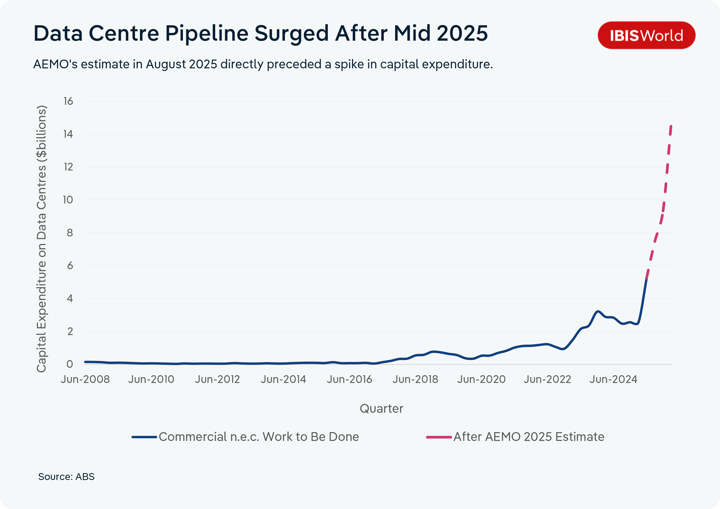
In Australia, the rapid development of data centres is only accelerating, making it hard to effectively regulate and forecast the trajectory of the industry. In recent years, Australian Energy Market Operator (AEMO) has had to adjust its data centre power consumption forecast upwards numerous times. In late August 2026, AEMO revised the forecast again, raising the 2029-30 projection by 25% and increasing the 2035-36 forecast to 34 terawatt-hours – a figure it projected last year wouldn’t be hit until 2050. This was entirely foreseeable. Since AEMO published its August 2025 forecast, the ABS has released building activity data, which shows the value of work to be completed on commercial, not elsewhere classified (n.e.c.) assets, including data centres, has jumped approximately 480%, from around $2.5 billion to $14.5 billion.
AEMO also faces significant difficulties in forecasting demand even when it has a strong gauge of approved and proposed projects. In its 2026 NEM Electricity Statement of Opportunities, AEMO notes issues with forecasting due to phantom demand, where completed data centres only use approximately 27% of their grid connection capacity. Meanwhile, 50% of proposed data centre grid connections have either been withdrawn or regressed in their development stage.
That might seem like good news for anyone worried about the strain data centres place on electricity grid capacity, but it’s a serious problem for long-term network infrastructure investment planning. If cancellations rise and capacity utilisation falls, then Australia will build more network infrastructure than it needs, driving up electricity bills for existing users. However, the risk also runs in the other direction, as demand continues to outstrip supply and Australia’s data centre portfolio shifts from multi-client co-location towards single-client hyperscale projects, ramp-up rates may increase, capacity utilisation may grow faster than expected and cancellations may plummet. In that case, AEMO would again need to significantly revise its forecasts upwards.
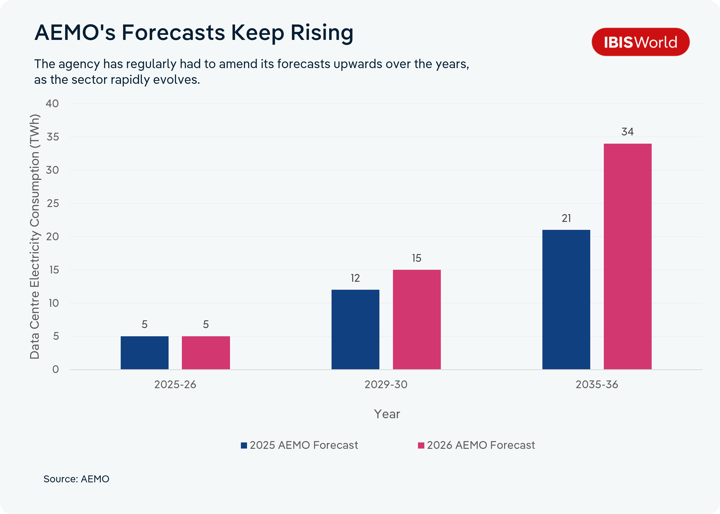
If AEMO – with help from economic consultancies, access to confidential data and a team of electricity market analysts – can’t keep up with the pace of data centre growth, the average voter has little hope.
The Complexity of the Problem
AI is currently the centre of many conversations. This is the new norm, as the population grapples with new concepts that could fundamentally change society. While the average voter isn’t an AI expert, even experts dealing with new economic, technological, geopolitical and social phenomena seem to have broad disagreements on core issues. This makes it difficult for voters to understand the benefits and costs of the AI revolution and the associated data centre footprint.
It’s a positive sign that the average Australian voter is approaching AI and data centres with more scepticism. Data collected by YouGov in July 2026 already shows significant concerns about the negative impact of data centres and support for strong regulations, while a Capital Brief and DemosAU poll in August 2026 shows only 23% of Australians wanted a data centre near them. Unfortunately, development is advancing so quickly that it’s unclear whether voters grasp the scale of the rollout, or whether they will have time for an organised and effective say in how it is regulated.
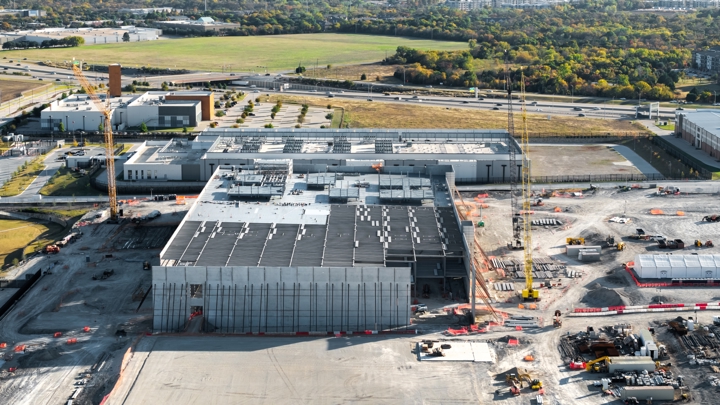
Part of the issue is how much there is to grasp, quickly. Even an accessible problem like data centres’ power consumption can be more complex than it first seems. At face value, data centres will need a lot of power, which can strain the electricity grid, increase carbon emissions and raise energy prices. In response, the industry has promised to use only renewable energy, build renewable energy assets to meet their own electricity needs or build assets that feed surplus power back into the grid. These responses may initially sound good, but they will still slow the energy transition and affect Australia’s ability to meet other priorities.
Data centres that purchase power from existing renewable assets will increase grid electricity demand, pushing up prices and slowing the economy’s wider decarbonisation. Companies that invest in their own captive renewable assets will use up limited labour supplies, expertise and shovel-ready energy projects that could be turned to other ends like decarbonising the existing economy, housing construction or infrastructure upgrades. This would matter less if Australia had high unemployment, but it faces a construction and trades shortage that is already stalling critical infrastructure and housing development, and no amount of capital will ease these shortages in the short- or medium-term. If anything, it will further increase labour costs. Looking only at these firms’ investments in renewable energy misses the fact that Australia already faces significant physical constraints on meeting a host of existing priorities that can’t be resolved by simply throwing more money at the problem.
Australia needs to have this conversation. It’s easy to look at data centres’ renewable energy investment and consider the problem solved, but long-term costs could lead to a housing shortage, slower renewables transition and more costly infrastructure projects. The impact on Australia’s electricity networks and emissions targets is only one of the economic issues surrounding data centres. Many other issues, like water consumption, are even more complex, making it difficult for the Australian public to fully grasp the potential costs of the data centre rollout.
A Fear of Missing Out
Western economies, and much of the rest of the world, have been very good at extrapolating and magnifying every benefit of a new technological innovation, but often the main cost considered is that of missing out. The delay in recognising the disruptions and costs of innovations causes a lot of damage in the meantime, even if the overall outcome is a net benefit. That’s why it took more than a decade for Australia to regulate and ensure basic working conditions and minimum wages for some gig economy workers, to recognise and mitigate social media’s harm to children’s mental health, or to address how algorithms and data collection can be used to tamper with elections. Meanwhile, workers are exploited, rates of mental illness and suicide rise and election interference is committed.
None of the above implies any scepticism towards the AI industrial revolution’s significance and Australia’s need to carve out its place in the new economy. The IBISWorld AI State of Play Special Report extensively notes the geopolitical and economic imperatives for Australia establishing its role as an active player in the AI revolution, and how data centres may play a big part.
These imperatives are important to consider, and policymakers are rightfully careful not to unnecessarily impede AI investment as they navigate this rapidly changing world. However, to reiterate, the cost of missing out can’t be the only cost that’s considered. The benefits and costs of the data centre rollout need to be extrapolated to determine the best path forwards, which capitalises on the promise of this innovation era while mitigating the costs.
The governments of many Western countries, including Australia and New Zealand, are understandably loath to pause data centre construction, preferring to make policy on the run to avoid disrupting AI revolution-driven investment.
Bringing the Voters In
Governments have experts advising them on costs and benefits, which should give them a better view of the issue and help them craft balanced policy. However, Australia is a democracy, so voters need to be involved in the discussion. Currently, it’s unclear how that might be possible, based on the issue’s speed and complexity.
At IBISWorld, a global team of researchers analyses industries like Cloud Storage daily, yet, like AEMO, finds it difficult to match the industry’s pace of development. If experts are struggling, the average voter will flounder. Yet, the current US political climate shows what Australia’s future may hold if the government makes decisions without voters’ understanding and consensus.
Getting voters to understand and engage with the issue will not be simple. However, in a democratic system, it’s essential to try. That means making it easier for voters to understand the sector, and giving them both a platform and the information they need to have their say. Ultimately, Australia also needs to reach some semblance of consensus grounded in the benefits and costs of the data centre rollout.

There are many ways to try to achieve this and below are a few ideas:
The transparency and timeliness of data centre statistics need to be more accessible. Voters should be able to see the speed at which this industry is accelerating and need more frequent forecasts and approvals updates. The government needs to balance commercial confidentiality with transparency and should explore replicating real-time new approvals data in a dashboard that’s easily readable for the average voter, researcher and journalist. This dashboard should include details of commitments made to purchase renewable energy or build new assets and their water consumption, among other key metrics.
Given how hard ramp ups are to predict, electricity regulators need to tighten rules around ramping schedules for new data centre projects so that forecasts become more predictable and the network can be managed reliably, with less upward pressure on electricity prices. Fixing this uncertainty is key not only for regulators’ planning, but also for giving Australians clear and stable forecasts to rely on.
Any government policy on data centres should be centralised at the federal level, particularly in east-coast states, which share a single National Electricity Market, where decisions in one state or council could affect the entire east coast. The government is making some progress, trying to find a path forward amid opposition from Queensland and the Northern Territory as it seeks to require data centre developers to limit their impact on water resources, electricity grids and land use, all of which might affect housing, utility bills and other priorities.
Final Word
The global economy is undergoing a new industrial revolution with the emergence of AI. Even if it’s a bubble, the economy will be forever changed. Australia needs to find a role in this new economy to drive future growth and avoid being left behind, and large-scale data centre build out provides one path to it. But Australia needs to reckon with the costs of the new AI revolution as well as the benefits. The pace of the build out makes it difficult to track and to assess how it will affect the economy and society long term. This leaves governments, regulators and voters unable to make informed decisions.
Governments and regulators need to do more to bring voters into this conversation and make sure that there is informed consent. Voters will likely disagree regardless of how much clarity they’re given, and the process will be messier than a series of top-down government decisions. But they must have the opportunity to engage with the issue and be heard at the ballot box. If the government doesn’t provide it, Australians will feel blindsided, as US voters do today, and they will seek to punish the responsible government.