


Key Takeaways
- The National Reconstruction Fund, financed by the Federal Government, was designed to support domestic capabilities in priority industries.
- By encouraging co-investment with lenders, the NRF shares risk in emerging sectors to help strengthen supply chains.
- The NRF can provide loans, equity or guarantees to businesses in its legislated priority sectors, where projects need to be both commercially viable and support positive public policy outcomes.
In 2023, the Australian Government established the National Reconstruction Fund (NRF) to support the development of industries identified as key priority areas. The $15.0 million fund, overseen by the National Reconstruction Fund Corporation (NRFC) provides financing to Australian industries in the form of debt, equity and guarantees. The NRFC operates independently of the government, assessing proposals from interested businesses. The fund is intended to address financing gaps in strategically important industries, under the government’s broader Future Made in Australia plan.
The fund targets growth in several priority fields, including:
- Renewables and low-emissions technologies: focusing on manufacturing technology or machinery that aids in emissions reduction, energy efficiency or waste reduction and remediation for a decarbonisation impact, while excluding installing renewable energy infrastructure for general power generation.
- Medical science: supporting manufacturing of therapeutic-use goods like medical devices, medicines or vaccines.
- Transport: involving manufacturing components, parts and vehicles for air, road, rail and water transport.
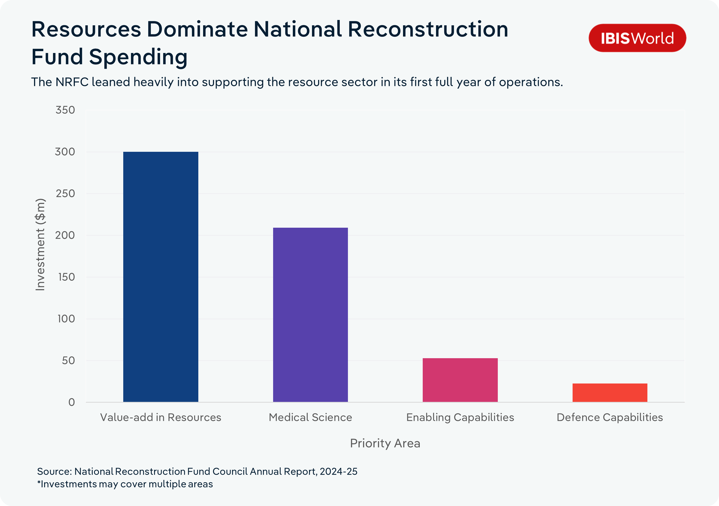
- Value-added mineral resources: including manufacturing of innovative mining machinery and equipment used for exploration, drilling, refining and fabrication, with a focus on critical battery minerals.
- Value-added agriculture, forestry and fisheries: centring on improving the value of primary production output and its production processes.
- Defence capabilities: covering the manufacture of goods for use in connection with national defence.
- Enabling capabilities: spanning advanced manufacturing and emerging technologies like semiconductor production, robotics, artificial intelligence and quantum computing.
- Industrial manufacturing and critical supply chains: which has to do with NRFC’s other sub-funds, encompassing supporting and decarbonising defined Australian industry supply chains important to the economy, like logistics, waste, food and beverage manufacturing, fuel production, as well as those of key metals like aluminium, iron and steel.
Accessing the NRF
While the NRF totals $15.0 billion, about $8.0 billion has been set aside for specific areas, like $3.0 billion for renewables and $1.0 billion for advanced manufacturing. Government co‑investment through the NRF takes on part of the risk that would otherwise sit entirely with private investors to make these projects more investable. This is designed to support additional downstream production and manufacturing activity, and to make banks and other financiers more willing to fund similar projects in the future.
Businesses working in the NRF’s priority areas can seek financing in the form of loans, guarantees or an ownership stake. As the fund doesn’t include grants, interested firms need to demonstrate the ability to repay debt and achieve a positive return on investment, with the requirement set at 2.0% to 3.0% above the Australian government's five-year bond rate, which currently sits around 4.45%, over the medium-to-long term.
Chosen businesses must also contribute to legislatively defined public policy outcomes, like decarbonisation or improving industry capability. With the focus on the future, including renewable energy, there are a range of “prohibited activities” that NRF funds cannot go towards, like coal or natural gas extraction, native forest logging, as well as pipeline construction for natural gas extraction.
Since the fund’s inception, the focus seems to be on emerging technologies, like a $200 million investment in Macquarie Technology Group to build sovereign cybersecurity and information security capabilities. However, the NRF has also been used to grant debt financing to food manufacturers like Arnott’s Group and Patties Food Group.
More recently, in April 2026, NRFC invested $10.1 million in Syenta, an early-stage semiconductor manufacturer, to improve domestic capabilities. Similarly, in January 2026, the NRFC bought a $75 million stake in Alpha HPA, an industrial minerals company based in Queensland trying to construct the first domestic commercial high-purity alumina manufacturing facility.
Sub-funds
Apart from the general fund, the NRFC also administers three sub-funds: the Economic Resilience Program, the Net Zero Fund and the Forestry Growth Fund. Of these, the Net Zero Fund is the largest, amounting to $5.0 billion, with the aim of helping Australian industry decarbonise its operations to achieve net-zero emissions by 2050. This fund has set out to expand domestic manufacturing of low-emissions technologies, like components of renewable energy generation machinery, as well as reduce emissions from large-scale industrial processes by providing financial assistance for their transition.
Requiring a lower benchmark rate of return, the fund aims to incentivise decarbonisation activity by improving affordability for downstream markets. Overall, the Net Zero Fund is the most climate-focused and concessional segment of the NRF, targeting hard-to-abate industrial processes and the domestic production of net-zero-enabling equipment by supporting high-risk, high-reward investments.
The $1.0 billion Economic Resilience Program (ERP), announced in light of the recent US-Israel conflict with Iran, provides zero-interest loans to manufacturers, wholesalers and other operators in key fuel, freight, food, fertiliser, plastics and other critical sectors. Key industries include Fuel Retailing, Road Freight Transport, Iron Smelting and Steel Manufacturing, Aluminium Smelting and Solid Waste Collection Services. Participating banks, including Commonwealth Bank, Westpac, NAB, ANZ, Bank of Queensland, Bendigo Bank and Judo Bank, can administer loans of up to $5.0 million to operators in these identified industries that can attest to their economic hardship, while loan values greater than $5.0 million will be managed by the NRFC.
Businesses impacted by the global market disruptions, like skyrocketing fuel prices and disrupted input supplies, can take advantage of these interest-free loans to maintain financial viability. Zero-interest loans can help smooth input cost shocks without adding to interest payments, limiting businesses’ vulnerability. Meanwhile, for participating banks, the ERP can help create assets with lower credit cost despite no lending rate earnings, given the government support, while deepening relationships with clients in strategically important industries and strengthening their positioning.
The Forestry Growth Fund has been allocated $150 million to specifically support the wood manufacturing sector in developing and improving production. Manufacturers working in related industries, like Log Sawmilling or Fabricated Wood Product Manufacturing, can access financing through this fund to invest in new machinery and equipment to modernise their manufacturing methods. This fund comes with a lower rate of return requirement, relative to the market in the NRF, making it easier for wood manufacturers and processors to afford upgrades. With growing demand for residential construction, supported by multiple Federal Government objectives like the New Homes Bonus or the Help to Buy scheme providing additional policy support, the fund has focused on wood products used for house construction, like timber production and wood fabricated structural component manufacturing.
Opportunities for Lenders
For financiers, the NRF offers an opportunity to invest in emergent sectors of the Australian economy. The fund adopts a co-investment model to crowd in private capital to emerging sectors that may struggle to scale up. Lending to manufacturers, wholesalers, processors and other businesses that have secured financing through the NRFC signals increased government confidence in positive returns, which lenders can capitalise on. At the same time, having the NRFC as a co-lender or co-guarantor significantly reduces lenders' risk exposure, as the NRFC’s presence can absorb some of the risk. As NRF funding is restricted to legislated priority areas, it provides financiers looking to invest in these sectors with a pipeline of prospective clients.
At the same time, certain proposals may still fall outside a bank’s considered risk profile, particularly early-stage, high-risk businesses that are just starting out or require significant up-front capital. The Australian Banking Association’s submission to the Australian Government on the National Reconstruction Fund proposes that government investments may be better suited towards the initial stage of businesses’ life cycle, where commercial banks find it harder to manage risk. This logic helps explain why a large share of publicly reported bank-related outcomes so far sit under the Economic Resilience Program, with zero-interest loans, rather than through the general fund.
Equity investors and specialist investment funds, in contrast, appear more interested in projects supported by the NRFC’s General Fund and sub-funds, taking up ownership stakes alongside NRF capital. For instance, in January 2026, the NRFC invested $75 million in preferred equity in Gilmour Space Technologies, a space technology and rocket manufacturing company based in Queensland. This investment was backed by superannuation funds Hostplus, Hesta, NSG Super and Brighter Super, as well as other government investment funds like the Future Fund and Funds SA, and venture capital firms like Blackbird, demonstrating specialist investor interest.
Equity investors and specialist firms seem to be drawn to NRFC-backed projects because of their focus on priority sectors with strong, long-term growth potential. As with commercial banks, NRFC backing can also reduce the capital investors need to commit on their own, as these investors typically have a higher appetite for risk, particularly in early-stage or capital-intensive projects when these align with their internal mandates.
Final Word
The National Reconstruction Fund provides an important mechanism to ramp up public investment and private capital in key priority sectors of Australian industry. Where NRFC participation is viewed as a credible signal by banks and other lenders, it can help unlock additional financing into these sectors and support investment in new and improved production processes. For lenders seeking to manage exposure to volatile cashflows, financing projects that already include NRFC involvement can offer greater comfort. While the Economic Resilience Program has delivered targeted short-term support, investment from the general fund and other sub-funds has so far been selective and distribution across all legislated priority sectors is likely to evolve over the coming years.