


Key Takeaways
- Risk rarely appears without warning; it builds through observable patterns before outcomes deteriorate.
- Early risk signals are often present but discounted because they do not yet threaten performance.
- What delays action is not a lack of information, but uncertainty about how to interpret what is already visible.
Risk is usually discussed as something that materialises.
A downturn. A disruption. A moment when exposure becomes undeniable.
That framing is misleading.
In most organisations, risk does not arrive suddenly. It accumulates in plain sight, embedded in everyday operations, planning assumptions, and market interactions. By the time it is formally recognised, it has often been present for some time.
The challenge is not detection. It is recognition.
Why early risk does not look like risk
Early risk rarely resembles the scenarios leaders are trained to respond to.
It does not announce itself through breached thresholds or abrupt declines. It appears as pressure, friction, and reduced flexibility. A dependency tightens. A cost becomes less elastic. A timeline leaves less room for error.
Because these signals fall short of failure, they are treated as manageable rather than meaningful.
At this stage, risk does not feel like exposure. It feels like inconvenience.
Two ways early risk signals commonly surface
Early risk rarely announces itself through a single, decisive indicator. More often, it shows up in one of two forms.
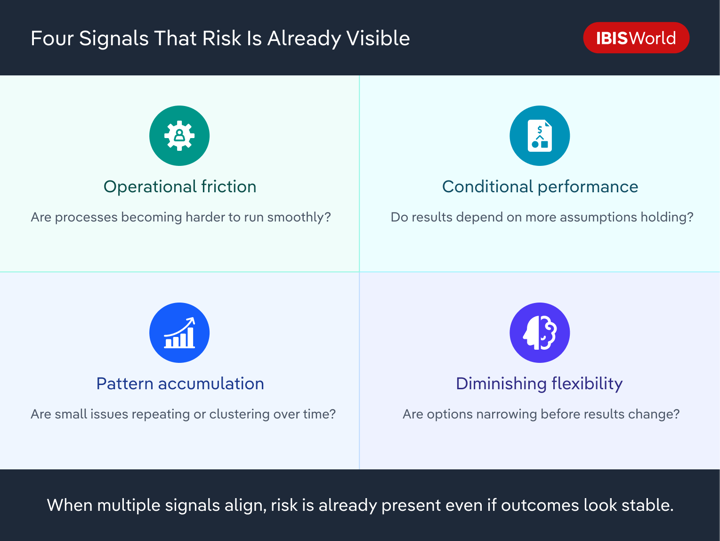
1. Accumulating friction
Processes that once ran smoothly begin to slow. Exceptions increase. Coordination requires more effort. Individually, these changes are easy to explain away. Collectively, they signal rising strain within the system.
Friction is rarely labelled as risk because it does not immediately threaten outcomes. But it reduces flexibility, increases dependency, and narrows the margin for error.
2. Conditional performance
Results still appear acceptable, but they increasingly depend on specific conditions holding steady. Forecasts rely on tighter assumptions. Plans work only if demand, costs, or timing behave as expected.
At this stage, performance has not declined, but resilience has.
Both patterns are visible early. What they lack is not evidence, but interpretation.
When warning signs blend into normal operations
One reason early risk is overlooked is that it often resembles routine variation.
Markets fluctuate. Costs drift. Customer behaviour shifts. Leaders are trained to absorb this volatility without escalating it.
That discipline prevents overreaction. It also makes it harder to distinguish between noise and the early stages of structural change.
When risk begins by altering the shape of operations rather than the level of results, it is easy to miss.
How interpretation determines whether risk is noticed
Risk is not a data point. It is a judgement.
The same signal can be read as an exception, a temporary disruption, or early exposure depending on the frame applied to it.
Without broader context, most signals are interpreted locally. Teams explain issues within their own scope. Causes are attributed narrowly. Patterns remain fragmented.
Risk becomes visible only when those fragments are assembled into a coherent picture.
Why leaders often acknowledge signals without acting on them
In many organisations, recognising a signal is not the same as treating it as risk.

Issues are logged. Discussions are held. Mitigations are noted. But until a signal is clearly linked to downside, it rarely changes decisions.
This creates a gap between awareness and response.
Leaders may sense that something feels less stable while still concluding that it is too early to adjust course.
Three reasons early risk signals are discounted
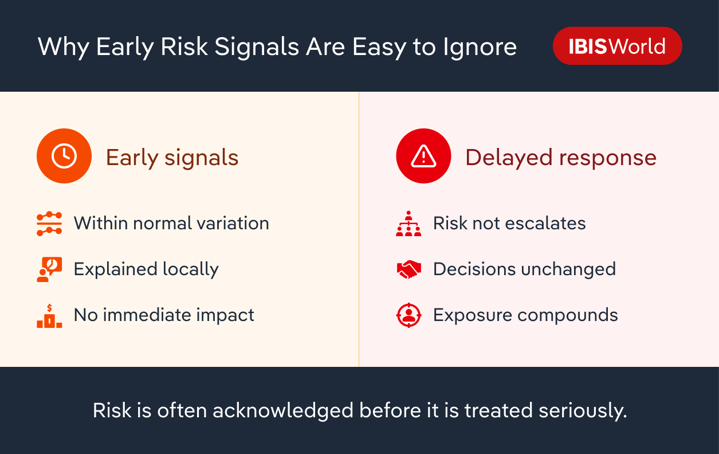
Even when early risk signals are recognised, they are often deprioritised. This typically happens for three reasons.
1. They do not yet threaten results.
Organisations are conditioned to respond to outcomes. When performance remains within tolerance, signals that point to future exposure feel premature.
2. They resemble familiar noise.
Early risk often looks like the variability leaders have learned to manage. Distinguishing structural change from routine fluctuation requires context that is not always available.
3. They lack a clear escalation path.
Without a shared frame for interpreting early signals, concerns remain local. They are discussed and monitored, but not elevated to the level where decisions change.
None of these responses are irrational. Together, they explain why risk can be visible without being acted on.
When risk becomes obvious only after it is costly
Risk tends to become undeniable at the point where flexibility has already narrowed.
Options shrink. Costs of adjustment rise. Decisions feel reactive rather than deliberate.
At that stage, leaders often look back and identify earlier moments where intervention might have been easier. The signals were present, but they did not yet justify action.
What was missing was not foresight, but confidence in interpretation.
Why context sharpens risk perception
Context does not eliminate risk. It makes it legible.
Industry conditions, peer behaviour, and structural benchmarks help leaders determine whether emerging pressures are isolated or systemic, temporary or persistent.
That perspective changes how signals are weighted. What once felt manageable begins to look directional.
Context turns observation into assessment.
When organisations start seeing risk earlier
Organisations that surface risk sooner do not rely on sharper instincts.
They look for patterns rather than certainty. They treat weak signals as inputs, not distractions. They ask what current conditions make more likely, not just what has already occurred.
In those environments, risk is understood as something that develops, not something that suddenly appears.