
Key Takeaways
- Corporate profit continues to climb, led largely by gains in the financial, mining & exploration and energy sectors.
- Canadian businesses are capitalizing on economic uncertainty and inflationary concerns to achieve historically high profit.
- Amid the long-term trend of cutting corporate tax rates, there is a growing imbalance between consumers and corporations.
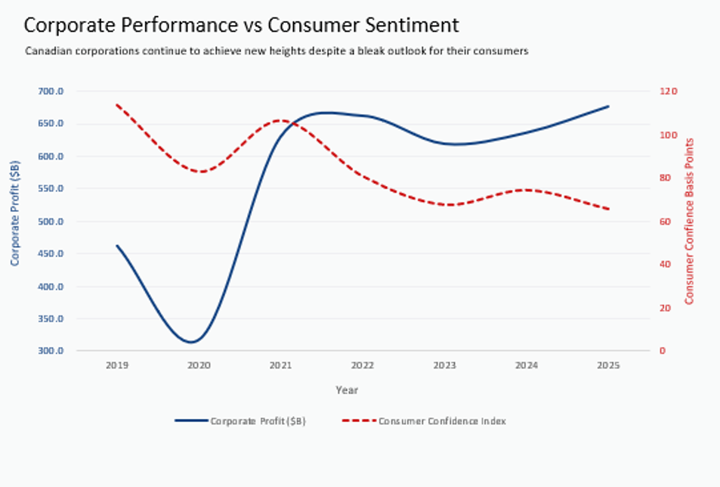
Canadian corporate profit reached an all-time high of $677.0 billion in 2025, surpassing the previous high in 2022. According to Q1 2026 figures from Statistics Canada (latest data available), corporate profit is up 3.3% year-to-date. Many businesses have cited higher commodity prices, complex supply chains and rising efficiency from AI and other technology as the primary reasons behind greater business efficiency. In the business sector alone, investments in machinery and equipment grew by 12.3% in 2025, as corporations recognized the demands of AI adoption and the associated systems it requires. For energy and mining companies, higher product prices have been spurred by global conflicts and resulting supply shortages, causing spikes in gold, copper and oil prices. Typically, surging profitability prompts higher corporate tax revenue and greater fiscal contributions from businesses. However, corporate tax rates have steadily declined even as profit has climbed, limiting how much of these gains are reinvested in local communities and straining the broader economy.
According to the most recent StatCan data, corporate profit reached 10.7%, and this figure has remained above 10.0% since 2021. Historically, this figure was closer to 7.0%, but the operating environment has shifted considerably since the pandemic. In some instances, businesses are capitalizing on negative sentiments regarding the overall economy to impose price hikes that don't necessarily reflect the true landscape. For example, one of Canada's largest companies, Loblaws Companies Ltd., reported an operating income percentage of 6.9% in 2025, up from 4.4% in 2020, according to its annual reports for those years. Also, the company’s 2025 annual report (latest data available) specifically highlights macroeconomic conditions influencing price hikes for food and drugs as a primary driver of recent revenue performance. This sharp climb in corporate profit has occurred despite complaints from businesses about pressure from tariffs and higher supplier prices, amid plummeting consumer confidence.
Which industries are fuelling the surge in corporate profit?
Record-high corporate profit has been reported in certain sectors, while others are struggling amid heightened uncertainty and geopolitical instability. Most notably, Canadian financial firms, energy companies and mining businesses have been able to capitalize on a complex macroeconomic environment to achieve new levels of success.
In the financial sector, significant global disruptions, like surging energy prices and the closure of the Strait of Hormuz, have created favourable opportunities in stock and commodity markets. According to its 2025 annual report, Royal Bank of Canada (RBC) generated a net income percentage of 30.6%, up from 24.2% in 2020. Also, the company's net income grew 25.4% in 2025 alone. Wealth management and capital market services were the primary drivers behind strong gains in 2025. This is a notable divergence from the US financial sector, which has not contributed to strong corporate tax gains in the country.
Oil and gas companies have experienced a boom driven by sharp declines in global supply, prompting price hikes. Suncor Energy and Imperial Oil have contributed to steadily rising levels of domestic production because of the unreliability of global supply since the Russian invasion of Ukraine and the recent conflict between the US and Iran. According to IBISWorld figures as of July 2026, the world price of crude oil has jumped 65.8%, 39.2% and 38.2% in 2021, 2022 and 2026, respectively. Altogether, IBISWorld expects the world price of crude oil to climb at a CAGR of 6.2% between 2021 and 2026. Domestic companies are responding to an opportunity while also using it to justify prolonged price hikes.
As consumption patterns continue to strengthen and products become increasingly technologically complex, commodities such as gold and copper have boosted mining and exploration activity. Agnico Eagle Mines and Barrick Gold anchor the sector, as companies continue to explore and mine across Canada's vast geography. Between 2022 and 2024, the mining of several critical materials expanded by 10.0%, as Canada aims to reduce its dependency on foreign supply chains. Companies must contend with significant legal and regulatory hurdles, which have prevented further gains in corporate profit. While these projects are highly profitable, government delays and procedures can fuel uncertainty regarding project timelines and viability.
Recent market shifts have had a disproportionate influence on profit across the economy
While the recent economic landscape has poised some businesses for historic growth, some sectors have struggled. Manufacturing industries have struggled with rising labour and inventory costs. At the same time, a cutthroat retail environment, spurred by the ongoing shift to e-commerce, has prevented suppliers from implementing sizeable price hikes on some products. Meanwhile, the Canadian minimum wage was raised to $18.15 per hour, which has an impact on labour markets across the country. According to 2026 figures from the Government of Canada, the cumulative wage hike since the introduction of the standalone federal minimum wage in 2021 is 21.0%. This illustrates a higher-cost operating environment for Canadian businesses, creating difficulties for businesses that struggle to implement price hikes. Some companies wield greater pricing power, such as those in Canada's mining sector that can exert unusual control over the supply of critical minerals because a handful of large producers dominate production. Large energy companies also hold long-standing pricing power because their products are deemed essential to consumers and the modern economy.
In the retail, manufacturing and insurance sectors, corporate profit gains have been subdued by higher levels of buyer power driven by stiff competition. Higher buyer power means that businesses in these sectors can struggle to pass inflationary price hikes on to customers, carving into profit gains. While certain technological advancements, such as AI and advanced data analysis, have boosted efficiency and driven historic gains for some businesses, they have created a competitive quagmire for others. Consumers and businesses have access to unprecedented amounts of information and technology, which have revolutionised decision-making. This has created a race to the bottom in many cases, with lower prices being the primary basis of competition. This activity has offset some of the historic gains in corporate profit exhibited by Canada's most successful businesses.
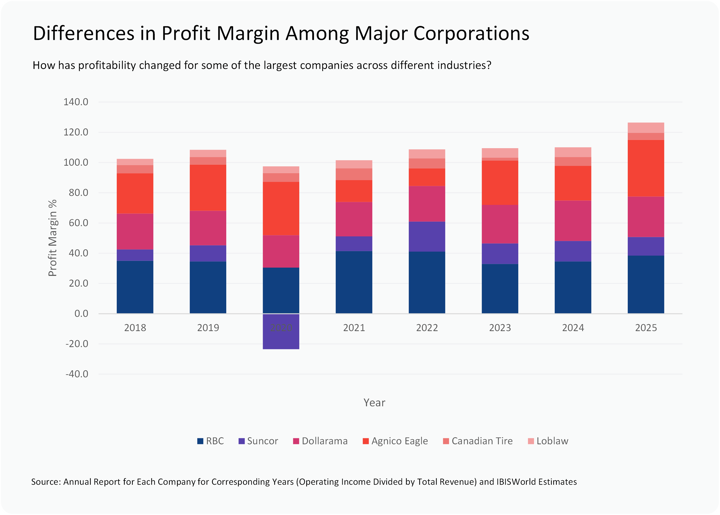
Performance discrepancies across sectors create a clear picture of what is driving record corporate profit
As illustrated, soaring corporate profit levels have been disproportionately evident across different parts of the economy. From this, we can conclude that record corporate profit levels are not the result of organic price growth, favourable demand shocks or a red-hot economy. Instead, certain sectors are capitalizing on an increasingly favourable operating environment to reach new heights. Sectors that have achieved record profit are often able to do so because the costs of switching are high for consumers, and these businesses invest in infrastructure and systems that deepen their structural advantages. For example, energy companies can continue to implement price hikes because customers will need to invest significant resources, such as capital in an electric vehicle (EV) or additional time using public transportation, to avoid paying higher prices for oil and gas products.
As the leading Canadian corporations continue to invest in systems and technology that widen their structural advantages, there is potential for future gains in corporate profit. There have been concerns from Canadian consumers and regulators about the overall influence of lower corporate tax rates, which have steadily declined from about 40.0% in the 1990s to less than 20.0% in recent years. The goal of these tax cuts was to attract more corporate investment to the country and spur greater reinvestment in communities. Instead, many corporations are diverting tax income to other sources, as evidenced by the growing corporate tax gap in Canada.
As some industries have leveraged lower tax obligations, favourable government programs since the pandemic and the ability to enact price hikes, consumers have felt the sting. In some instances, this has harmed the overall economy as consumers delayed investing in large-scale purchases like housing and automobiles, particularly among younger Canadians. As a result, Canada's consumer confidence index has fallen despite upward trends in per capita disposable income and consumer spending.
The divergence in these trends is largely explained by a growing disparity between consumer buying power and pricing power in some sectors of the Canadian economy. In general, an environment of high pricing power can erode consumer confidence in the economy, incentivizing consumers to dedicate a larger share of their income to savings in case of a downturn. As consumers dedicate more of their income to savings, it delays large purchases, constraining the performance of the overall economy.
The future of corporate profit in Canada
Global uncertainty and geopolitical volatility are expected to remain prevalent trends in the medium term. The patterns of corporations using that instability to sustain unusually high profit levels will continue. Against that backdrop, pressure for policy responses is growing. Recently, the Alberta Federation of Labour (AFL) called for greater taxes on oil and gas companies in the region. The AFL argues that these businesses are disproportionately benefiting from unique market conditions to achieve windfall profit, which doesn't reflect the harsh price environment that consumers have endured. The Canadian government may explore measures and legislation to ensure that domestic businesses contribute appropriately to the economy. However, the new administration under Prime Minister Carney has also explored options to make Canada more business-friendly, citing a tax system similar to Ireland's.
Final Word
Uncertainty remains over whether the government will prioritize an environment that entices corporations to establish operations in Canada or one that increases the tax burden of domestic businesses. A major concern among some Canadians is the sizeable tax gap, which measures the disparity between the amount of corporate taxes owed and the tax actually paid. In 2022 (latest data available), the corporate tax gap reached $59.5 billion, accounting for 16.0% of federal tax revenue. Amid concerns about Canada's largest corporations' lack of domestic investment, businesses could be under more scrutiny in the coming years.
At the same time, Canada's most successful enterprises will continue to invest in technology, software and systems to strengthen their competitive advantages and suppress factors that may boost buyer power. For financial services companies, greater spending on AI and machine learning systems may unlock the potential of improved prediction models, widening the disparity between these entities and the rest of the market. Meanwhile, energy and mining companies will continue to secure land and mineral rights and attempt to corner the market on commodities and resources. If corporations remain relatively unfettered by government regulation or tax burdens, it’s likely that flourishing corporate profit will continue to mask the challenging economic conditions that consumers face.