


Key Takeaways
- TikTok Shop, Instagram and other social platforms are excelling in visually driven categories such as fashion, beauty and consumer electronics, compressing product life cycles and increasing demand volatility.
- Regulatory scrutiny of "dark patterns," data use and AI‑mediated content in the US, UK and EU is forcing retailers to redesign social commerce funnels around transparency, consent and trust.
- Retailers that pair compliant, friction‑light journeys with creator‑led discovery, trusted reviews and robust post‑purchase service are best positioned to turn social impressions into repeatable, profitable revenue.
Social commerce is shifting from a side experiment to a core growth engine in US retail, as more everyday shopping occurs within social feeds rather than on standalone websites. As e‑commerce takes a larger share of total retail, social platforms are becoming storefronts that determine which brands shoppers notice, trust and ultimately buy from. At the same time, regulators and consumers are forcing a reset of the social shopping "trust contract," raising the bar on privacy, AI‑generated content and post‑purchase service to make this new channel scalable and sustainable.
Social shopping shifts from niche test to core sales channel
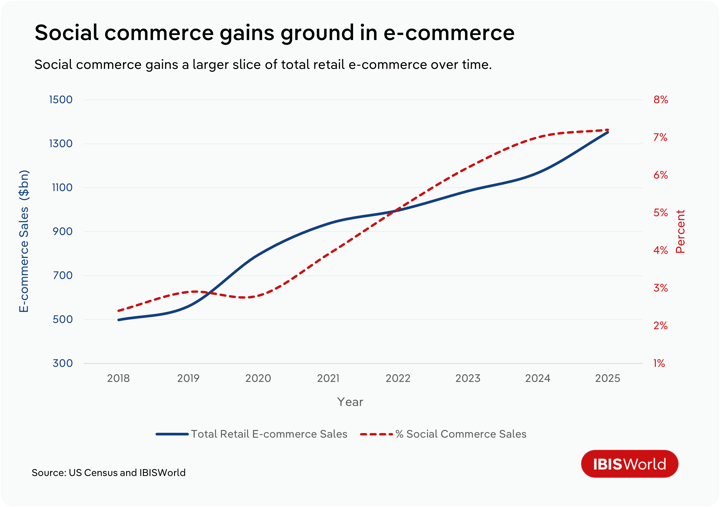
US e‑commerce penetration jumped sharply during the pandemic as lockdowns pushed everyday shopping online and, crucially, much of that behavior persisted even after stores reopened. Social shopping is now moving from an experimental add‑on to a structural force as e‑commerce continues to gain a larger share of overall US retail sales. Retail e‑commerce accounted for about 16.4% of total retail sales in the third quarter of 2025, with online spending still growing faster year over year than brick‑and‑mortar sales, so digital channels are becoming central to revenue generation rather than just a supplement. Over the 2018–25 period, the share of US retail e‑commerce attributed to social commerce rises from roughly 2.4% to 7.2%, a more than three‑fold climb that signals how quickly buying behavior is consolidating inside social platforms rather than on standalone websites.
As a larger share of revenue depends on platform feeds and policies, segments that rely heavily on social commerce are more exposed to sudden changes in visibility, ad costs and targeting rules. This exposure makes it easier for short‑term performance to spike when algorithms or viral content work in a retailer’s favor, and just as easy for performance to drop if platform rules, consumer sentiment or regulation shift.
Facebook holds the lead, but TikTok is redefining how US shoppers decide and buy
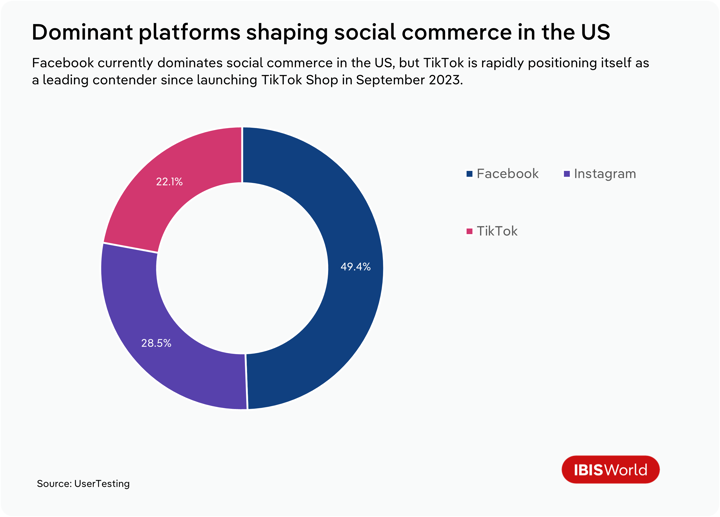
Facebook remains the anchor of social commerce in the US. Still, TikTok is scaling so quickly that it is rewiring how demand is generated, not just where the final transaction happens. Facebook and Instagram still account for roughly three‑quarters of US social commerce activity, but TikTok Shop has already captured more than one‑fifth of the market since its September 2023 US launch. TikTok Shop combines Temu‑style ultra‑low prices with an in‑feed, one‑tap checkout model that keeps consumers inside a vertically integrated loop of entertainment, discovery and purchase, a structure that makes it increasingly competitive with Amazon and Temu in categories like beauty, fashion and home goods.
What distinguishes this new wave is not just where people buy, but how they decide. Consumer research from UserTesting shows that 68.0% of US social media shoppers describe their experience as positive and 62.0% are satisfied with products purchased through social platforms, even though many have received items that did not fully match the ad. Nearly half say they are likely to purchase when they see others using a product, highlighting the power of creator content, comments and live‑streamed reviews as real‑time social proof, while about 53.0% to 60.0% actively avoid items with negative feedback, giving platforms like TikTok, Facebook and Instagram outsized influence over winners and losers in categories such as fashion, beauty and home décor.
How is social commerce reshaping fashion, beauty and consumer electronics?
As social commerce matures, its influence is spreading unevenly across the retail landscape, transforming how different sectors create value. Industries with strong visual appeal or frequent product refreshes tend to feel the effects first, as social media shorten feedback loops between consumer interest and purchasing decisions. Fashion, beauty and consumer electronics illustrate how these dynamics play out in distinct ways, accelerating trend cycles, amplifying influencer power and redefining what shoppers consider impulse versus planned purchases.
Fashion: Accelerating trends and shortening life cycles
Fashion retailers sit at the forefront of social commerce because visual, trend‑driven products translate naturally into shoppable content. Social feeds allow apparel and footwear brands to test styles in near-real time, using engagement and click‑through data to inform buying and replenishment decisions. Fast‑fashion and online‑only players often gain an advantage because their supply chains and pricing models are designed around rapid trend adoption and frequent drops.
However, the same dynamics increase inventory and reputational risk. A viral product can sell out before retailers can restock, while negative sentiment can build quickly if quality or fulfillment falls short of expectations. Industry research that links social‑driven demand spikes to input costs, logistics constraints and competitive responses helps decision‑makers calibrate how aggressively to chase social commerce trends in fashion.
Beauty: Community‑driven demand and the "creator shelf"
Beauty products benefit from social commerce's heavy reliance on tutorials, reviews and before‑and‑after content. Influencers effectively serve as an alternative "shelf," curating and demonstrating products to highly engaged audiences. This can drive outsized demand for specific items, creating sharp but sometimes short‑lived volume shifts across categories like skincare, cosmetics and hair care.
For retailers, social commerce in beauty can lift average order values and repeat purchase rates when content and product assortments are tightly aligned. At the same time, heavy reliance on paid or commission‑based creator content can compress profit and make demand more volatile. Human‑verified industry data helps distinguish structural growth in beauty sub‑industries from temporary surges tied to viral trends, supporting more resilient inventory and pricing strategies.
Consumer electronics: From big-ticket research to impulse accessories
Consumer electronics purchases have traditionally involved longer research cycles and higher consideration, particularly for high value items like smartphones, laptops and televisions. Social commerce is most immediately impacting the accessory and peripheral segments, such as earbuds, chargers, cases, and small smart devices, where price points are lower and visual demonstrations are compelling.

Retailers can use social commerce to bundle accessories with flagship products or to clear inventory through limited offers promoted by creators. However, platform-driven price competition and the visibility of low-cost alternatives can heighten profit pressure for branded consumer electronics retailers. Industry-level analysis clarifies which electronics subsectors are likely to see durable social commerce penetration versus those where traditional retail and direct-to-consumer channels remain dominant.
Risks, regulation and the new trust contract
Rising regulatory and consumer scrutiny is forcing retailers to redesign social shopping journeys, especially around data, consent and manipulative interfaces. Authorities in the US, UK and EU are explicitly targeting "dark patterns" that trick users into sharing more data, paying more, or accepting subscriptions and clarifying that consent collected through these interfaces is invalid, which directly challenges growth tactics built on aggressive opt‑ins, pre‑checked boxes and confusing flows in social commerce funnels. As social feeds become de facto storefronts, retailers are being pushed to simplify privacy choices, shorten terms and make data uses, retargeting and tracking across the feed‑to‑checkout journey clearly understandable, reframing compliance as a prerequisite for scalable conversion rather than a back‑office issue.
At the same time, trust at scale now hinges on how brands handle AI‑mediated content and post‑purchase experience within social channels, from shoppable posts to DM‑based service. Legal and industry guidance stresses that AI‑generated or heavily AI‑edited creative content in ads, virtual try‑ons or influencer posts must be clearly disclosed to avoid deception, while research on social commerce shows that credible information, verified reviews and transparent communication significantly lift purchase intention and reduce perceived risk. In practice, leading retailers are pairing explicit AI labels and anti‑counterfeit measures with easy, mobile‑friendly returns, strong authenticity signals and responsive, social‑native customer care, turning trust, disclosure and service into core levers that move shoppers from social impression to completed sale and repeat purchase.
Final Word
Social commerce is no longer a peripheral sales tactic, but a structural evolution in how retail demand is created, evaluated and converted into revenue. As platform algorithms, creator ecosystems and embedded checkout models compress the path from discovery to purchase, retailers face amplified upside and heightened volatility. Performance is increasingly shaped by feeding visibility, platform policies and real-time consumer sentiment rather than by traditional merchandising cycles alone.
Retailers that combine agile supply chains and data-driven trend response with transparent data practices, clear AI disclosure and strong post-purchase service will be best positioned to transform social impressions into repeat purchases. In a platform-mediated retail economy, trust, compliance and operational resilience are becoming as important as creativity and conversion.