


Key Takeaways
- AI and cloud growth are driving a rapid build‑out of specialized data centers that significantly increase electricity and water demand, forcing major investments in new generation, transmission and cooling infrastructure.
- Local backlash against data centers is intensifying as communities confront higher utility bills, water stress, and land-use conflicts, leading to project delays, moratoria, and more aggressive grassroots organizing across multiple states.
- To meet rising 24/7 power needs, utilities and tech firms are leaning on a mix of gas, renewables, storage and increasingly nuclear, positioning nuclear as a favored low‑carbon baseload option for AI facilities.
Data centers have typically been used for storing, managing and processing large volumes of digital information. There is a growing need for infrastructure to host IT services and network equipment, which has led to an increase in the number of data centers through 2026. Another early catalyst for this has been the growing popularity of cloud computing, since these centers hold the physical equipment that powers these systems.
This surge in demand has pushed many data centers to continuously upgrade their systems, with many opting for solid-state drives (SSDs) over hard disk drives (HDDs) because of their superior speed, power efficiency and scalability. These newer technologies are also less susceptible to damage. Despite the higher costs, data centers are willing to invest more to ensure better performance.
Starting in 2025, data center construction has increased as artificial intelligence (AI) continues to expand. Running and supporting AI applications requires significant energy. Data centers offer the most effective solution to handle this demand. Even with improved efficiency, the heavy demands of AI workloads are pushing data center service providers to invest in new facilities.
The impact data centers will have on consumers
Data centers accounted for more than 4.0% of the nation's electricity consumption in 2023 and this figure could climb to as much as 12.0% by 2028. While most recent utility rate hikes have resulted from system upgrades and maintenance, consumers worry that the rapid expansion of data centers could trigger a sharp climb in costs.
Much of the challenge stems less from total national energy use and more from the costly upgrades and new power lines needed to serve these facilities in specific regions. Utilities often raise rates to recover the cost of grid and transmission improvements, but with so many data centers being built so quickly, those costs are expected to trickle down to consumers, driving up the average household utility bill.
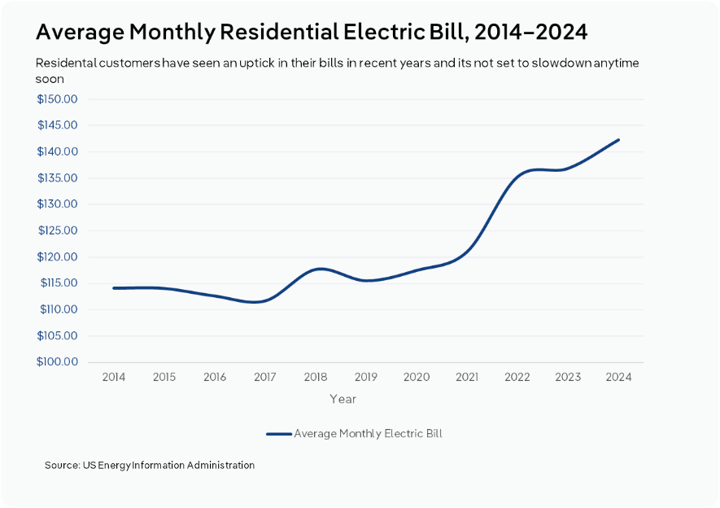
Many technology companies are entering the energy space and building or purchasing power plants to power their data centers while also selling their electricity on the wholesale market. According to the Federal Energy Regulatory Commission, in the second quarter of 2025, electric sales by technology companies exceeded $150.0 million, more than triple the level at the start of the first quarter of 2021.
Alongside higher bills, the rapid expansion of data centers can narrow capacity margins on local grids, raising the risk of brownouts and other reliability problems during peak demand. Regional grid operators anticipate that clusters of large data centers can add several gigawatts of new load within just a few years, accelerating the need for additional generation and transmission. In some areas, this has already prompted moratoriums or temporary pauses on new data center hookups while utilities and regulators evaluate whether existing infrastructure can handle the extra stress.
There is also the issue of customers paying upfront for grid upgrades and new construction that may not come online for several years. While these data centers can create more jobs in the surrounding region, projects are sometimes delayed or even abandoned, leaving consumers paying for infrastructure that may never be fully used or completed. Although existing regulations govern how utilities recover grid costs, policymakers and public utilities are actively debating new rules and reforms to prevent additional burdens on consumer electric bills.
Examples include Georgia’s SB 34, which was passed by the state House to prevent electricity or grid infrastructure costs incurred solely by data centers from being passed on to other customers. Meanwhile, Virginia and New Jersey are each considering policies that would impose specific electricity rates for data centers, with Oregon already passing one in late 2025. Utah has already enacted legislation allowing power companies to enter direct contracts with data centers, ensuring those costs are not transferred to regular ratepayers.
These anticipated hikes have also led many communities to protest the development of data centers in their areas. In February 2026, the New Brunswick City Council announced that it had passed an amendment to designate a mixed-use zone for a park instead of a data center. The decision followed a large protest organized by the Climate Revolution Action Network, which cited several drawbacks of data centers, including pollution, higher utility bills, blackouts, reduced water supply and health concerns.
Alongside electricity, water consumption is also a significant concern for both the environment and the utility sector. Data centers use large volumes of water for cooling to prevent hardware from overheating. Large facilities can use up to several million gallons of water per day, comparable to the daily consumption of a small to mid-sized city of roughly 10,000 to 50,000 people, according to the Environmental and Energy Study Institute. Concerns include higher water bills for nearby communities, potential health risks if supplies are strained and thermal pollution when warmer water is discharged into local rivers or lakes, which can harm aquatic life and degrade water quality for residents.
Beyond these issues, a major concern associated with data centers is their contribution to the growing risk of global water scarcity. While electricity can be expanded through the development of additional power plants and transmission infrastructure, water availability is constrained by geography and climate. The International Energy Agency has noted that many data centers rely on cooling systems that permanently remove water from the local supply.
Data centers continue to impact the energy sector as a whole
Growing data center demand is accelerating investment in renewables, energy storage and demand‑side flexibility across the country. Utilities and technology firms are deploying grid‑scale batteries and flexible load strategies, so data centers can shift consumption away from peak hours, stabilizing the grid rather than only adding stress. Carefully timed curtailments or workload shifting can integrate large amounts of new data center load while reducing the need for new peaker plants and extensive transmission upgrades, helping contain long‑run consumer costs.
Rising electricity demand will still require additional generation capacity and gas‑fired projects continue to move forward despite environmental concerns. Solar and wind remain key resources for data centers, with solar’s low cost and ease of deployment driving companies like OpenAI to invest in paired solar and battery storage for their facilities.
While both renewable and conventional energy sources have their advantages, gas and coal are often criticized for their environmental impact and solar and wind alone cannot yet provide the consistent, large-scale output needed to power data centers reliably. With far higher energy density than solar or wind and a much lower carbon footprint than natural gas, nuclear power emerges as the preferred choice for companies looking to invest in AI. According to the U.S. Department of Energy, in 2024, nuclear power had a 92.3% capacity factor, meaning plants operated at or near maximum power without interruption for that share of the time. This is much higher than natural gas and coal, which sit at 59.9% and 42.6% respectively.
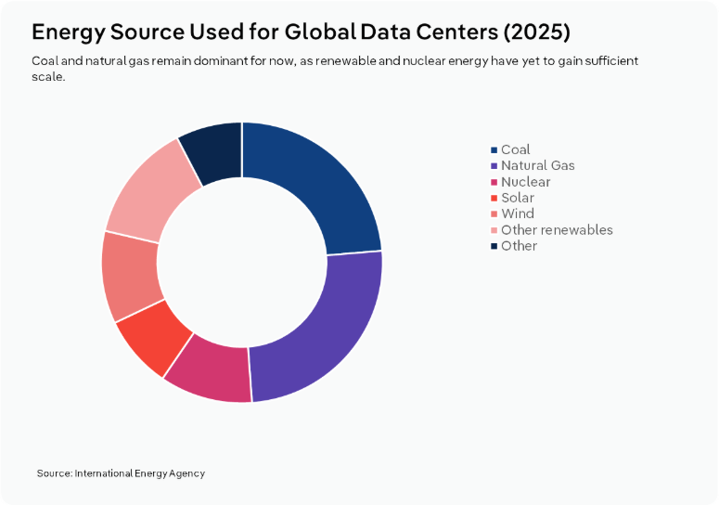
As of Fall 2024, Amazon, Google, Microsoft and Meta have each taken steps toward investing in nuclear energy. Amazon and Google have partnered with nuclear startups to purchase and help build small modular reactors (SMRs) across the United States. These compact units are safer, faster to construct and easier to scale. Microsoft announced plans to buy nuclear power from the resurrected Three Mile Island plant, which has been idle since 2019, while Meta has issued requests for proposals (RFPs) from nuclear energy producers to support its AI initiatives.
Despite its long-standing reputation as one of the most dangerous energy sources, the urgent need to cut emissions has pushed governments and voters to look beyond fossil fuels. Nuclear power's low‐carbon, reliable output fits that need. International climate forums and agencies now explicitly include nuclear in their net‑zero pathways, normalizing it alongside renewables rather than treating it as an outlier.
A survey by the Pew Research Center found that 59% of American adults support nuclear power, with 40% of supporters citing its cleanliness as an energy source. Among those opposed, 44% said their main concern is overall safety.
Nuclear power continues to raise safety concerns because an uncontrolled nuclear reaction can cause widespread air and water contamination. The disposal of hazardous waste also poses a challenge, as some radioactive materials can remain active for many years. Nonetheless, President Trump loosened several regulations on nuclear power, including requirements for groundwater protection and the threshold for triggering accident investigations. While these changes heighten safety risks, they also aim to accelerate reactor construction and bring new generation capacity online more quickly.
Final Word
Taken together, these trends are likely to push utilities toward larger, longer-term investments in generation and transmission, deepen the role of nuclear in meeting AI‑driven demand and ultimately reshape how reliably and affordably electricity is delivered to consumers. Over the next decade, decisions made by regulators, utilities and technology companies about data center siting, resource planning and cost recovery will play a significant role in determining whether this transition results in cleaner, more resilient power systems or higher bills and growing public resistance.