

Key Takeaways
- Prediction markets are evolving from niche platforms into major sources of real-time, crowd-sourced intelligence that institutions are using to gauge sentiment and forecasts for events.
- Explosive growth in liquidity and participation makes prediction market prices more efficient and credible, functioning as live probability signals that complement traditional finance indicators.
- Financial institutions and brokerages are integrating prediction data into research, risk models and trading apps, creating new revenue opportunities.
Prediction markets, once operating at the fringes of traditional finance, are rapidly reshaping how investors and institutions evaluate risk and forecast future events. These platforms allow participants to trade contracts tied to the outcomes of scenarios such as elections, economic indicators, central bank policy decisions, sports and much more. Prediction market expansion underscores a growing appetite for real-time, crowd-sourced intelligence. Consequently, prediction markets are increasingly regarded not only as vehicles for speculation but also as insightful barometers of market sentiment and valuable complements to conventional financial analysis.
Financial markets are responding by integrating prediction data into investment research and risk assessment frameworks. Institutional investors now monitor betting prices from platforms like Kalshi and Polymarket alongside economic indicators, interpreting them as sentiment signals. Hedge funds and asset managers use this data to enhance probabilistic modeling, particularly around macro events such as Federal Reserve decisions. The evolution underscores how decentralized forecasts are informing portfolio positioning and volatility hedging strategies across asset classes.
Rapid growth in prediction market volume and liquidity implies price discovery and market efficiency
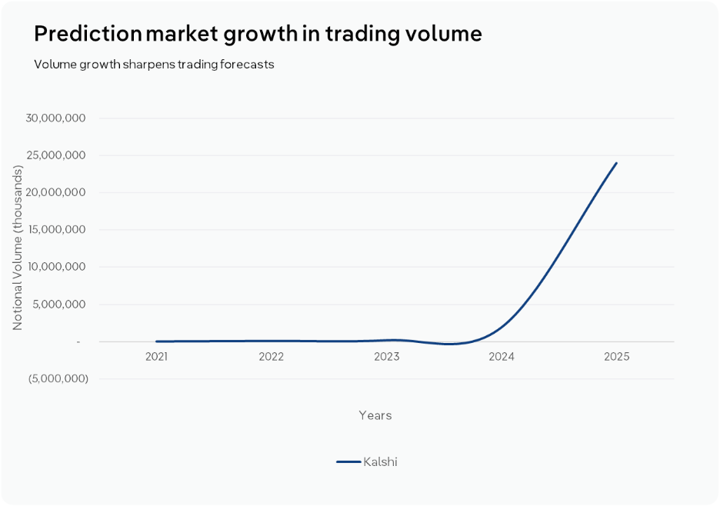
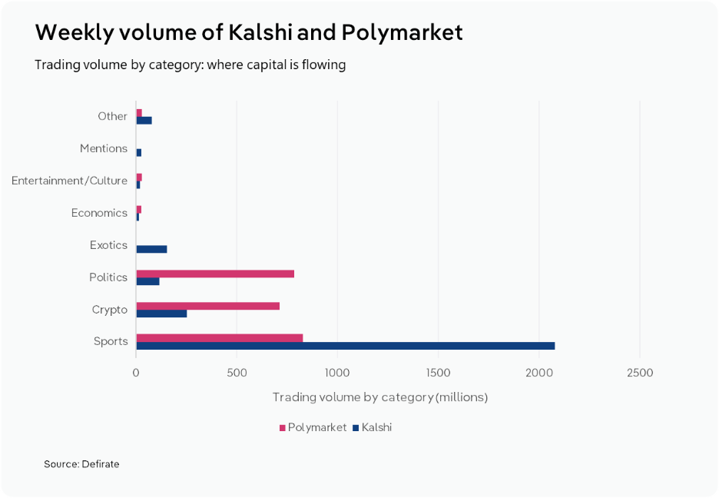
Prediction markets’ rapid growth resulted in shifts from niche curiosities to meaningful venues with sustained volume across politics, macro, sports and idiosyncratic events. For example, almost $12.0 billion was traded on Kalshi and Polymarket in December 2025, up more than 400.0% from December 2024, according to Piper Sandler. Growing open interest and tighter bid-ask spreads mean prices now reflect a broader set of opinions rather than a thin, speculative fringe. As retail apps and crypto-native platforms scale user bases into the millions, the depth of their order books increasingly mirrors that of traditional derivative markets in terms of microstructure. This growth makes prediction prices harder to dismiss as noise and more defensible as usable probability signals.
As liquidity improves, prediction markets enhance price discovery by continuously updating implied probabilities in response to new information and order flow. Unlike polls or analyst notes, which are periodic and often lagging, prediction odds are a live, tradeable consensus that moves second by second. The presence of sophisticated arbitrageurs, cross-trading between sportsbooks, prediction venues and listed assets helps keep these markets relatively efficient. Mispricings tend to be short-lived, especially around widely followed macro events where news is rapidly incorporated by retail and institutional participants.
Liquidity across prediction markets strengthens crowd intelligence by aggregating information dispersed across geographies, expertise levels and risk appetites. Participants include various traders such as informed traders, casual traders, risk managers and data scientists, each contributing fragments of information that are synthesized into a single implied probability. The more diverse the participation, the more the prediction price reflects a genuine cross-section of beliefs rather than the idiosyncrasies of a small clique.
From a broader market-efficiency standpoint, the rise in prediction market volume offers a parallel mechanism for absorbing and processing information. If prediction odds on events like rate hikes, elections or regulatory decisions are robust, they can anchor expectations across multiple asset classes. Equities, bonds and foreign exchange rates can reference these probabilities when discounting cash flows or stress-testing scenarios. In effect, prediction markets become a complementary “layer” in the global price discovery stack, sitting alongside options implied volatility, futures curves and survey-based expectations.
Brokerages and trading apps integrate prediction market insights into research, risk management and new revenue streams
Institutional investors are beginning to treat prediction market prices as another probabilistic input, similar to implied probabilities derived from options. Macro research desks incorporate event odds into scenario trees for central bank decisions, elections and policy shifts. Analysts can explicitly map how changes in prediction market probabilities translate into expected spread moves, equity factor tilts or sector rotations. This tightens the feedback loop between crowd-implied probabilities and top-down views, forcing teams to reconcile internal house calls with live external signals.
In portfolio construction, prediction data is increasingly useful for sizing and timing around binary events. Rather than relying solely on qualitative judgment, managers can use explicit probability paths from prediction markets to evaluate risk allocation and adjust investment position sizes. According to Yahoo Finance, Dysrupt’s CEO, Karl Mattingly, stated that the data from prediction markets often aligns with the consensus from traditional sources, enabling traders a chance to profit from deviations. Hedge funds and financial institutions are determining the most effective ways to utilize prediction market data.
Over time, some institutions have been experimenting with systematic or semi-systematic strategies that explicitly trade around prediction market dislocations. These might include arbitrage between prediction odds and listed derivatives, variance swaps that hedge around events with implied probabilities or relative value trades across countries or sectors tied to political outcomes.
Retail brokerages and trading apps are increasingly adding prediction markets alongside stocks, options and crypto. For these platforms, event contracts create new engagement surfaces as users can trade on elections, sports outcomes, fiscal policy and much more without needing deep financial knowledge. The interfaces are simple, often framed as yes or no questions and binary contracts with clear payouts, which reduces cognitive load compared to options chains. Financial brokerages such as Robinhood, Coinbase and Webull have recently added prediction market event contracts to their financial services, highlighting the expansion of financial companies into the prediction market space.
From a business model perspective, prediction markets open additional revenue streams through spreads, fees and order flow internalization. Just as zero-commission equity trading is monetized via payment for order flow or margin lending, event contracts can generate economics through small per-trade fees, wider effective spreads or packaged event bundles.
Engagement is a key metric for consumer fintech, so prediction markets are often intertwined with gamification features. Leaderboards, social feeds and streaks can be layered on top of event trading to increase session length and frequency. The growing social aspect of prediction market platforms attracts younger individuals and has fueled the growth of these platforms in recent years.
Prediction markets balance engagement, legitimacy and gambling risks
The challenge for platforms is balancing engagement with responsible trading constraints to ensure that prediction markets are not perceived purely as gambling. To maintain legitimacy and avoid regulatory backlash, many apps emphasize integration with broader financial planning tools rather than a pure entertainment framing.
Prediction markets face mounting legal uncertainty as regulators and courts wrestle with whether these platforms are financial exchanges or de facto gambling platforms, and that ambiguity is itself a central drawback for the sector. In the US, at least 20 federal lawsuits have been filed across multiple states, arguing that companies such as Kalshi and Polymarket should be treated like state-licensed sportsbooks rather than federally regulated CFTC markets.
Regulatory pressure exposes design choices that blur the line between neutral market infrastructure and casino‑style operation, which can increase liability and weaken the core argument that these are informational markets rather than games. If courts and regulators agree, prediction market providers may be forced to adopt more rigid rulebooks, tighter controls over which events can be listed and extensive surveillance and suitability obligations, limiting the breadth and spontaneity that make event contracts attractive to sophisticated users.
Final Word
Prediction markets have rapidly evolved from experimental tools on the periphery of finance into credible instruments for real-time insight. Their growth has transformed speculative trading into a collective forecasting engine where millions of participants from both retail and institutional sectors shape probability-based views on politics, macroeconomics, and much more. As liquidity deepens and prices reflect a wider range of perspectives, these markets now carry genuine informational value rather than mere novelty.
For investors and analysts, prediction data is becoming a vital complement to traditional indicators. Institutions are increasingly embedding event probabilities into research models, risk analytics and portfolio decisions, linking shifting crowd sentiment directly to market positioning. This integration signals a maturing feedback loop between decentralized prediction signals and conventional finance.
At the same time, the rise of retail participation and fintech adoption ensures that prediction markets are becoming mainstream financial infrastructure. Brokerages see them not only as engagement enhancers but as new sources of pricing data. As regulation and design evolve to balance speculation with responsibility, prediction markets look poised to shape how the world measures uncertainty and how finance interprets the future.