

Key Takeaways
- US farms have faced a shrinking pool of workers for more than two decades, well before the immigration policy changes of 2025. Fewer young immigrants are arriving to work, the existing workforce is getting older and US-based workers have shown little interest in seasonal farm jobs.
- Farms are relying more on the H-2A guest worker program and certified positions reached a record in fiscal 2025 as border crossings fell to their lowest level in decades. A court has ordered the Department of Labor to replace the program’s wage rules by December 30, 2026, leaving growers unsure what guest workers will cost in 2027.
- Specialty crop farms, which grow fruit, vegetables and nursery products, carry most of agriculture’s labor risk. They spent 39.6% of their cash expenses on labor in 2024, nearly three times the average farm share and account for more than half of all US farm labor spending.
US farms have long struggled to find workers. The people who plant, prune and pick the country's crops are growing older and are less likely to follow the harvest from place to place, with fewer new migrants joining them. Close to 40.0% of hired crop workers lack legal work authorization, down from a peak near 55.0% around 2000, according to USDA analysis of federal farmworker survey data.
Growers and policy analysts warned that stepped-up immigration enforcement would sharply cut the farm labor supply following the 2024 presidential election. One California grower group leader told The New York Times in July 2025 that a single Border Patrol raid would empty the fields and could ruin local farms. The American Immigration Council, an immigrant advocacy group, estimated that mass deportations could remove up to 225,000 workers from agriculture.
Some of these effects have since materialized. Since 2025, far fewer migrants have crossed the border and enforcement has kept some workers home even when their own farms are not targeted, tightening a labor supply that was already thin. However, the nationwide collapse many predicted has not arrived. Total wages paid by farm employers grew 2.1% in 2025, slower than inflation, according to Bureau of Labor Statistics (BLS) data and the USDA expects total spending on farm labor to dip slightly in 2026. A sudden, nationwide loss of workers would likely have pushed labor costs sharply higher.
Instead, agriculture is changing how it finds labor, moving from an informal, largely undocumented workforce toward a formal guest worker system whose rules the federal government has rewritten and whose costs are now contested in court and in Congress. How hard that shift hits a farm depends largely on what it grows.
Why are US farms running short of workers?
Through the late 1990s, a steady stream of young immigrants arrived each year to work in US fields. Many of them would follow the harvest from state to state, working seasonally. That labor stream has largely dried up. Newcomers in their first year in the US made up as much as 22.0% of hired crop workers around 1998 to 2000, but today they account for less than 5.0%, according to the USDA's Economic Research Service (ERS).
Farms that hire through the H-2A guest worker program must advertise jobs to domestic applicants first. Very few US workers apply. In fiscal year 2025, only 182 of more than 415,000 advertised positions drew a domestic applicant, The New York Times reports. Seasonal fieldwork is physically demanding, often far from cities and available only part of the year, which limits its appeal to workers with other options.
Real wages for nonsupervisory farmworkers grew 1.9% a year from 2014 to 2024, faster than pay in the rest of the economy. According to ERS, this is a sign of how tight the labor supply has become. Rising per-hour labor costs have pushed some growers to mechanize where they can or to limit planting crops that require hand harvesting. Others have turned to farm labor contractors, which recruit and manage crews on growers' behalf and have taken a growing share of farm payrolls over the past decade, according to BLS data.
Hands-on industries feel the pressure most, with wages accounting for 28.6% of revenue for vegetable farmers. Employment in the industry has fallen 22.4% since its 2015 peak. Pruning, hand harvesting and delicate packing still resist automation, as many crops are too delicate for machinery to handle. This leaves orchard and berry growers especially reliant on seasonal crews.
Why and how are more growers hiring through the H-2A program?
The H-2A program lets US farms hire foreign workers for temporary or seasonal jobs. Employers must show that no US workers are available, pay at least a government-set minimum known as the Adverse Effect Wage Rate (AEWR) and provide free housing and transportation. The rules make H-2A slower and more expensive than hiring locally, but for many growers it is one of the few reliable sources of labor.
Hiring through H-2A can take months, because growers must secure certification from the Department of Labor (DOL), an approved petition from the Department of Homeland Security and visas issued by the State Department before workers can travel. Many farms hire agents or join grower associations to manage the process, which adds fees but spreads the paperwork and recruiting across many employers. The North Carolina Growers Association, the largest H-2A employer in the country, files applications on behalf of its member farms, helps them keep the records the program requires and moves workers between farms as harvests shift.
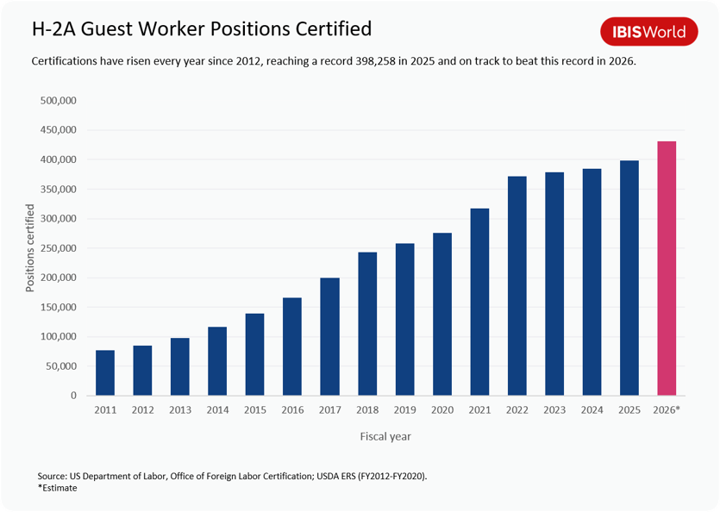
Demand for the program has climbed every year for more than a decade and the DOL certified a record 398,258 H-2A positions in fiscal 2025. Fiscal 2026 is on track for another record based on certifications through June, according to the department. H-2A workers now make up close to 15.0% of all crop workers, according to The New York Times. Use of the program is concentrated in a handful of states, led by Georgia, Florida, Washington, California and North Carolina, where fruit and vegetable production depends heavily on seasonal labor.
Beyond wages, the USDA estimates that housing and related amenities alone cost roughly $9,000 to $13,000 per worker and employers also pay for travel from the workers' home countries and government filing fees. Employers must provide approved housing before workers arrive; expanding an H-2A crew often means building or buying housing first.
How has immigration policy changed the farm labor equation?
Immigration policy has reshaped both the supply of farmworkers and the cost of hiring them from abroad. The flow of new unauthorized workers, historically the main source of new farm labor, has slowed. Border Patrol apprehensions at the southwest border fell to fewer than 99,000 in fiscal 2026, according to preliminary US Customs and Border Protection data. The year before, migrant encounters at the US-Mexico border had dropped to their lowest point since 1970, according to the Pew Research Center.
The DOL has noted the trend's effect on agriculture, citing a drop in unauthorized immigration and a shortage of legal workers as drivers of what it called a "structural, not cyclical, workforce crisis" in a 2025 regulatory filing.
When immigration enforcement activity rises nearby, some farmworkers stay home, including legal residents with undocumented relatives. Enforcement has affected farm labor more through fear than through raids. A survey of nearly 500 California farmers by the California Farm Bureau and Michigan State University found that only two had lost workers to enforcement on their own farms, while 14.5% lost workers to fear and anxiety about enforcement. Research published in the Journal of the Agricultural and Applied Economics Association in 2025 finds that the effect on labor force participation often fades within a month, but repeated surges can still disrupt time-sensitive harvests.
Aiming to lower costs for employers, the DOL in October 2025 changed how the AEWR is calculated, basing it on BLS wage data, splitting jobs into two skill tiers and adjusting wages to reflect the value of employer-provided housing. The department estimated that the change would shift $2.46 billion in annual wages from workers to employers.
Many growers welcomed the lower costs, though some said the changes came too late for farms that had already closed, The New York Times reports. Criticism came from opposite directions. Farmworker advocates argued the changes would displace domestic workers and expand a workforce vulnerable to abuse, while immigration restrictionists said they would encourage more foreign hiring and discourage investment in automation.
In August 2026, a federal judge in California found the new methodology unlawful and in October the court ordered the DOL to publish a replacement by December 30, 2026, when the current rule will be vacated. Employers who hired at lower rates since September 2, 2026, could owe back pay, depending on the outcome, leaving growers budgeting for 2027 without knowing what their labor will cost.
Congress has tried at multiple points in recent years to overhaul farm labor rules without success. The House passed the Farm Workforce Modernization Act in 2019 and again in 2021, but neither version became law. The latest attempt, the Securing Agriculture's Workforce Act, introduced in June 2026, would open H-2A to year-round employers such as dairies, limit sharp annual swings in required wages and allow some farmworkers already in the US to obtain H-2A status without a path to citizenship.
Which parts of the agricultural sector are most exposed?
Specialty crop farms, which grow fruit, tree nuts, vegetables, melons and nursery products, spent 39.6% of their cash expenses on labor in 2024, compared with 14.6% for the average farm, according to USDA farm survey data. Corn and soybean farms, which harvest with combines, spend only a small fraction of their budgets on hired workers.
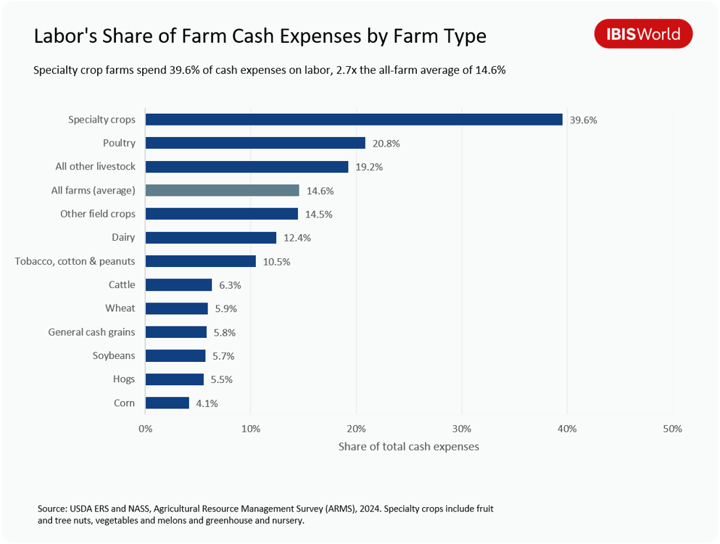
In 2024, specialty crop farms made up 7.1% of US farms but more than half of all farm labor spending, according to USDA data. The 14,026 specialty crop operations with $1.0 million or more in annual sales accounted for 84.6% of that spending, so changes to wage rules land hardest on them in dollar terms.
California, Washington and Florida together accounted for 43.9% of US farm labor spending in 2024, according to USDA data. Several states have added their own rules on top of federal wage floors. California requires overtime after 40 hours a week for all farm employers; Washington has done so since 2024 and Oregon will follow in January 2027. New York is phasing down to a 40-hour threshold by 2032. Colorado has gone the other way, raising its farm overtime threshold from 48 to 56 hours starting January 1, 2027.
Labor accounts for a smaller share of dairy farms' costs than it does for fruit and vegetable growers, but cows need to be milked year-round and the H-2A program covers only seasonal work. That leaves dairies with few legal options for hiring foreign workers.
Further down the supply chain, wages account for 8.8% of revenue for meat processors, far less than on produce farms. Still, some meat production segments such as beef are concentrated in a small number of large plants that are vulnerable to sudden absences.
In late September 2026, an immigration enforcement push in southwest Kansas, home to major Cargill and National Beef plants, coincided with a 16.0% drop in daily US cattle slaughter from the previous week as workers stayed home, according to USDA figures. Homeland Security Secretary Markwayne Mullin said ICE was not conducting worksite operations in Kansas. The disruption lasted only a few days, but it showed how quickly absences at a few plants can ripple through the cattle market.
What do these trends mean for fruit and vegetable prices?
Higher farm labor costs reach grocery shelves gradually because farm wages make up a modest share of what shoppers pay for produce. Farms received 28.4 cents of every dollar consumers spent on fresh vegetables in 2023, with the rest going to packing, shipping and retailing, according to a March 2026 USDA report. Worker shortages still add up, however. A 10.0% drop in farm employment would raise food prices by 2.9%, adding $3.4 billion a year to the cost of specialty crops, Michigan State University economist Zachariah Rutledge estimated in December 2025.
Produce prices are rising faster than groceries overall, with the USDA expecting fresh vegetable prices to climb 5.8% in 2026 and fresh fruit prices 2.9%, compared with 2.3% for all food bought at grocery stores, according to its October 2026 Food Price Outlook, but labor is only one factor. Higher energy prices have pushed up farms' other costs much faster and the USDA forecasts farm spending on fuel to rise 28.8% in 2026 and on fertilizer by 15.3%. Elevated fuel prices also raise the cost of trucking produce to stores.
Trade policy and production are also at play. The Commerce Department imposed an antidumping duty on most imports of fresh tomatoes from Mexico in July 2025 and the US International Trade Commission upheld it in June 2026. Smaller harvests are meanwhile pushing up fruit prices. The USDA expects US apple production to fall 6.0% in 2026, to the smallest crop since 2022 and pear production to fall 15.0%, with peach output lower in six of the seven states it surveys.
Over the longer term, more of the fruit and vegetables Americans eat is grown abroad. Imports supplied 58.6% of US fresh fruit in 2025, up from 51.1% in 2007, according to the ERS, which attributes much of the change to trade agreements. The American Farm Bureau Federation argues that rising labor costs are also part of the story, citing a decline in US fruit and vegetable production since 2010 as imports have climbed. For shoppers, imports offer year-round supply and often lower prices, helping keep produce on shelves when US crops or crews fall short, but they also leave grocery prices more exposed to trade disputes.
Final Word
US agriculture’s labor shortage is structural and predates the policy changes of 2025, which have accelerated growers’ move to H-2A. As a result, a growing share of the country’s farm labor now depends on a federal program whose rules are in flux. The DOL’s replacement wage methodology, due by December 30, will help set what many growers pay for labor in 2027.
Large growers that can absorb H-2A costs, along with the labor contractors and grower associations that recruit and manage guest workers for smaller farms, are best positioned to adapt. Smaller specialty growers, dairies and downstream processors face more volatility. Farm groups and farmworker advocates will keep shaping the rules that come next. Groups such as the American Farm Bureau Federation, the Georgia Fruit and Vegetable Growers Association and the National Council of Agricultural Employers have pushed to lower H-2A wage rates and simplify the program.
At the same time, farmworker advocates argue that cheaper guest labor undercuts domestic workers. Labor shortages are also likely to push more farms toward autonomous machinery over time, although weaker farm incomes have cut equipment sales in the near term. How reliably the guest worker system can keep growing will help determine how and how much of America’s specialty crops are grown at home.